Vitrification offers a way to freeze sperm so quickly that damaging ice crystals never get the chance to form, but the moment of thawing can undo much of that advantage. A new study from Trakia University in Stara Zagora, Bulgaria, reports that when vitrified canine epididymal spermatozoa are warmed, the temperature chosen for that brief step makes a measurable difference. Sperm suspended in a coconut water-based extender supplemented with 20% egg yolk and warmed at 37 °C for two minutes emerged with significantly higher total motility, viability, and proportion of morphologically normal cells than matched samples warmed at 42 °C for the same duration. Several kinematic parameters tracked by computer-assisted sperm analysis were also better preserved in the cooler warming group. The findings, published in Acta Veterinaria Scandinavica, suggest that a simple adjustment of warming temperature could improve how veterinarians and conservationists recover frozen genetic material from dogs and, potentially, from endangered wild canids.
The research team, led by Boyana Ivanova with colleagues Radka Garnoeva, Rumen Roydev, and Anton Antonov, worked with epididymal sperm recovered from twelve clinically healthy client-owned dogs undergoing elective castration for reasons unrelated to the study. The dogs ranged in age from one to four years and included German Shepherds, Beagles, English Cocker Spaniels, and mixed breeds. Because the testes would otherwise have been discarded, the researchers obtained written consent from the owners and used the tissue for research without requiring additional ethics committee approval. Twenty-four testes were collected in total, transported to the laboratory in saline pre-warmed to 37 °C within one hour of surgery, and processed immediately.
Recovering sperm from the epididymis requires care, since the tightly packed ducts must be opened without contaminating the sample with blood. The team used a float-up method: the cauda epididymis and ductus deferens were separated from each testis, placed in a dry Petri dish, and cut with multiple incisions while blood vessels were deliberately avoided. Spermatozoa were then allowed to swim out spontaneously into seven milliliters of extender made from 50% coconut water, 25% distilled water, and 25% of a 5% anhydrous monosodium citrate solution. The coconut water came from certified organic green coconuts, a choice the authors made to minimize compositional variability. After 45 minutes under a metal plate that shielded the sample from light, the sperm-rich medium was collected for evaluation.
Coconut water has a long history as a semen extender component. The authors note that it is isotonic, non-toxic, inexpensive, and easy to obtain, with strong antioxidant properties, and that it contains phytohormones, sugars, vitamins, electrolytes, and amino acids. Most previous work with coconut water has involved conventional slow freezing of ejaculated semen; only a handful of studies, including earlier work by this same research group, have tested it in vitrification. Its use for vitrifying canine epididymal spermatozoa, specifically, had not been reported before this study. Egg yolk served as the principal cryoprotective additive, a traditional ingredient known to protect sperm from cold shock, inhibit premature capacitation, and increase extender viscosity, thereby reducing water crystallization and ice formation.
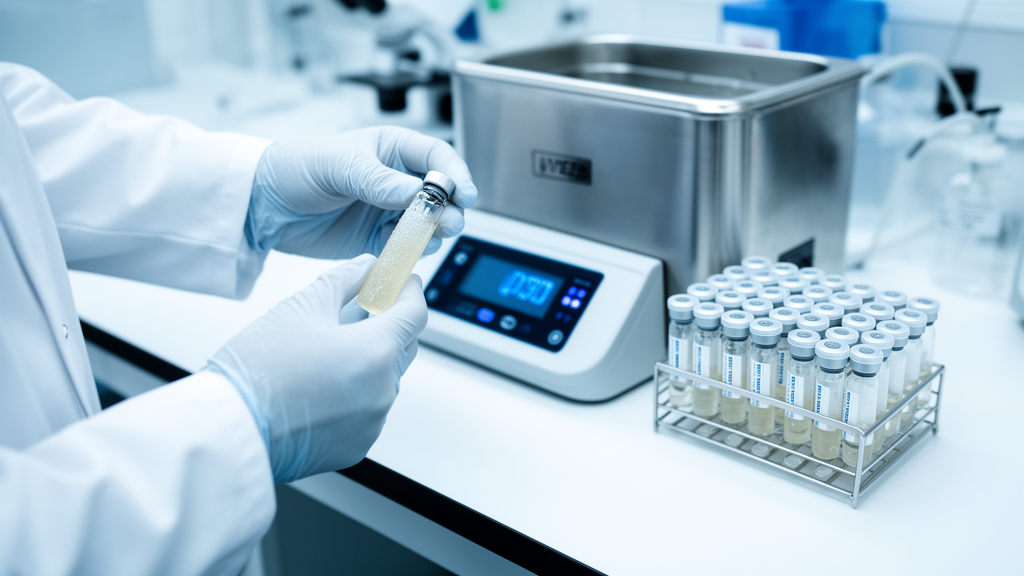
After an initial quality assessment, samples were centrifuged at 581 × g for 10 minutes at 37 °C, resuspended in the coconut water extender with 20% egg yolk, and adjusted to a final concentration of 100 million spermatozoa per milliliter, with a final osmolarity of 718 mOsm/kg. The samples were equilibrated at 4 °C for 60 minutes and then vitrified by dropping 33-microliter aliquots from a height of 10 centimeters onto a stainless-steel strainer positioned above liquid nitrogen, an ultra-rapid approach that solidifies the suspension into a glass-like state without crystalline ice. The solidified pellets were stored in cryotubes in liquid nitrogen for seven days before thawing.
The critical experimental step came at warming. Three pellets from each sample were placed into 0.5 milliliters of CaniPlus AI medium at either 37 °C or 42 °C, each for exactly two minutes, and evaluated immediately afterward. The researchers measured sperm concentration, total and progressive motility, and a suite of kinematic parameters including curvilinear, straight-line, and average path velocity, linearity, straightness, amplitude of lateral head displacement, and beat cross frequency, all with a computer-assisted sperm analysis system held at 37 °C. Morphology was assessed with SpermBlue staining, and viability was determined by eosin-nigrosine staining, counting at least 500 spermatozoa per sample.
The results were clear on both counts. Vitrification significantly reduced sperm quality compared with fresh samples, confirming the inherent cost of the procedure. Yet the warming temperature strongly shaped how much function survived. Samples warmed at 37 °C showed significantly higher total motility, viability, and percentage of morphologically normal spermatozoa than those warmed at 42 °C. Morphologically normal cells accounted for 72.91 ± 5.72% in the 37 °C group versus 68.51 ± 4.92% in the 42 °C group, a statistically significant difference. The most frequent abnormalities seen after vitrification were cytoplasmic droplets and bent or coiled tails. Notably, no significant differences were observed in most kinematic parameters between fresh and vitrified samples, a finding the authors say supports vitrification as a viable alternative to conventional freezing.
Why would the cooler, slower endpoint win? The authors point to thermal stress. Vitrified spermatozoa remain vulnerable to membrane destabilization and osmotic stress during rehydration, and exposure to 42 °C for two minutes may impose a greater thermal burden than 37 °C over the same period. They also note that during cryopreservation, spermatozoa pass twice through the temperature range between −10 °C and −60 °C, where the plasma membrane is particularly sensitive to damage, so the warming rate must be coordinated with the cooling rate. Importantly, the authors are careful about mechanism: the study did not directly measure membrane lipid phase transitions, oxidative stress, mitochondrial function, or intracellular osmotic changes, so these explanations remain plausible interpretations rather than demonstrated causes.
The result also diverges from earlier work on ejaculated semen, where the same group had previously found better outcomes at 42 °C. The authors attribute this contrast to the distinct biology of epididymal spermatozoa, which lack exposure to seminal plasma proteins known to influence membrane remodeling and stability during maturation, potentially altering resistance to thermal stress. Their new findings align with an earlier study in ejaculated canine sperm that compared slow warming at 37 °C for one minute with rapid warming at about 65 °C for two to five seconds and found the slow approach superior. Taken together, the picture emerging is that warming rate and final temperature must be matched to both the sperm source and the vitrification system.
Practical implications follow. The authors note that motility values of 30 to 50% are generally considered acceptable in frozen semen, and although vitrification reduced motility relative to fresh samples, the 37 °C group remained within that range. They acknowledge the study’s main limitation: only twelve animals were included, a small sample constrained by the inherent difficulty of obtaining epididymal material from clinically healthy dogs, though comparable sizes appear in previous canine cryopreservation studies. Future work, they write, should evaluate fertility outcomes after artificial insemination and explore additional cryoprotective and antioxidant additives. For now, the message is straightforward: in canine germplasm banking, how you thaw may matter as much as how you freeze, and a modest two-degree difference in warming temperature can decide how much of a precious genetic legacy survives the journey back to life.
Subject of Research: Effect of warming temperature on vitrified canine epididymal spermatozoa preserved in a coconut water and egg yolk extender
Article Title: Effect of warming regimen on canine epididymal spermatozoa following vitrification using a coconut water extender supplemented with egg yolk
Article References: Ivanova, B., Garnoeva, R., Roydev, R., & Antonov, A. (2026). Effect of warming regimen on canine epididymal spermatozoa following vitrification using a coconut water extender supplemented with egg yolk. Acta Veterinaria Scandinavica, 68(1), Article 44. https://doi.org/10.1186/s13028-026-00886-1
Image Credits: AI Generated
DOI: 10.1186/s13028-026-00886-1
Keywords: canine sperm, vitrification, epididymal spermatozoa, sperm cryopreservation, coconut water extender, egg yolk, warming temperature, CASA, dog breeding, germplasm banking, assisted reproduction, Acta Veterinaria Scandinavica
Cite Scienmag News
William Thompson. (October 28, 2026). Warming at 37 °C preserves vitrified canine epididymal sperm better than 42 °C. Scienmag. https://scienmag.com/warming-at-37-c-preserves-vitrified-canine-epididymal-sperm-better-than-42-c/
William Thompson. "Warming at 37 °C preserves vitrified canine epididymal sperm better than 42 °C." Scienmag, 28 October 2026, https://scienmag.com/warming-at-37-c-preserves-vitrified-canine-epididymal-sperm-better-than-42-c/. Accessed 28 October 2026.
William Thompson. "Warming at 37 °C preserves vitrified canine epididymal sperm better than 42 °C." Scienmag. October 28, 2026. https://scienmag.com/warming-at-37-c-preserves-vitrified-canine-epididymal-sperm-better-than-42-c/