


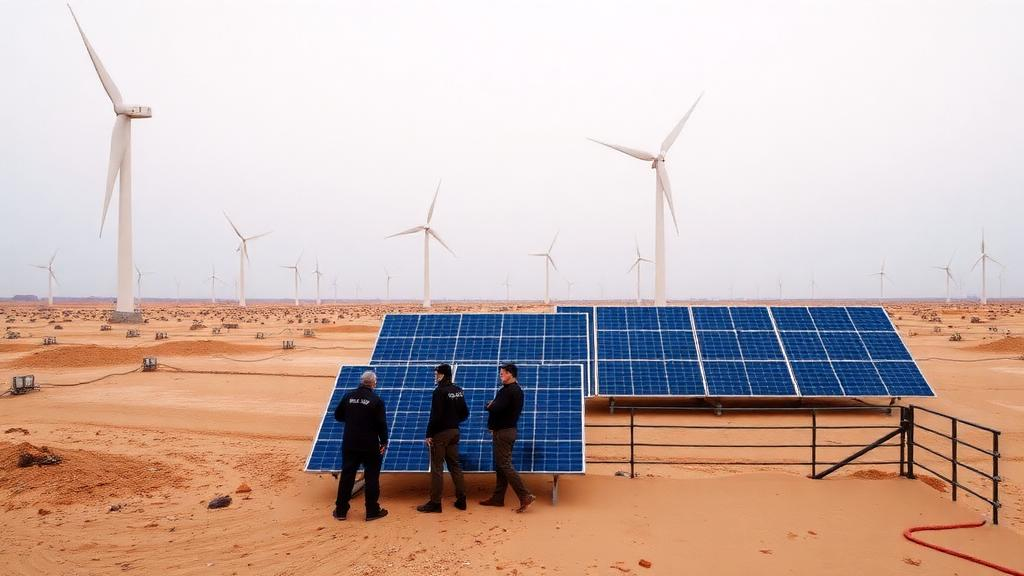
When missiles began striking energy infrastructure across the Gulf in early 2026, the shockwaves were felt not only in the region but in every fuel market on the planet. A new analysis published in PLOS Sustainability and Transformation by Moustafa Bayoumi and Robert Mason of the Anwar Gargash Diplomatic Academy in Abu Dhabi examines how the conflict involving the United States, Israel and Iran is reshaping the global energy landscape, and reaches a conclusion that is likely to reverberate through ministries of energy and defence alike: the war will probably slow the energy transition in the short term, yet accelerate it structurally, because electrification and renewable power are increasingly being treated as instruments of national security rather than merely climate policy.
The numbers behind that argument are stark. The Strait of Hormuz, the narrow maritime chokepoint through which roughly a fifth of the world’s oil supply passes, has been repeatedly disrupted, constraining hydrocarbon exports and sending crude prices from around $70 to more than $110 per barrel by March 2026, before easing back to around $80 in July as the market absorbed the volatility. According to the analysis, attacks on shipping in the strait have curtailed up to 20 million barrels per day of exports, generating substantial daily revenue losses for producing states. For consumers, the same disruption translated into higher petrol, diesel and jet fuel prices; for producers, it meant a paradoxical combination of elevated prices and collapsing export volumes.
Iran’s response to Israeli and American strikes on military, nuclear and some energy facilities included attacks on targets across the region, among them energy infrastructure within the Gulf Cooperation Council states. The analysis documents physical damage and, in some cases, temporary suspensions at key sites such as Ruwais in the United Arab Emirates, Ras Tanura in Saudi Arabia, Bapco Energies in Bahrain and Mina Al-Ahmadi in Kuwait, alongside disruptions to Qatari liquefied natural gas production. These are not marginal facilities. They anchor the export capacity of some of the largest hydrocarbon producers on Earth, and their vulnerability exposed a structural weakness at the heart of the Gulf’s economic model.
That weakness, as Bayoumi and Mason frame it, is a circular dependency. For years, Gulf states, particularly Saudi Arabia and the UAE, have invested heavily in renewable and clean energy as part of broader economic diversification strategies. But the hydrocarbon revenues that fund that diversification are precisely the revenues most exposed to geopolitical disruption. Despite elevated oil prices, revenue losses, rising defence expenditure and inflationary pressures are weighing on gross domestic product, national budgets and planned investments across the region. The severity of the impact depends on how long the conflict lasts, but a prolonged disruption could force governments to reprioritise, potentially squeezing the very clean energy programmes designed to reduce their dependence on oil income.
The authors place the 2026 conflict in a longer historical pattern of energy shocks driving policy change. The oil crises of the 1970s and the 1979 Iranian revolution quadrupled prices and pushed the United States to expand fossil fuel production, including opening new fields in Alaska and loosening drilling regulations. The price surge of the early 2000s led many oil-importing countries to subsidise fuel prices while the US and Canada expanded output. More recently, the Russia-Ukraine war prompted the European Union to diversify its energy sources and increase investment in renewables through its REPowerEU programme. Each shock, in other words, produces a short-term scramble for supply followed by a longer-term restructuring of the energy system.
What distinguishes the current moment, the analysis argues, is the revelation of a persistent policy failure: governments continue to treat energy security primarily as a supply problem rather than a demand-side transformation challenge. The distinction matters technically. Supply-side responses, stockpiling, diversifying suppliers, subsidising fuel, leave economies exposed to the next disruption because demand for globally traded fuels remains intact. Demand-side transformation, by contrast, reduces the volume of traded fuel an economy needs in the first place, through efficiency, electrification of transport and heating, and deployment of domestic renewable generation whose fuel cost is zero and whose supply chain is local. Repeated geopolitical shocks strengthen the strategic case for exactly that approach.
The differential outcomes among importing economies illustrate the point. China has fared better than many East Asian economies thanks to strategic stockpiles and more resilient supply chains, and its firms hold dominant positions in solar photovoltaics and electric vehicle manufacturing, positioning them to benefit if sustained high oil prices accelerate global electrification. In the European Union, natural gas prices have risen more than 70 percent and refined products such as jet fuel have experienced extreme price volatility, prompting the bloc to tell member states to prepare for prolonged disruption. Europe, already reshaping its energy system after the war in Ukraine, has diversified gas supplies across Norway, Qatar, Algeria and, at reduced levels, Russia, with Azerbaijan emerging as an additional supplier, while oil imports are spread across the United States, Norway, Kazakhstan and Middle Eastern producers.
Yet the transition is not a zero-sum contest between West and East. Cross-border clean energy investment has become a central pillar of energy security in its own right. The UAE’s Masdar and France’s TotalEnergies operate an approximately $2.2 billion joint venture across Asia, combining capital and technology. Saudi Arabia’s ACWA Power is partnering with European firms to export solar electricity and develop transmission links, while hydrogen projects such as the Yanbu green hydrogen project aim to supply European markets, with similar initiatives underway in the UAE and Oman. Gulf funds and firms have already financed multi-gigawatt solar projects in emerging markets, especially in Africa and Asia, and the UAE is leading cooperation with a South Korean KEPCO consortium on nuclear power. These partnerships suggest that the clean energy economy is being built through networks of interdependence rather than blocs of exclusion.
In the near term, the authors expect governments to respond to price shocks in familiar ways: subsidising fossil fuels, rationing, promoting remote working and demand-reduction measures, and in some cases reverting to more carbon-intensive options such as coal. Such measures echo past crises and may temporarily raise emissions. But over the longer term, the logic of energy security points in the opposite direction. Reducing dependence on globally traded fuels, not merely diversifying their sources, will be critical, the analysis argues, and governments that shift to clean technologies will benefit from adoption curves already driven by falling costs and rapid innovation. Recent research on electric vehicles has even identified evidence of a cascading positive tipping point, in which growing uptake reinforces itself through infrastructure, consumer expectations and manufacturing scale.
The central lesson the authors draw is that electrification and clean power are no longer just climate strategies but instruments of economic resilience and national security. Countries that move fastest will not only reduce emissions but also insulate themselves from future geopolitical shocks, whether those shocks come from a strait closed by war, a pipeline sabotaged, or a supplier weaponising exports. The 2026 Iran war, in this reading, is less a detour on the road to decarbonisation than a demonstration of why the road exists at all: an energy system built on concentrated, contested, globally traded fuels will remain a strategic liability, and every crisis makes that liability harder to ignore.
Subject of Research: The impact of the 2026 Iran war and Gulf energy infrastructure disruption on global energy security and the clean energy transition
Article Title: Conflicts and energy transitions: The case of the 2026 Iran War
Article References: Bayoumi, M., & Mason, R. (2026). Conflicts and energy transitions: The case of the 2026 Iran War. PLOS Sustainability and Transformation, 5(8), e0000265. https://doi.org/10.1371/journal.pstr.0000265
Image Credits: AI Generated
DOI: 10.1371/journal.pstr.0000265
Keywords: energy transition, energy security, Iran war, Strait of Hormuz, Gulf Cooperation Council, renewable energy, electrification, oil prices, geopolitics, Masdar, ACWA Power, PLOS Sustainability and Transformation
Cite Scienmag News
Faith Mcneil. (October 10, 2026). War in the Gulf Shows Why Clean Energy Is Now a National Security Strategy. Scienmag. https://scienmag.com/war-in-the-gulf-shows-why-clean-energy-is-now-a-national-security-strategy/
Faith Mcneil. "War in the Gulf Shows Why Clean Energy Is Now a National Security Strategy." Scienmag, 10 October 2026, https://scienmag.com/war-in-the-gulf-shows-why-clean-energy-is-now-a-national-security-strategy/. Accessed 10 October 2026.
Faith Mcneil. "War in the Gulf Shows Why Clean Energy Is Now a National Security Strategy." Scienmag. October 10, 2026. https://scienmag.com/war-in-the-gulf-shows-why-clean-energy-is-now-a-national-security-strategy/


