


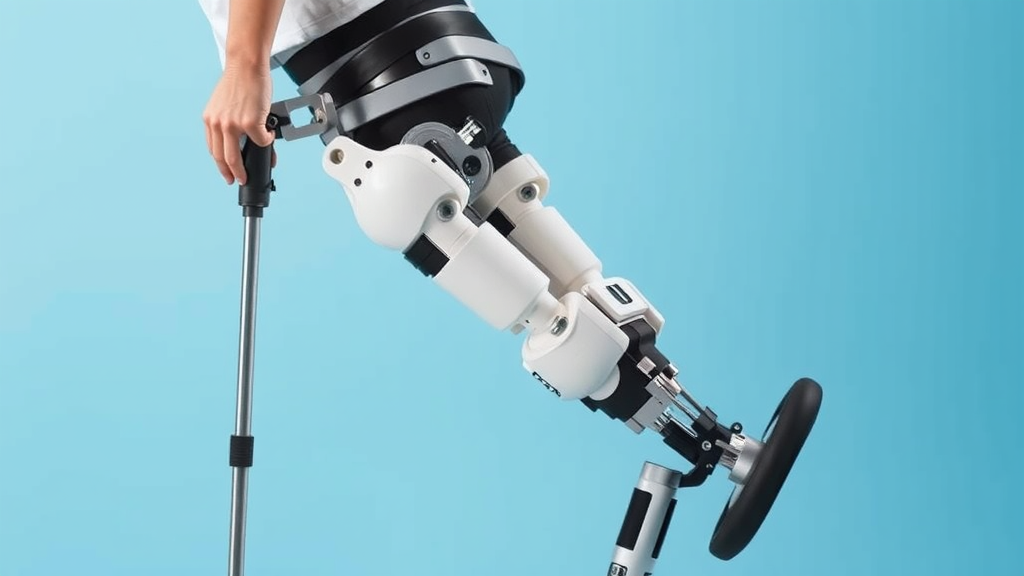
For people living with an above-knee amputation, a simple sideways shove while walking can be the difference between a routine stumble and a serious injury. More than half of adults with lower-limb amputations fall at least once every year, and most of those falls happen while walking. Even state-of-the-art microprocessor-controlled prosthetic knees, which are marketed partly on their ability to detect and react to stumbles, have not erased the problem: injurious fall rates for these devices range from roughly 6 to 14 percent over just six months. A new study published in the Annals of Biomedical Engineering now provides the most detailed picture yet of exactly how, and how badly, above-knee amputees lose their balance when yanked sideways mid-stride, and why their recovery strategies fail in ways that never trip up able-bodied walkers.
The research, led by Andrew J. Gunnell, Owen Winship, Lukas Gabert and senior author Tommaso Lenzi at the University of Utah, brought eight above-knee amputees and eight non-amputee controls into a motion capture laboratory and subjected them to a battery of precisely controlled sideways tugs. Participants walked on an instrumented split-belt treadmill while a cable-driven perturbation system, built from the open-source BumpEm design and controlled through custom LabVIEW software, delivered sharp 300-millisecond pulls to a harness worn at the waist. The cables attached at approximately the height of each person’s center of mass, near the navel, and the motors were positioned so the pulls remained perfectly horizontal. That detail matters: a cable anchored too high would twist the trunk, and one anchored too low would act on the legs rather than the whole body. Between perturbations, the cables maintained a gentle six-newton pre-tension so no slack could dull the force.
The experimental matrix was exhaustive. Each participant experienced twelve distinct perturbation conditions: pulls delivered at three different moments in the gait cycle (heel strike, late swing, and late single support), from two directions (toward the prosthesis side or the sound side for amputees, left or right for controls), and at two force levels, roughly 7.5 and 15 percent of body weight. Each condition was applied once per trial across five randomized trials, totaling 60 perturbations per session, with random three-to-ten-second delays to prevent anticipation. Walking speed was standardized at 0.9 meters per second, though two amputees needed to slow to 0.7 meters per second. Twelve Vicon cameras tracked 65 reflective markers at 200 hertz while force plates under each foot recorded ground reaction forces at 1000 hertz, allowing the team to reconstruct whole-body biomechanics in extraordinary detail.
To quantify instability, the researchers turned to integrated whole-body angular momentum, or iWBAM, a validated metric that captures the body’s cumulative rotational dynamics around its center of mass. They computed iWBAM for every steady-state step during a three-minute baseline walk and for the first step after each perturbation, then normalized each perturbed step against the person’s own baseline variability. The Euclidean distance between a perturbed step and the steady-state mean, expressed in standard deviations, yielded a continuous instability score, binned into four levels: no response, low, medium, and high. A fall was defined as grabbing the handrails with more than five percent of body weight or stepping off the treadmill belt. Recovery was declared only when whole-body angular momentum re-entered the person’s steady-state variability band, within four standard deviations, and stayed there for at least 400 milliseconds.
The headline result is stark. Non-amputee participants never fell, not once, across every condition. Above-knee amputees fell 45 times out of 471 perturbation trials, a fall rate of 9.6 percent. Every single fall came from a high-force pull, and 42 of the 45 occurred during the late single support timing, when the body is balanced on one leg with the other limb swinging forward. Within that most dangerous condition, statistical modeling showed that direction mattered enormously: amputees were significantly more likely to fall when pulled toward their prosthesis side than toward their sound side. Sixteen falls occurred on sound-side pulls and 29 on prosthesis-side pulls, a pattern that ultimately traces back to the mechanical limitations of prosthetic knees and the weakened residual hip.
The instability analysis added a subtle twist. When averaged across all conditions, amputees did not show uniformly worse stability than controls. Instead, the group difference emerged through interactions: high-force pulls and late single support timings hit amputees disproportionately hard, with a significant group-by-timing-by-magnitude interaction confirming that this population is especially sensitive when difficult factors combine. Surprisingly, during late single support, pulls toward the sound side actually produced greater measured instability than prosthesis-side pulls, yet prosthesis-side pulls caused more falls. The resolution to this apparent paradox lies in the recovery strategies each group could deploy, and in the strategies that were simply off the table.
During early and mid-cycle perturbations, both groups relied on similar lateral stepping strategies and amputees fell only twice. The trouble came during late single support. Non-amputees facing high-force pulls shifted away from ankle-and-hip joint strategies toward cross-behind steps and even jumps, using their two biological legs to rapidly reposition their base of support. Amputees pulled toward the prosthesis side had no such freedom. Jumping was essentially impossible because a passive prosthetic knee and ankle cannot generate the positive power needed to leave the ground, and joint strategies demand that the weakened residual hip supply all the corrective torque alone. That left only crossover and cross-behind steps, both of which require rapid weight shifting between limbs and precise interlimb coordination. When amputees attempted crossover steps under high force, they fell in 67 percent of prosthesis-side trials and 100 percent of sound-side trials; cross-behind attempts fared only marginally better at 62 percent.
Sound-side pulls told a different story. Because crossing the prosthesis behind the sound limb was effectively unavailable, as microprocessor knees offer little resistance early in swing and may fail to transition correctly into the high-resistance stance phase, amputees leaned heavily on jumping, attempting it for roughly 40 percent of high-force sound-side pulls compared with just 17 percent for non-amputees. Jumping worked remarkably well as a fall-prevention tactic, with a fall rate of only 5.8 percent, which helps explain why sound-side pulls produced more measured instability but fewer falls. The catch is metabolic and orthopedic: jumping places extreme loads on the sound-side knee, and above-knee amputees already face elevated osteoarthritis risk. The researchers suggest that this habitual reliance on a high-cost strategy may quietly accelerate joint wear over years of daily ambulation.
The findings carry direct implications for rehabilitation and device design. The authors argue that physical therapy should target the perturbation conditions most likely to cause falls, particularly medial stepping maneuvers, and that hip strengthening programs could make joint strategies viable at higher perturbation forces, reducing the need for desperate jumps. On the engineering side, they propose that microprocessor knee algorithms could automatically increase extension torque capacity when they detect sudden lateral pelvic acceleration, preventing the prosthesis from buckling during a reactive step. Powered knee-and-ankle prostheses and frontal-plane hip exoskeletons, both active areas in Lenzi’s laboratory, could further expand the recovery toolkit by supplying the push-off power and hip torque that passive devices cannot deliver.
The study is not without limitations. Treadmill walking at a fixed, slightly sub-preferred speed, constrained arm movement, narrow belt width, and the presence of handrails all diverge from real-world conditions and may have shaped the observed strategies. The cohort consisted exclusively of highly active K3 and K4 ambulators using a variety of microprocessor knee models, so results may differ for less mobile users or specific devices. Still, as the first mediolateral waist-perturbation study conducted on above-knee amputees during treadmill walking, the work fills a critical gap and offers engineers and clinicians a condition-by-condition map of exactly where and why balance breaks down, a roadmap that could guide the next generation of fall-prevention technology for millions of prosthesis users worldwide.
Subject of Research: Balance recovery strategies of above-knee amputees after mediolateral walking perturbations
Article Title: Above-Knee Amputees’ Balance and Recovery Strategies After Mediolateral Perturbations from a Cable-Driven System
Article References: Gunnell, A. J., Winship, O., Williams, A. E., Murray, R., Stoddard, G. J., Gabert, L., & Lenzi, T. (2026). Above-Knee Amputees’ Balance and Recovery Strategies After Mediolateral Perturbations from a Cable-Driven System. Annals of Biomedical Engineering. https://doi.org/10.1007/s10439-026-04355-8
Image Credits: AI Generated
DOI: 10.1007/s10439-026-04355-8
Keywords: above-knee amputees, balance recovery, gait perturbation, prosthetic knee, whole-body angular momentum, fall risk, cable-driven system, biomechanics, microprocessor knee, treadmill walking, recovery strategies, assistive technology
Cite Scienmag News
Denise Maddox. (September 22, 2026). Waist-Pull Robot Reveals Why Above-Knee Amputees Fall So Often. Scienmag. https://scienmag.com/waist-pull-robot-reveals-why-above-knee-amputees-fall-so-often/
Denise Maddox. "Waist-Pull Robot Reveals Why Above-Knee Amputees Fall So Often." Scienmag, 22 September 2026, https://scienmag.com/waist-pull-robot-reveals-why-above-knee-amputees-fall-so-often/. Accessed 4 October 2026.
Denise Maddox. "Waist-Pull Robot Reveals Why Above-Knee Amputees Fall So Often." Scienmag. September 22, 2026. https://scienmag.com/waist-pull-robot-reveals-why-above-knee-amputees-fall-so-often/


