

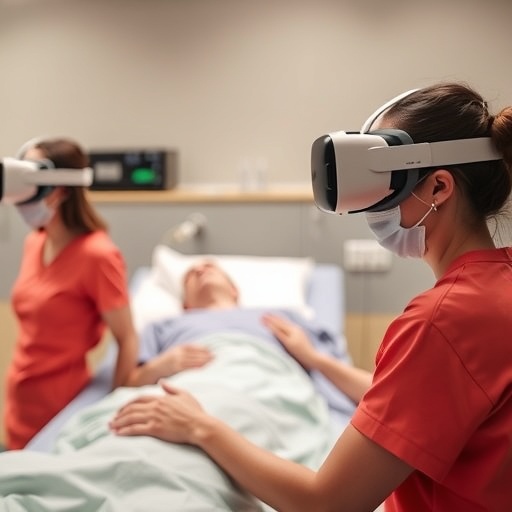
In a groundbreaking study published in BMC Nursing, researchers from a teaching hospital have explored the transformative potential of virtual reality (VR) in the realm of postmortem care training, highlighting its viability in enhancing the educational experience of nursing students and newly employed nurses. This innovative approach offers an immersive learning platform, allowing healthcare professionals to engage deeply with the sensitive and complex nature of postmortem care in a safe and controlled environment.
Virtual reality, a technology once confined to gaming and entertainment, is now carving a niche in medical training and education. The application of VR in postmortem care training stands to redefine how nursing education is delivered, addressing critical gaps in knowledge and experience that can affect the quality of care provided by healthcare professionals. By simulating real-life scenarios, VR enables trainees to practice and refine their skills empathetically and ethically, ultimately promoting better patient-centered practices in end-of-life care.
With the growing emphasis on effective training methodologies in healthcare, the study conducted by Chen and colleagues offers significant insights. It employs a quasi-experimental design, which pairs nursing students and newly hired nurses with VR technology as a means to enhance their understanding of postmortem procedures. This approach not only cultivates technical skills but also fosters a deeper emotional comprehension of the importance of compassionate care during such a delicate time.
The study’s findings reveal that participants who engaged with the VR training exhibited a marked improvement in their confidence and preparedness when handling postmortem care situations. This is particularly essential, as many nursing students may struggle with discomfort or uncertainty surrounding end-of-life scenarios. By providing an engaging platform where students can confront these challenges head-on, VR training diminishes anxiety and builds a foundational competence that is critical for future healthcare practice.
Moreover, the study emphasizes the importance of experiential learning. Traditional training often involves passive methods, such as lectures and textbook learning, which may not adequately equip students with the skills necessary for real-world applications. In contrast, VR training stimulates active participation and decision-making, making the learning experience more dynamic and relatable. As learners navigate through postmortem care scenarios in a virtual setting, they can develop not only their technical skills but also their interpersonal abilities, enhancing overall patient care.
The implications of this research extend beyond the immediate benefits for nursing students and newly employed nurses. By integrating VR technology into nursing curricula, educational institutions can stay ahead in an increasingly competitive and evolving field. As healthcare practices advance, so too must the methods employed to train the professionals who will carry out these practices. VR represents a forward-thinking approach that aligns with modern technological advances while prioritizing patient care quality and safety.
As with any innovative approach, the challenges and limitations of VR training must be carefully considered. While the initial findings are promising, further research will be essential to assess the long-term impacts of VR training on actual clinical practice. This includes evaluating whether the confidence gained through virtual simulations translates into real-world competencies and improved patient outcomes. Additionally, accessibility to VR technology across different hospitals and educational institutions may pose a barrier that needs to be addressed to ensure equitable training opportunities for all nursing students.
The study also invites conversations about ethical considerations in postmortem care. Engaging in VR simulations allows students to confront hard truths about death and dying within a secure space, fostering discussions around cultural sensitivities and ethical dilemmas involved in such care. This cultural competence is increasingly recognized as a crucial aspect of effective nursing practice, where understanding the diverse beliefs and values of patients and their families plays a pivotal role in care provision.
As healthcare continues to evolve rapidly, the integration of novel technologies like virtual reality into training programs signifies a shift toward more holistic and patient-driven education. Such advancements are particularly pertinent in light of demographic shifts, with an aging population and increasing complexity in patient care needs. In this context, training healthcare workers to be adept in both technical skills and emotional intelligence is paramount, and VR training offers a valuable tool to bridge that gap.
The virtual reality-based postmortem care training provides an exciting glimpse into the future of nursing education. With the potential to enhance the learning experience, boost confidence, and improve care outcomes, it paves the way for a new standard in healthcare training methodologies. As such, it is imperative that educators, institutions, and healthcare systems come together to harness these technologies, ensuring that the next generation of healthcare providers is not only skilled but also compassionate and well-prepared to face the complexities of patient care.
As we move forward, the ongoing dialogue about the role of technology in healthcare education will be critical. Stakeholders must remain proactive in exploring and implementing cutting-edge methods, like VR, to enrich nursing curricula. By fostering a culture of innovation and adaptability within training programs, the healthcare community can ensure that its workforce is equipped to meet the ever-changing landscape of patient care, ultimately benefiting those who rely on their expertise.
In conclusion, the study by Chen and colleagues serves as an important stepping stone in understanding how virtual reality can enhance postmortem care training. By providing evidence-based insights into the effectiveness of VR in nursing education, the research lays the groundwork for future exploration within the field. As we embrace these advancements, we must stay committed to improving the quality of care for patients at every stage, particularly during their final moments.
Subject of Research: Virtual reality training in postmortem care for nursing education.
Article Title: Virtual reality-based postmortem care training: a quasi-experimental study with nursing students and newly employed nurses at a teaching hospital.
Article References: Chen, YL., Liu, YK., Cheng, CH. et al. Virtual reality-based postmortem care training: a quasi-experimental study with nursing students and newly employed nurses at a teaching hospital. BMC Nurs (2026). https://doi.org/10.1186/s12912-025-04287-z
Image Credits: AI Generated
DOI:
Keywords: Virtual reality, nursing education, postmortem care training, healthcare technology, experiential learning, compassionate care.


