


A groundbreaking study led by researchers at the National Institute of Information and Communications Technology (NICT) has unveiled a novel mechanism for reducing fear responses to heights, leveraging the immersive potential of virtual reality (VR). Contrary to longstanding theories that emphasize repeated exposure to fear-inducing stimuli as the primary path to fear extinction, this new research illustrates how an "action-based prediction" of safety—achieved through active VR flight—can significantly diminish both physiological and subjective fear reactions. This paradigm-shifting discovery could redefine therapeutic approaches to treat acrophobia and other related phobias by focusing on predictive safety states rather than mere habituation.
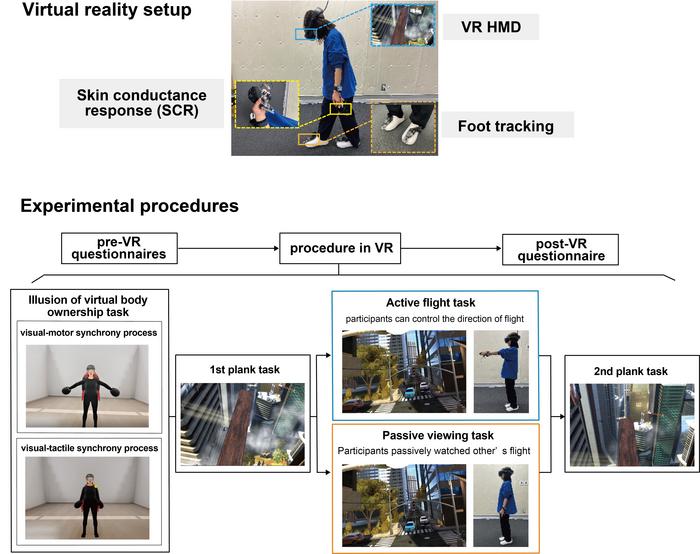
In this meticulously designed experiment, participants predisposed to fear of heights engaged in a two-phase VR protocol involving virtual plank walking at extreme altitudes combined with either an active flight intervention or passive observation. The initial phase required participants to traverse a narrow plank suspended approximately 300 meters above ground level in the VR environment, a task designed to elicit measurable fear responses. The physiological dimension of fear was quantified through skin conductance response (SCR), a sensitive indicator of autonomic nervous system arousal, while subjective fear levels were self-reported using an 11-point fear scale.
Following this initial fear-inducing task, participants were randomly segregated into two groups. The Flight Group embarked on a seven-minute session of low-altitude flight within the VR environment, actively maneuvering under five meters above the unreal terrain using handheld controllers. This active participation was theorized to cultivate a predictive model within the brain, indicating that even if one were to fall, the ability to fly would provide a secure transition to safety. Meanwhile, the Control Group was exposed to a passive experience by watching recorded footage of a Flight Group participant’s VR flight, effectively controlling for visual exposure without self-generated action.
Upon completion of the flight or observation session, both groups repeated the high-altitude plank task, with continuous measurement of SCR and self-reported fear scores. The results were striking. While both groups demonstrated some reduction in fear responses during the second plank task—likely attributable to general habituation—the Flight Group showed a profoundly greater decrease in both objective and subjective fear markers. This finding robustly supports the hypothesis that active engagement in predictive safety-related actions fosters more effective fear extinction than passive observation alone.
The underlying mechanism, identified by the researchers, revolves around what they term "action-based prediction." This cognitive process involves forming expectations about transitioning to a secure state based on one’s own initiated actions. Specifically, the experience of actively flying within VR provides the brain with compelling evidence that a fall could be mitigated through self-generated flight, fundamentally altering the participant’s fear framework. This contrasts sharply with traditional exposure therapies, which rely on repetitive encounters with the fear stimulus without such predictive feedback.
Further statistical examination via multivariate regression analyses illuminated the critical role of a “Safety Prediction Score.” This metric, derived from questionnaire responses post-VR tasks, quantifies the degree to which participants internalized the belief that falling was not perilous due to their ability to fly. Notably, higher Safety Prediction Scores correlated strongly with greater reductions in skin conductance, underscoring the physiological potency of this cognitive reassessment in attenuating fear.
The implications of these results extend far beyond the virtual environment. By demonstrating that fear extinction can be mediated through predictive modeling of safety states, the study paves the way for innovative clinical interventions. Individuals suffering from acrophobia and similar anxieties could potentially engage in targeted VR-based active experiences that empower them to reframe their perception of danger through embodied actions, circumventing the often distressing requirement of repeated exposure to heights.
Importantly, the VR flight intervention was conducted at altitudes deliberately kept low—under five meters—to prevent potential habituation to height itself, ensuring that fear reduction stemmed primarily from the action-based safety prediction and not mere desensitization. This meticulous control highlights the researchers’ commitment to dissecting the distinct cognitive mechanisms at play.
Complementing physiological data, subjective fear ratings exhibited parallel patterns. Participants in the Flight Group consistently reported feeling less fear during the second plank task compared to their Control counterparts, validating the experiential potency of active flight. This dual convergence of objective and subjective measures enhances confidence in the robustness and real-world relevance of the findings.
This research also confronts and expands current theoretical frameworks within behavioral neuroscience and psychology. Traditional extinction paradigms often presuppose that repeated exposure leads to new inhibitory learning suppressing conditioned fear responses. However, the concept that self-initiated actions can generate predictive safety models introduces a dynamic, agency-centered dimension to fear modulation, which could reshape therapeutic strategies across various anxiety disorders.
Looking ahead, the study’s authors express optimism regarding the translational potential of VR-based active flight experiences. Planned longitudinal studies aim to assess whether such interventions yield enduring reductions in fear responses outside the laboratory, evaluating ecological validity. Moreover, exploring tailored VR protocols might optimize efficacy across different phobic populations, integrating advances in neurofeedback and adaptive virtual environments.
Ethically, the study adhered to rigorous standards, with informed consent obtained from all participants and approval by the NICT Ethics Committee. This reinforces commitment to participant safety and scientific integrity as immersive technologies intersect increasingly with mental health research.
Technologically, leveraging VR to induce embodied self-agency provides a unique platform for manipulating perceptual and cognitive schemas underlying fear. The seamless integration of physiological monitoring (SCR) with psychometric assessment affords a comprehensive view of fear extinction, blending objective and subjective data streams with high temporal fidelity.
In sum, this pioneering investigation challenges entrenched notions in fear extinction by unveiling an alternative, action-based prediction mechanism rooted in virtual reality-induced embodiment. Through harnessing the brain’s capacity to anticipate safety via self-initiated actions, this approach promises a paradigm shift in how anxiety disorders might be understood and treated, heralding a new era where immersive technology and neuroscience converge for transformative mental health solutions.
News Publication Date: 13-May-2025
References: DOI: 10.1073/pnas.2416920122
Cite Scienmag News
Courtney Benton. (May 14, 2025). VR Flight Experience Alleviates Fear of Heights Through Action-Based Safety Prediction. Scienmag. https://scienmag.com/vr-flight-experience-alleviates-fear-of-heights-through-action-based-safety-prediction/
Courtney Benton. "VR Flight Experience Alleviates Fear of Heights Through Action-Based Safety Prediction." Scienmag, 14 May 2025, https://scienmag.com/vr-flight-experience-alleviates-fear-of-heights-through-action-based-safety-prediction/. Accessed 5 September 2026.
Courtney Benton. "VR Flight Experience Alleviates Fear of Heights Through Action-Based Safety Prediction." Scienmag. May 14, 2025. https://scienmag.com/vr-flight-experience-alleviates-fear-of-heights-through-action-based-safety-prediction/


