


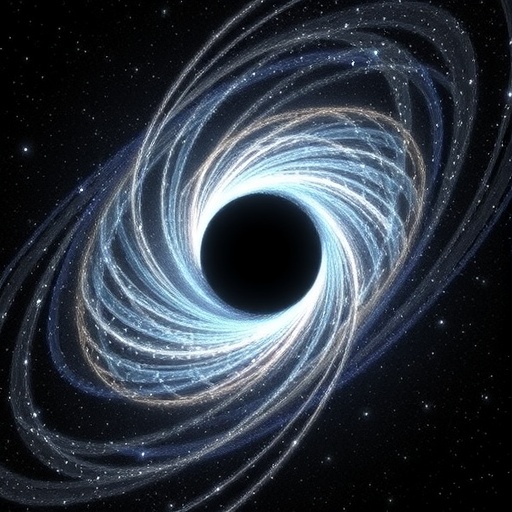
A new theoretical study suggests that tiny, topologically protected vortices could make a three-dimensional black hole grow a subtle form of “hair”—not strands of matter, but a persistent pattern in spacetime curvature. The work, published in General Relativity and Gravitation, explores how a localized vortex in a modified theory of gravity can excite a propagating gravitational field around a BTZ black hole. In ordinary three-dimensional Einstein gravity, such local gravitational waves or particles do not exist. But when gravity is amended with a small quadratic correction, the curvature itself becomes dynamical, allowing the black hole to carry an additional, measurable-in-principle profile beyond its mass and horizon.
The black hole in the study is the Bañados–Teitelboim–Zanelli, or BTZ, solution, a mathematically exact black hole in a universe with three spacetime dimensions and a negative cosmological constant. Its geometry is described by an anti-de Sitter, or AdS, background, in which space curves inward at large distances. In pure Einstein gravity, the local geometry of a vacuum three-dimensional spacetime is completely fixed by the cosmological constant. There are no ordinary propagating graviton degrees of freedom: unlike four-dimensional black holes, a disturbance does not travel through empty space as a local gravitational wave. The BTZ black hole can nevertheless have a horizon and nontrivial global properties, making it a powerful laboratory for testing ideas about black holes, quantum gravity and holography.
Almeida and Lima studied what happens when Einstein’s theory is replaced by quadratic f(R) gravity, whose simplest form adds an (R^2) term to the familiar Ricci-scalar action. Here, (R) measures the curvature of spacetime and the coefficient (\alpha) determines the strength of the correction. This modification does more than slightly alter Einstein’s equations. Through a mathematical reformulation known as the scalar–tensor correspondence, the extra curvature term behaves like a massive scalar field coupled to gravity. The resulting excitation is commonly called the scalaron. In three dimensions, it is especially important because it becomes the unique local propagating gravitational degree of freedom introduced by the theory. The researchers asked whether a localized topological defect could act as a source for this otherwise hidden mode.
Their source is a Maxwell–Higgs vortex, a field configuration related to the Nielsen–Olesen vortices used in particle physics and cosmology. A vortex forms when a complex field breaks a continuous symmetry while retaining a quantized winding around a narrow core. The winding number cannot change continuously, so the defect is topologically protected. Around its center, the Higgs-like field and gauge field vary rapidly, concentrating energy and stress in a finite region. That localized energy-momentum tensor generally has a nonzero trace, represented by (T). In standard Einstein gravity, the trace of the field equations fixes the Ricci scalar algebraically. In quadratic f(R) gravity, however, the trace becomes a differential equation, turning the vortex into a source that can launch a curvature disturbance.
In the regime where the higher-curvature correction is small compared with the AdS curvature scale, the researchers linearized the theory. The trace equation then reduces to a massive Klein–Gordon equation for (R), schematically ((\Box-m^2)R=-(2\pi/\alpha)T), with an effective scalaron mass (m^2=1/(4\alpha)). This relation produces an unusual but clear physical picture: reducing (\alpha) makes the scalaron heavier, causing the curvature excitation to become increasingly localized. The approximation requires (\alpha R\ll1), ensuring that nonlinear terms such as (\alpha R^2) remain subdominant. The authors interpret this small-(\alpha) limit as a controlled effective-field-theory expansion rather than an arbitrary mathematical simplification.
To calculate the response, the team treated the BTZ geometry as a fixed background and assumed a static, circularly symmetric vortex positioned outside the event horizon. The resulting radial equation has a self-adjoint Sturm–Liouville form, a structure that makes it possible to construct an exact radial Green function. One homogeneous solution is chosen to remain regular at the horizon, while the other decays at spatial infinity. The Green function combines these two solutions across the source region, allowing the curvature profile to be written as an integral over the vortex’s energy-momentum trace. In essence, every part of the vortex contributes to the scalaron field, but the black-hole geometry determines how those contributions propagate and how they are filtered at large distances.
The most striking result is that the far-field profile forgets almost everything about the vortex’s microscopic structure. Outside the vortex core, the curvature perturbation falls as (R(r)\sim r^{-(1+\nu)}), where (\nu=\sqrt{1+m^2\ell^2}) and (\ell) is the AdS radius. The exponent is fixed by the scalaron mass and the geometry, not by the detailed shape, width or internal field structure of the defect. The core affects mainly the amplitude through an integrated effective scalar charge, (Q_{\mathrm{eff}}), obtained by weighting the source profile with the radial Green-function response. This universality was checked numerically using a resolved Nielsen–Olesen vortex rather than a simplified idealized source. The calculated curves reproduced the predicted slope on a log–log plot for different vortex parameters, while their overall strengths varied as expected with the source details.
That long-distance behavior is also where the study connects to holography. In the AdS/ CFT correspondence, a massive scalar field in the bulk is associated with an operator in the lower-dimensional boundary theory. The exponent gives the operator’s conformal dimension, (\Delta=1+\nu). Because the researchers impose the normalizable boundary condition, the non-normalizable mode—which would represent an externally imposed source at the boundary—is absent. The vortex instead creates a response in the bulk that can be interpreted as a source-free expectation value of the dual operator. The boundary theory would therefore register the defect through a one-point function whose amplitude depends on (Q_{\mathrm{eff}}), while its scaling dimension depends only on (\alpha) and (\ell). The result offers a clean example of how a localized object deep in an AdS geometry could leave a universal imprint on boundary physics.
The calculations also indicate that the new black-hole hair is stable and energetically well behaved, within the assumptions of the model. For positive (\alpha), the scalaron has positive mass squared, so it is not tachyonic in the flat-space sense. In AdS, the relevant condition is the Breitenlohner–Freedman bound, which permits certain negative mass-squared fields but requires (m^2\geq -1/\ell^2). The scalaron lies safely above that threshold. Its energy, calculated from the effective massive-scalar action, contains gradient and mass contributions and remains finite both near the horizon and at infinity. Because the asymptotic field decays rapidly, the energy integral converges strongly rather than accumulating an infrared divergence.
Perhaps most importantly, the excitation does not significantly reshape the black hole in the perturbative regime. When (\alpha\ll\ell^2), the parameter (\nu) becomes large, approximately (\ell/(2\sqrt{\alpha})). For a vortex centered at radius (r_v) outside a horizon of radius (r_h), the scalar energy is estimated to contain a suppression factor of roughly ((r_h/r_v)^{2\nu}). Since (r_h/r_v<1), this becomes exponentially small as (\nu) grows. The scalaron can therefore form a mathematically extended curvature profile while carrying far less energy than the BTZ black hole itself. As (\alpha) approaches zero, its mass diverges and the mode decouples, smoothly recovering ordinary three-dimensional Einstein gravity, where no local gravitational degree of freedom remains.
The findings do not yet describe a fully backreacting black hole with a vortex, nor do they predict an immediately observable signature in an astrophysical system. The analysis assumes a static vortex outside the horizon, a fixed BTZ background and a linearized curvature equation. The authors identify rotating BTZ black holes as a more difficult next step. Rotation introduces inner and outer horizons, frame dragging and couplings between radial and angular modes; a vortex that is static in the nonrotating case may also need angular momentum inside an ergosphere. Future work could examine scalaron quasinormal modes, solve the coupled gravitational and vortex equations beyond leading order, and determine how the holographic response changes in a rotating geometry. For now, the study provides an analytically controlled demonstration of a remarkable possibility: in a minimal universe where Einstein gravity has no local gravitational waves, a topological vortex can activate a new curvature field and give a black hole a faint, stable and highly structured form of gravitational hair.
Cite Scienmag News
Grant Pearson. (August 26, 2026). Vortex-Induced Scalaron Hair on BTZ Black Holes in Quadratic f(R) Gravity. Scienmag. https://scienmag.com/vortex-induced-scalaron-hair-on-btz-black-holes-in-quadratic-fr-gravity/
Grant Pearson. "Vortex-Induced Scalaron Hair on BTZ Black Holes in Quadratic f(R) Gravity." Scienmag, 26 August 2026, https://scienmag.com/vortex-induced-scalaron-hair-on-btz-black-holes-in-quadratic-fr-gravity/. Accessed 4 September 2026.
Grant Pearson. "Vortex-Induced Scalaron Hair on BTZ Black Holes in Quadratic f(R) Gravity." Scienmag. August 26, 2026. https://scienmag.com/vortex-induced-scalaron-hair-on-btz-black-holes-in-quadratic-fr-gravity/


