


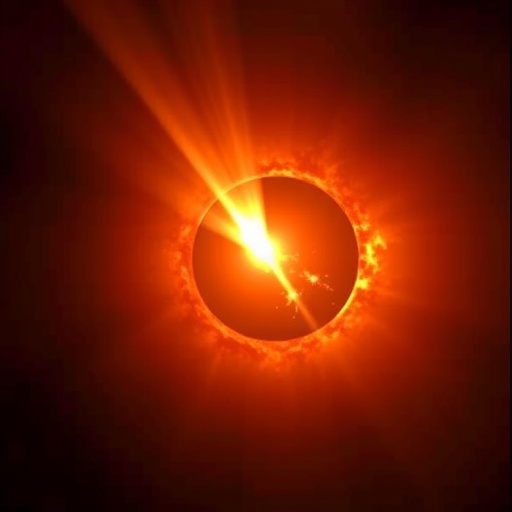
A solar instrument has captured cool, neutral helium racing through the Sun’s outer atmosphere as part of coronal mass ejections, offering scientists a new way to measure the speed and direction of eruptions that can trigger powerful space-weather storms. The observations, made with the Upgraded Coronal Multi-channel Polarimeter (UCoMP) at the Mauna Loa Solar Observatory in Hawaii, reveal prominence material remaining visible far above the solar surface and into the middle corona. The study shows that the helium signal can be detected out to roughly two solar radii, or about 1.5 solar radii above the Sun’s visible limb, near the edge of UCoMP’s field of view. Because the instrument records spectral information rather than merely taking images, the technique can expose motion along the line of sight—an essential measurement that conventional white-light images often cannot provide. The result could eventually help forecasters determine whether a potentially hazardous eruption is heading toward Earth or moving away from it.
Coronal mass ejections, or CMEs, are enormous expulsions of magnetized plasma from the Sun. When directed toward Earth, they can compress the planet’s magnetosphere and drive geomagnetic storms, disrupting radio communication, satellite operations, navigation systems and electrical grids. Many CMEs carry fragments of solar prominences, immense structures in which relatively cool, dense plasma is suspended above the solar surface by curved, sheared or twisted magnetic fields. Prominence plasma typically has a temperature near 10,000 kelvin, far cooler than the million-degree corona surrounding it. That low temperature allows neutral atoms to survive inside the eruption. The UCoMP team targeted a near-infrared spectral feature called the helium I 1083-nanometre line, produced by neutral helium. The wavelength of light emitted by the moving plasma shifts through the Doppler effect: material moving toward the observer shifts the line toward shorter wavelengths, while material receding shifts it toward longer wavelengths. Measuring that shift provides a direct estimate of radial velocity.
The observations came from UCoMP’s commissioning period between July 2021 and January 2022. During 79 observing days that included helium 1083-nanometre measurements, the researchers found prominence material extending significantly above the instrument’s internal occulter on 14 days. The occulter blocks the brilliant solar disk, allowing the much fainter corona to be examined, and has an effective radius of approximately 1.04 to 1.05 times the solar radius. Only a subset of the events produced sufficiently clear data for detailed analysis, because some observations consisted of a single image, were affected by poor atmospheric seeing or used unsuitable instrumental settings. The team examined particularly clear eruptions on 15 July, 30 July and 28 August 2021, comparing UCoMP images and spectra with observations from the K-Cor coronagraph at Mauna Loa, NASA’s Solar Dynamics Observatory and the Solar and Heliospheric Observatory’s LASCO coronagraph. Together, the instruments provided views of cool plasma, hotter coronal structures and the broader white-light CME.
UCoMP is an imaging spectropolarimeter designed to measure the solar corona in visible and near-infrared wavelengths. It can record the full Stokes parameters—quantities describing the intensity and polarization state of light—across several coronal emission lines. In principle, polarization encoded through effects such as the Hanle effect can reveal information about magnetic fields in erupting structures, including the flux ropes believed to power many CMEs. The helium observations in this study, however, were used primarily for intensity and Doppler measurements. The instrument’s optical system includes an on-band channel tuned near the helium line and a nearby off-band channel intended to estimate and remove sky and continuum light. A complication emerged because the off-band filter transmission profile has a secondary peak that can respond strongly to helium emission shifted far from the line center. Rather than simply representing background, the off-band signal could therefore contain Doppler-shifted prominence plasma. That imperfection became scientifically useful: in the fastest eruption, bright off-band emission indicated helium moving away from Earth at several hundred kilometres per second.
The clearest example occurred on 15 July 2021, when a CME associated with a flare beyond the eastern solar limb became visible in LASCO images. UCoMP detected the prominence across its observed wavelength range, with the emission becoming stronger at longer wavelengths. Such a systematic increase is the signature expected from a redshifted source. Parts of the eruption appeared especially bright in the off-band images, implying that the helium emission had shifted into the secondary transmission peak of the filter. The inferred line-of-sight speeds were on the order of a few hundred kilometres per second, consistent with the motion measured independently in K-Cor’s plane-of-sky images. K-Cor tracking placed the CME core’s average propagation speed at approximately 420 kilometres per second, while the leading front moved substantially faster. LASCO classified the event as a fast halo CME that ultimately exceeded 1,000 kilometres per second. Yet the redshift showed that the prominent structure was receding from Earth, helping distinguish a visually threatening halo from an eruption actually aimed at the planet.
That geometric information is crucial because a halo CME can appear to surround the Sun in a coronagraph image regardless of whether it is travelling toward or away from Earth. White-light coronagraphs detect sunlight Thomson-scattered by free electrons, and the resulting image records projected structure without directly revealing the plasma’s radial motion. UCoMP’s helium line adds a spectroscopic dimension. In the July 15 event, observations from the STEREO-A spacecraft, located roughly 45 degrees behind Earth, confirmed that the eruption originated slightly behind the limb from that spacecraft’s perspective and propagated broadly away from Earth. The agreement between the Doppler measurements, K-Cor’s projected speeds and STEREO-A’s viewing geometry demonstrates how combining spectral and imaging data can reduce ambiguity in CME direction. Even before a CME reaches the wider field of view of space-based coronagraphs, a ground-based spectropolarimeter could potentially provide an early indication of whether its cool core is approaching or receding.
The other eruptions illustrated a different advantage of the technique: the ability to trace complex internal motions. In the event observed on 30 July, the prominence formed a twisted structure above the limb and erupted only after the UCoMP observations ended. Different portions of the structure emitted most strongly in different wavelength channels, suggesting multidirectional motion within the prominence. The two legs of the structure exhibited opposite Doppler shifts, a pattern consistent with twisting or rotating plasma associated with an unstable magnetic flux rope. Unlike the July 15 eruption, this prominence was comparatively static during the observations, and its measured Doppler velocities were much lower. Such spectral differences could help researchers track the transition from a slowly evolving magnetic configuration to a rapidly expanding CME, potentially improving models of how eruptions accelerate and rotate through the low corona.
The helium signal was also unexpectedly bright. Prominence emission exceeded 1,000 millionths of the solar disc brightness in some observations, making it roughly 50 to 100 times stronger than the infrared forbidden coronal lines routinely measured by UCoMP, whose intensities are typically around 10 millionths of disc brightness or less. The strength of the signal allowed the cool material to remain visible against the faint sky background as it moved outward, with no pronounced intensity decline detected during the clearest eruption. However, the commissioning data were not fully calibrated. The cameras had originally been optimized for much fainter coronal lines, and even after exposure times and detector gains were adjusted, many helium images entered a nonlinear or saturated regime. The reported intensities are therefore lower limits rather than precise brightness measurements. The off-band channel also requires a more sophisticated instrument model before it can be reliably used for quantitative intensity or polarization analysis. These limitations do not erase the detection, but they mean that the technique remains a promising demonstration rather than a mature operational forecasting system.
A major question is how often CMEs contain enough cool prominence material to emit detectable neutral helium. Across the 79 observing days, the researchers identified prominence eruptions on 14 days. For the same observing windows, the SOHO LASCO CME catalogue listed 31 eruptions, implying a rough correspondence of about 45 percent. The fraction should not be interpreted as a definitive physical rate: ground-based telescopes cannot observe continuously because of daylight and weather, the commissioning observations were often sparse, and not every CME contains a substantial cool component. Nevertheless, the comparison suggests that helium 1083-nanometre emission can identify a significant fraction of CME activity. Future observations will need detectors and exposure settings capable of handling the bright prominence signal without saturation, as well as faster and denser spectral sampling. More wavelength points would yield more reliable velocity distributions, but scanning a broad range takes time—an unavoidable trade-off when fast CMEs can evolve rapidly. With near-real-time operations, UCoMP and future coronagraphs designed for the COSMO facility could combine helium spectroscopy with white-light and extreme-ultraviolet imaging to construct a more three-dimensional picture of solar eruptions and provide earlier warnings of Earth-directed space weather.
Cite Scienmag News
Grant Pearson. (August 26, 2026). MLSO/UCoMP Capture Helium-1083 nm Prominence Eruption in Middle Corona. Scienmag. https://scienmag.com/mlso-ucomp-capture-helium-1083-nm-prominence-eruption-in-middle-corona/
Grant Pearson. "MLSO/UCoMP Capture Helium-1083 nm Prominence Eruption in Middle Corona." Scienmag, 26 August 2026, https://scienmag.com/mlso-ucomp-capture-helium-1083-nm-prominence-eruption-in-middle-corona/. Accessed 4 September 2026.
Grant Pearson. "MLSO/UCoMP Capture Helium-1083 nm Prominence Eruption in Middle Corona." Scienmag. August 26, 2026. https://scienmag.com/mlso-ucomp-capture-helium-1083-nm-prominence-eruption-in-middle-corona/


