


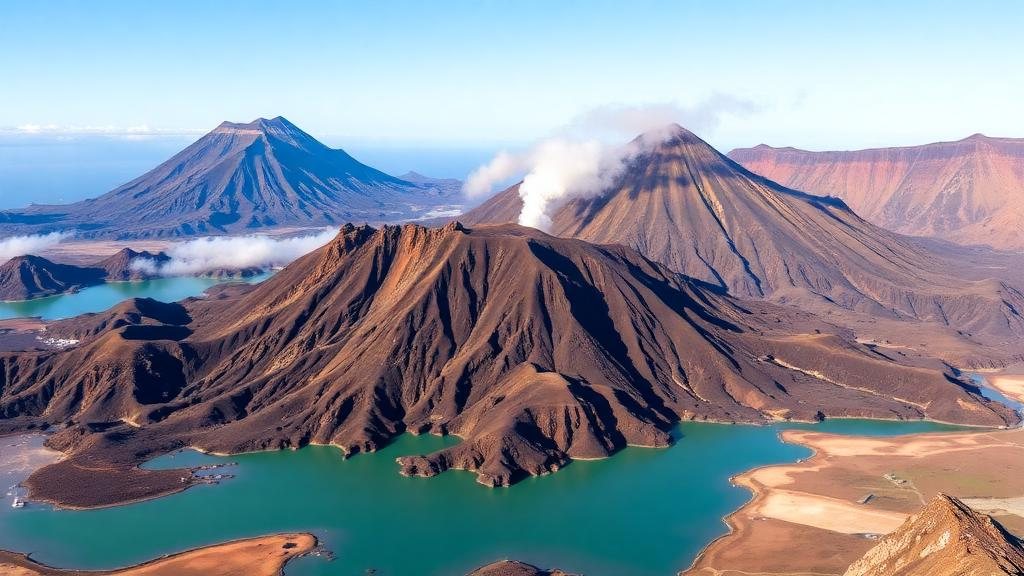
When the Tajogaite volcano tore open the western flank of La Palma in September 2021, it destroyed more than 3,000 buildings, buried roughly 1,345 hectares of farmland, displaced about 7,000 residents and caused direct losses exceeding €900 million over 85 days. But for a team of researchers, the eruption was something else as well: a bifurcation point, a rare moment when an entire island’s trajectory hangs open and the choice between transformative recovery and a return to business as usual becomes genuinely live. A new study published in Environmental and Sustainability Indicators seizes that moment, laying out a rigorous methodological framework that forces island futures to answer to physics before they are allowed to answer to politics.
The study, led by Serafin Corral, addresses what the author calls the narrative–biophysical gap, a chronic weakness in scenario planning. Futures studies has long produced compelling stories about alternative tomorrows — energy self-sufficiency, green tourism, resilient agriculture — but the plausibility of those stories is usually asserted rather than tested. A scenario may describe an attractive future without checking whether the energy and water flows it presupposes are physically attainable given the island’s renewable potential, infrastructure and sectoral metabolism. On a small island, where every drop of water and every kilowatt-hour can be accounted for, that gap between narrative and physics is not an academic quibble; it is the difference between futures that can guide the allocation of scarce public resources and futures that merely exercise the imagination.
To close the gap, the framework joins two powerful traditions. The first is Gallopín’s structural scenario method, which decomposes any future into critical dimensions, driving forces, strategic invariables, critical uncertainties and narrative images, and then evaluates each scenario against three criteria: plausibility, feasibility and desirability. The second is MuSIASEM — Multi-Scale Integrated Analysis of Societal and Ecosystem Metabolism — a fund–flow accounting framework that treats a society like a metabolism, tracking how energy, water and money flow through sectors defined by their human activity, land and capital. Together they produce a seven-step procedure in which qualitative narratives are screened against an empirical metabolic baseline: any scenario requiring resource flows the baseline cannot support is judged biophysically inadmissible.
The metabolic baseline for La Palma, compiled from official statistics for 2020–2023, is revealing in itself. Agriculture withdraws 68.0 cubic hectometres of water per year — a staggering 86.3 percent of total island use — overwhelmingly for banana irrigation, making water the binding constraint on every conceivable future. Residential and commercial demand together account for roughly three-quarters of electricity consumption. Gross value-added stood at €1,385.6 million in 2021, with public administration, health, education and recreation forming the largest branch on remarkably low resource footprints, while tourism and hospitality combine high metabolic density with high per-capita intensity. Comparative profiling places La Palma at 2,856 kWh per capita per year — between tourism-saturated Lanzarote at 4,123 and agro-ecologically governed Menorca at 2,144 — suggesting real efficiency headroom.
Crucially, the numbers were not imposed from above. Over three six-and-a-half-hour workshops in 2025, a standing multi-actor panel of 48 participants — spanning the Cabildo and municipalities, irrigation communities and banana cooperatives, tourism operators and the Instituto de Astrofísica de Canarias, scientists, and volcano-affected residents’ platforms — validated the causal map of the island system, scored the direct influence of eleven system variables on one another, tested draft scenarios against the feasibility filter, and co-designed the resulting policy roadmap. The process followed FAIR and CARE principles for knowledge governance, with written informed consent, anonymised reporting, and the knowledge returned to the community as a shared roadmap and a proposed Island Sustainability Observatory.
The elicited judgements were then formalised through a MICMAC-type cross-impact analysis, in which the influence matrix is multiplied by itself repeatedly until rankings stabilise, capturing effects transmitted along chains of intermediaries rather than only direct links. The result reorders the island’s power structure in instructive ways. Climate and water variability, scored modestly on direct links, rises to the determinant region once its influence through water quality, tourism and employment is traced. Environmental and water quality migrates from a mere outcome to a central transmission belt. And public policy emerges as the master lever — the only actionable determinant in a system where biophysical insularity is fixed and climate is exogenous. Tourism, energy and water quality occupy the relay region: the channels through which every intervention propagates and every shock is amplified.
Three scenarios to 2050 were constructed and quantified through a transparent delta model. In the Sustainable Island trajectory, electricity reaches 100 percent renewables by 2040 at about €0.10 per kWh, wastewater reuse covers half of agricultural irrigation, and the economy shifts toward higher value-added astro-, geo- and nature-based tourism — a reorientation already visible in the geotourism emerging around the Tajogaite edifice. Business-as-Usual restores the pre-eruption configuration behind modernised infrastructure. Decline compounds governance failure, climate stress and emigration. The quantified outcomes are stark: annual value-added changes of plus €63.7 million, plus €14.1 million and minus €127.4 million respectively, and cumulative balances to 2050 of roughly plus €1,100 million for Sustainable against plus €149 million for Business-as-Usual and about minus €2,600 million for Decline.
One of the study’s most striking findings is the asymmetry of choice: the potential loss is nearly three times the potential gain, and it is concentrated in a single variable. Tourism accounts for roughly three quarters of the value-added movement in both directions — the island’s greatest exposure and its greatest opportunity are the same sector seen from two ends. The water results deliver the most instructive lesson. Agricultural water volume falls by similar amounts under both Sustainable and Decline, yet the composition tells opposite stories: under Sustainable the reduction comes from reuse and precision irrigation at near-constant cost, buying supply security; under Decline the same physical reduction reflects an aquifer failing, forcing a shift to fossil-powered desalination at €0.80 per cubic metre. Identical movements in a physical indicator can carry opposite meanings — which is precisely why metabolic composition must be reported alongside aggregate numbers.
A sensitivity analysis stresses the conclusions honestly. The Sustainable balance of €1,116 million compresses to €480–970 million under the most adverse single assumptions and turns negative, at minus €132 million, only in a deliberately extreme case combining every adverse value with 5 percent discounting. But the ordering — Sustainable above Business-as-Usual above Decline — holds in every variation tested. The policy sequencing that follows is equally disciplined: enter through the one actionable determinant, public policy; deliver through the relay variables, starting with network rehabilitation that recovers the 25–30 percent of water now lost to leakage; and let renewable-powered desalination buffer the ungovernable climate determinant. The renewable transition is what makes the water strategy affordable, a synergy that exists only if the energy shift arrives first.
The deeper vulnerability, the study argues, is institutional rather than technical. Because public policy is the only governable lever, the entire trajectory depends on the most volatile variable in the system — one renewed at every electoral cycle — while the key investments have payback periods spanning several mandates. An Island Sustainability Observatory publishing the metabolic baseline, and a participatory long-term territorial plan aligning the island’s five governance tiers from municipalities to the European Union, would not guarantee continuity, but both raise the cost of abandoning it. The framework itself is designed to transfer to any island where sectoral energy, water, land and value-added data can be assembled, from the Azores to the Caribbean. Its value, the author concludes, is anticipatory: rendering the long-run consequences of present reconstruction choices legible while those choices remain open — before the next bifurcation point arrives unannounced, as on a September morning in 2021.
Subject of Research: Biophysically grounded scenario building for sustainability governance on the island of La Palma
Article Title: Biophysically-grounded scenario building for Island sustainability governance: A methodological framework and application to La Palma (Canary Islands, Spain)
Article References: Corral, S. (2026). Biophysically-grounded scenario building for Island sustainability governance: A methodological framework and application to La Palma (Canary Islands, Spain). Environmental and Sustainability Indicators, 32, Article 101531. https://doi.org/10.1016/j.indic.2026.101531
Image Credits: AI Generated
DOI: 10.1016/j.indic.2026.101531
Keywords: La Palma, scenario planning, MuSIASEM, island sustainability, Tajogaite eruption, water security, renewable energy, tourism, MICMAC analysis, socio-ecological metabolism, Canary Islands, post-disaster governance
Cite Scienmag News
Sloane Callahan. (October 2, 2026). Volcano, Water and the Future: La Palma Gets a Biophysical Reality Check for 2050. Scienmag. https://scienmag.com/volcano-water-and-the-future-la-palma-gets-a-biophysical-reality-check-for-2050/
Sloane Callahan. "Volcano, Water and the Future: La Palma Gets a Biophysical Reality Check for 2050." Scienmag, 2 October 2026, https://scienmag.com/volcano-water-and-the-future-la-palma-gets-a-biophysical-reality-check-for-2050/. Accessed 4 October 2026.
Sloane Callahan. "Volcano, Water and the Future: La Palma Gets a Biophysical Reality Check for 2050." Scienmag. October 2, 2026. https://scienmag.com/volcano-water-and-the-future-la-palma-gets-a-biophysical-reality-check-for-2050/


