


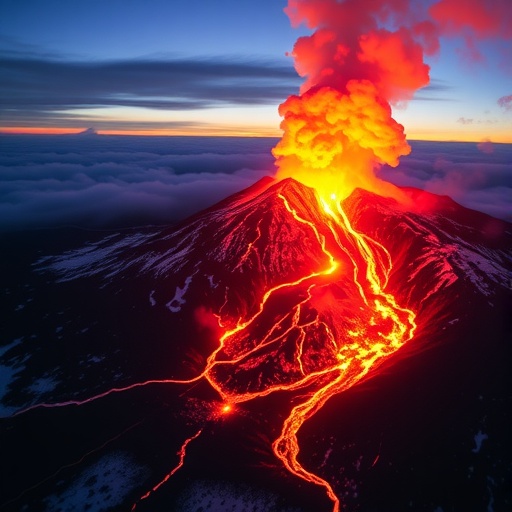
In a groundbreaking study published in Communications Earth & Environment, researchers led by University of Wyoming geologist Mark Clementz have unearthed compelling evidence linking late Miocene volcanic activity in the Andes to a significant global climatic shift. Their interdisciplinary investigation, combining multi-proxy field and laboratory data with sophisticated climate and ecosystem modeling, reveals that an uptick in volcanism between 7 and 5.4 million years ago likely triggered a profound cooling of Earth’s climate through ocean fertilization and subsequent carbon sequestration processes.
This research elucidates a pivotal period known as the Late Miocene Epoch, a transformative interval in Earth’s history where climate patterns began to resemble those of the modern era. The team focused on volcanic activity associated with the Altiplano-Puna volcanic complex—recognized as the Earth’s largest active silicic magma system—whose eruptions injected vast quantities of mineral-rich ash into the atmosphere and ultimately into the oceanic system. These volcanic deposits, rich in micronutrients such as iron, phosphorus, and silicon, are critical drivers of marine productivity.
Volcanic ash dispersal into the Southern Ocean enhanced nutrient availability, catalyzing a surge in the proliferation of diatoms—microscopic, photosynthetic algae instrumental in global carbon cycling. Diatoms are significant chlorophyll producers that assimilate atmospheric carbon dioxide, reducing greenhouse gas concentrations when thriving in enhanced numbers. This biogenic boost would have heighted primary productivity, setting the stage for a cascade of ecological and climatic consequences that profoundly altered marine ecosystems.
The fossil record from this period corroborates these environmental shifts by revealing notable changes in marine vertebrate populations, particularly the evolution of cetaceans—whales and their relatives. Esteemed for their large bodies and migratory behaviors, these marine mammals contribute to carbon fluxes not only by storing carbon during their lifespan but also by facilitating oceanic carbon sequestration upon death as they descend to the seafloor. Additionally, their carbon-rich feces likely stimulated episodic toxic algal blooms, influencing marine ecosystem dynamics and further promoting carbon storage in the ocean.
This convergence of data and model projections suggests that intensified volcanic activity supplied a prolonged pulse of iron and other critical nutrients, fostering an unparalleled period of marine ecosystem turnover and enhanced carbon drawdown. Analysis of atmospheric CO2 proxies aligns with these findings, indicating a measurable decrease of approximately 10 to 15 parts per million in the post-volcanism interval, a shift sufficient to initiate global cooling trends during an otherwise warm Miocene climate backdrop.
Crucially, these insights illuminate the complex feedback mechanisms by which tectonic and volcanic processes interplay with marine productivity and atmospheric chemistry to regulate Earth’s climate over geological timescales. The study highlights how natural Earth system components can dynamically influence global carbon cycles, serving as vital analogs for understanding present and future climate trajectories amid anthropogenic change.
From a methodological standpoint, the research team deployed a suite of climate and biogeochemical models calibrated with empirical geological data. These simulations accounted for nutrient fluxes, ecosystem responses, and atmospheric carbon variations, providing a comprehensive framework to evaluate the climatic impacts of sustained Andean volcanism. Such integrative approaches underscore the importance of interdisciplinary collaboration to unravel intricate Earth system processes.
The study’s implications extend beyond paleoclimate reconstruction, offering valuable perspectives on the resilience and vulnerability of marine ecosystems in response to nutrient perturbations. By characterizing a natural experiment in ocean fertilization and ecosystem adaptation, this research informs broader discussions about geoengineering proposals aimed at enhancing ocean productivity to mitigate climate change.
Moreover, positioning Wyoming and its paleontological resources within the global context of ecosystem evolution emphasizes the significance of geoscientific research in regional and international landscapes. Unraveling ancient environmental shifts through fossil records enriches our understanding of how life and climate interdependently advance, with reverberations for present-day biodiversity and conservation strategies.
Ultimately, the findings by Clementz and colleagues fortify the scientific foundation necessary for informed climate policy and resource management. As Earth’s climatic systems continue to evolve under anthropogenic pressures, appreciating the natural mechanisms and thresholds that have dictated past transitions is paramount for anticipating future scenarios and crafting effective interventions.
For those intrigued by the genesis of this research, detailed accounts and discussions about the project’s development and scientific journey are accessible through co-author Barbara Carrapa’s blog, offering an insider’s view into the evolution of ideas and methodologies underpinning this landmark study.
Full article details and access can be found via the DOI link: 10.1038/s43247-026-03457-4.
- Article: www.nature.com/articles/s43247-026-03457-4
- Blog: https://communities.springernature.com/posts/andean-volcanism-ocean-fertilization-marine-ecosystem-turnover-and-global-cooling-in-the-late-miocene-eb21fc68-b275-4df4-9f34-8b03d417a375
References: 10.1038/s43247-026-03457-4
Keywords: Earth sciences, climate change, volcanism, ocean fertilization, carbon cycle, Miocene, marine ecosystems, diatoms, paleoceanography
Cite Scienmag News
Bethany Barker. (April 14, 2026). Volcanic Eruptions Linked to Global Cooling: New Research Reveals Climate Impact. Scienmag. https://scienmag.com/volcanic-eruptions-linked-to-global-cooling-new-research-reveals-climate-impact/
Bethany Barker. "Volcanic Eruptions Linked to Global Cooling: New Research Reveals Climate Impact." Scienmag, 14 April 2026, https://scienmag.com/volcanic-eruptions-linked-to-global-cooling-new-research-reveals-climate-impact/. Accessed 3 September 2026.
Bethany Barker. "Volcanic Eruptions Linked to Global Cooling: New Research Reveals Climate Impact." Scienmag. April 14, 2026. https://scienmag.com/volcanic-eruptions-linked-to-global-cooling-new-research-reveals-climate-impact/


