


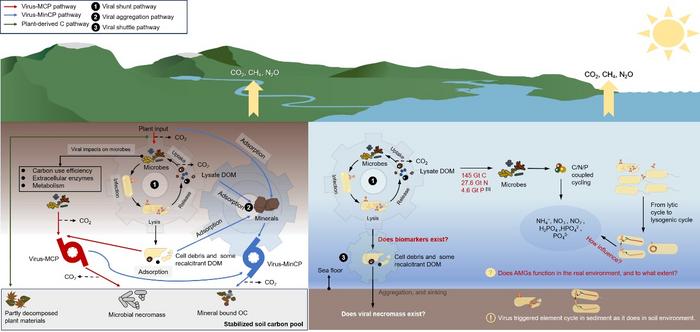
Viruses, previously regarded as microbial antagonists, have emerged as key players in the intricate web of environmental biogeochemical cycles. The recent research indicates that these microscopic entities, which are vastly more abundant than prokaryotic organisms, significantly impact elemental cycling, particularly in the contexts of carbon, nitrogen, and phosphorus. This article explores the latest insights into the dual role of viruses in promoting microbial processes and interacting with soil formations, shedding light on a fascinating frontier of ecological research.
The concept of viruses influencing biogeochemical cycles is rooted in their ability to manipulate microbial communities. When viruses infect bacteria and archaea, they initiate a process called lysis, where the host cell bursts open, releasing its contents, including organic matter. This release enriches the surrounding environment with dissolved organic matter (DOM), which serves as a crucial food source for various microorganisms, facilitating the cycling of nutrients. The interaction between viruses and microorganisms thus catalyzes the breakdown and assimilation of organic materials, an integral component of ecosystem functioning.
Viruses are not mere opportunists; rather, they have been observed to enhance the microbial carbon-use efficiency, which plays a pivotal role in the microbial carbon pump (MCP). The MCP is a critical ecological mechanism whereby microbes sequester carbon in the form of biomass and organic matter. Viral lysis boosts microbial productivity, ultimately leading to increased carbon storage in soils and sediments. This effect highlights the importance of viruses in regulating carbon stocks and, consequently, in monitoring climate change implications.
Furthermore, the interplay between viral activities and biogeochemical cycles extends beyond carbon. The release of nitrogen and phosphorus from lysed cells also impacts soil fertility and plant nutrition. By modulating microbial population dynamics and nutrient release, viruses contribute significantly to maintaining a balanced ecosystem. This nutrient cycling fosters plant growth and sustains agricultural productivity, illustrating the connection between viral processes and human food systems.
The research undertaken by Prof. Jianming Xu and Mr. Di Tong at Zhejiang University brought forth the novel term “viral aggregation,” describing the behavior of viral products in soil and sediment environments. This term reflects the observation that the spatial distribution of viruses and their lysis products is governed by factors such as soil heterogeneity and aggregation. The study emphasizes that this aggregation not only affects the physical state of nutrients in the soil but also influences their bioavailability to plants and microorganisms.
Crucially, the integration of viruses into existing biogeochemical models presents an opportunity for a paradigm shift in ecological understanding. The proposed virus-MCP and virus-MinCP (mineral carbon pump) models aim to consider viral impacts within the broader context of elemental cycling in terrestrial ecosystems. Such integrated models could elucidate the multifaceted roles of viruses in driving biogeochemical processes, thereby improving our understanding of carbon cycling dynamics, nutrient flows, and ecosystem health.
Despite promising advances, the field of viral ecology is still in its infancy, with several questions remaining unanswered. Researchers are eager to identify viral biomarkers that can serve as indicators of biogeochemical activity in various environments. This pursuit has the potential to transform how we assess ecosystem functions and health, providing insights that may guide environmental management practices.
Another pressing issue is quantifying the contribution of viruses to elemental cycles. As their roles become clearer, accurate estimations of virally-mediated nutrient cycling can inform land-use policies and conservation strategies. Understanding the balance between viral dynamics and ecological stability will be paramount in devising approaches that address environmental challenges, such as soil degradation, loss of biodiversity, and climate change.
Moreover, researchers are keen to establish effective methodologies for distinguishing viral behaviors in lytic versus lysogenic cycles. This understanding is essential, as the two cycles have differing implications for microbial communities and nutrient availability. Clarifying these distinctions will aid in developing targeted interventions for managing soil health, enhancing productivity, and preserving ecological integrity.
In conclusion, the role of viruses in elemental cycling is an exciting area of study that promises to reshape the contemporary understanding of ecology and environmental science. By redefining our perceptions of microorganisms and their interactions, particularly through the lens of viral influence, researchers are uncovering a new layer of complexity in terrestrial ecosystems. This burgeoning field offers invaluable insights that can lead to sustainable management practices and strategies to combat pressing environmental issues.
The research conducted by Prof. Jianming Xu and Mr. Di Tong serves as a timely reminder of the interconnectedness of life and the cycles that sustain our planet. As we continue to decode the mysteries of viral dynamics, we move closer to realizing their potential in fostering ecosystem resilience and sustainability in the face of global change.
News Publication Date: [Date not provided in the original content]
Web References: [Web references not provided in the original content]
References: [References not provided in the original content]
Keywords
Viruses, biogeochemical cycles, carbon cycling, nitrogen cycling, phosphorus cycling, microbial carbon pump, soil aggregates, ecological interactions, environmental microbiology.
Cite Scienmag News
Bethany Barker. (January 14, 2025). Viruses: Revolutionizing Our Understanding of Biogeochemical Cycles. Scienmag. https://scienmag.com/viruses-revolutionizing-our-understanding-of-biogeochemical-cycles/
Bethany Barker. "Viruses: Revolutionizing Our Understanding of Biogeochemical Cycles." Scienmag, 14 January 2025, https://scienmag.com/viruses-revolutionizing-our-understanding-of-biogeochemical-cycles/. Accessed 9 September 2026.
Bethany Barker. "Viruses: Revolutionizing Our Understanding of Biogeochemical Cycles." Scienmag. January 14, 2025. https://scienmag.com/viruses-revolutionizing-our-understanding-of-biogeochemical-cycles/


