


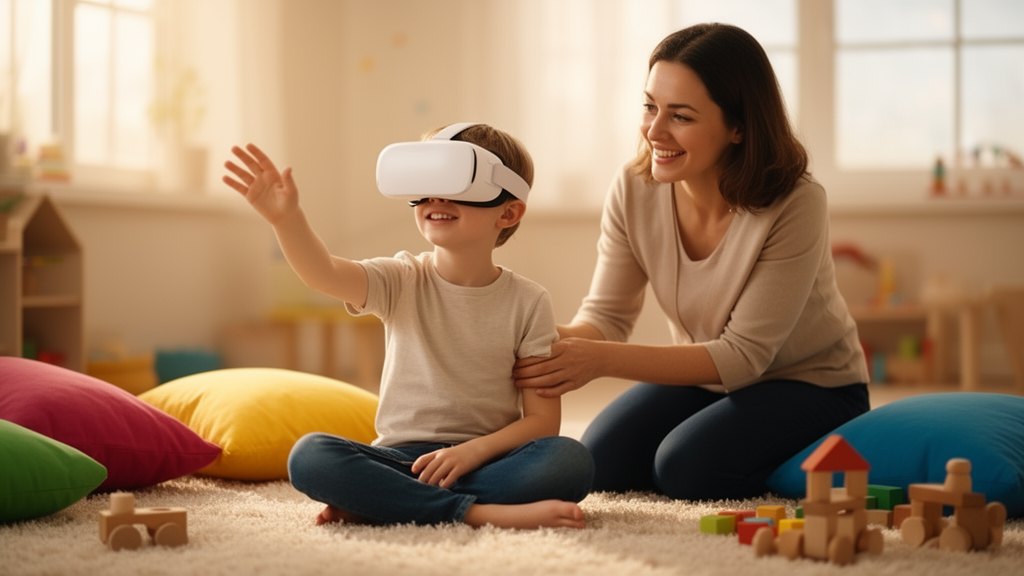
Virtual reality headsets, augmented reality overlays, and mixed reality environments are rapidly moving from science fiction novelty to serious therapeutic tools for children and adolescents with autism spectrum disorder. A sweeping systematic review published in Frontiers in Virtual Reality has synthesized a decade of research on immersive simulation interventions, analyzing 141 studies conducted between 2015 and 2025. The verdict is cautiously optimistic: immersive technologies consistently show the ability to improve social-emotional skills, cognitive abilities, daily living skills, motor coordination, and adaptive behaviors in young people with autism, but the field remains hampered by small samples, weak study designs, and glaring gaps in who gets included in the research.
The review, registered prospectively on the international PROSPERO database, set out to answer several fundamental questions about this emerging field. The researchers examined who participates in these interventions, which technologies are being deployed, how artificial intelligence is woven into the therapeutic experience, what comparison conditions studies use, what therapeutic outcomes are actually achieved, and how rigorous the underlying methodology really is. By systematically synthesizing evidence across virtual reality, augmented reality, mixed reality, and the umbrella term extended reality, the authors aimed to provide the clearest picture yet of where immersive autism interventions stand and where they need to go next.
One of the most striking findings concerns the technology landscape itself. Immersive interventions for autism remain overwhelmingly dominated by virtual reality, with the other modalities playing supporting roles. But the field is evolving quickly, and the review documents a growing integration of artificial intelligence into these systems. Modern platforms increasingly feature AI-driven emotion recognition, adaptive feedback that responds in real time to a child’s performance, and multimodal sensing capabilities such as eye-tracking and motion capture. This convergence means a child practicing a social scenario in a virtual environment may simultaneously be having their gaze patterns, facial expressions, and movements analyzed by machine-learning algorithms that adjust the difficulty and content of the simulation on the fly.
The performance numbers reported across the literature are eye-catching. Machine-learning models embedded in these systems achieved emotion recognition accuracy of up to 97 percent in the studies reviewed, a figure that suggests AI may soon serve as a reliable objective measure of emotional states in therapeutic contexts. This matters because emotion recognition has long been a bottleneck in autism interventions. Traditional assessment relies heavily on clinician observation and caregiver report, both of which are subjective and labor-intensive. If algorithms can reliably detect emotional responses during therapy sessions, clinicians gain a continuous, quantified stream of data about how a child is responding to specific scenarios, opening the door to truly personalized intervention protocols.
Therapeutic outcomes across the 141 studies paint an encouraging picture. The review found that studies report improvements in social-emotional skills, which is often the primary target of these interventions, as well as gains in cognitive abilities, daily living skills, motor coordination, and adaptive behaviors. Quantitative evidence frequently pointed to large effect sizes, with standardized measures exceeding 0.5, a threshold generally considered meaningful in behavioral intervention research. For families and clinicians, this suggests that the controlled, repeatable, and engaging environments that virtual reality provides are not merely entertaining distractions but genuine vehicles for skill development that generalize to real-world functioning.
The appeal of immersive simulation for autism intervention is rooted in a specific clinical logic. Many children and adolescents with autism find novel social situations overwhelming and unpredictable, which makes practicing those situations in the real world stressful or counterproductive. Virtual environments offer something the real world cannot: total control over sensory input, pacing, and complexity, combined with the ability to repeat a scenario as many times as needed without real-world consequences. A child can rehearse a conversation, navigate a crowded classroom, or practice crossing a street dozens of times in a single session, with the scenario calibrated precisely to their developmental level. That combination of safety, repeatability, and engagement is what has driven a decade of explosive growth in this research area.
Yet the review is equally clear about the field’s weaknesses, and these deserve as much attention as the headline results. Evidence quality is often limited by small sample sizes, non-randomized designs, and inconsistent outcome reporting. Many studies lack the control groups and randomization that would allow confident causal claims, and outcome measures vary so widely across studies that meta-analytic comparison becomes difficult. The large effect sizes reported, while promising, must be interpreted in the context of these methodological constraints. A field moving toward clinical implementation needs standardized outcome measures and rigorous comparative designs, and the review identifies both as significant gaps that currently hold the evidence base back.
Equally concerning are the disparities in who is being studied. The review found that females and lower-functioning individuals are underrepresented in this research, meaning the evidence base may not generalize to large segments of the autism population. Autism presentation varies enormously, and interventions validated primarily on higher-functioning male participants may not translate to others. Geographic concentration compounds the problem: research is clustered in North America, Europe, and parts of Asia, highlighting global disparities in access and implementation. Families in under-resourced regions, where the need for scalable interventions may be greatest, are least likely to benefit from technologies that require expensive hardware, reliable connectivity, and trained personnel.
The absence of long-term follow-up and generalization studies represents perhaps the most consequential gap. An intervention can produce impressive gains inside a virtual environment, but the ultimate clinical question is whether those gains persist over months and years and whether they transfer to real-world social interactions, classrooms, and workplaces. Without longitudinal designs tracking children after the headset comes off, the field cannot yet demonstrate durable, ecologically valid benefit. The review’s authors argue that future research should prioritize larger and more diverse samples, standardized outcome measures, longitudinal designs, and ethically informed AI integration to push the field toward evidence-based, scalable, and inclusive immersive interventions.
That last point, ethical AI integration, is becoming urgent as the technology matures. Systems that track eye movements, capture motion, and run emotion recognition algorithms on children are collecting extraordinarily sensitive data about some of the most vulnerable users in healthcare. The review’s call for ethically informed integration signals a recognition that technical accuracy, such as 97 percent emotion classification, is not the same as clinical appropriateness, and that questions of consent, data protection, algorithmic bias, and the role of human clinicians must be resolved alongside the engineering challenges. If the field addresses its methodological gaps while keeping ethics at the center, immersive simulation could evolve from a promising research niche into a mainstream, evidence-based component of autism care worldwide.
Subject of Research: Immersive virtual reality and AI-based interventions for children and adolescents with autism spectrum disorder
Article Title: Immersive simulation interventions for children and adolescents with autism spectrum disorder: technologies, cognitive and socio-emotional development, and AI-driven emotion estimation: a systematic review
Article References: Rahman, M. M., Chemnad, K., Assi, M. A., Babiker, A., & Othman, A. (2026). Immersive simulation interventions for children and adolescents with autism spectrum disorder: technologies, cognitive and socio-emotional development, and AI-driven emotion estimation: a systematic review. Frontiers in Virtual Reality, 7, Article 1850096. https://doi.org/10.3389/frvir.2026.1850096
Image Credits: AI Generated
DOI: 10.3389/frvir.2026.1850096
Keywords: autism spectrum disorder, virtual reality, augmented reality, mixed reality, immersive simulation, artificial intelligence, emotion recognition, systematic review, social-emotional skills, eye-tracking, machine learning, child and adolescent therapy
Cite Scienmag News
Blake Davidson. (October 17, 2026). Virtual Reality Meets AI: Immersive Therapy Shows Promise for Children With Autism. Scienmag. https://scienmag.com/virtual-reality-meets-ai-immersive-therapy-shows-promise-for-children-with-autism/
Blake Davidson. "Virtual Reality Meets AI: Immersive Therapy Shows Promise for Children With Autism." Scienmag, 17 October 2026, https://scienmag.com/virtual-reality-meets-ai-immersive-therapy-shows-promise-for-children-with-autism/. Accessed 17 October 2026.
Blake Davidson. "Virtual Reality Meets AI: Immersive Therapy Shows Promise for Children With Autism." Scienmag. October 17, 2026. https://scienmag.com/virtual-reality-meets-ai-immersive-therapy-shows-promise-for-children-with-autism/


