


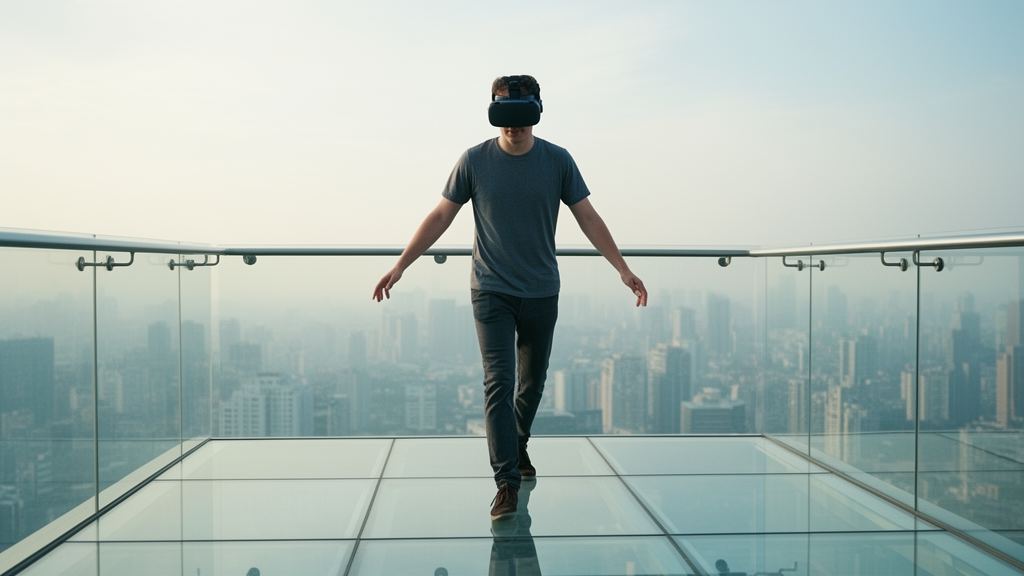
Picture yourself walking back and forth along a narrow wooden plank, the ground far below, with nothing but a headset separating you from a long fall. For eighteen able-bodied young adults, that scenario played out inside a virtual reality laboratory, and their bodies told a clear story. The moment they began walking at a simulated elevation of roughly 15 meters, their steps became slower and shorter, and they spent more time with both feet planted on the walkway. Then, over the course of a single minute, those protective patterns steadily dissolved. By the end of the exposure, their gait looked much like it had at ground level. The study, published in Frontiers in Virtual Reality, is the first to track steady-state walking changes over time within a continuous bout of virtually induced fall-related anxiety, and it offers a preliminary blueprint for turning virtual heights into a habituation-based intervention.
The clinical stakes are considerable. Up to 60 percent of older adults report concerns or anxiety about falling, and that emotional burden is not merely uncomfortable; it is associated with activity restriction and increased fall risk. Yet most current rehabilitation approaches to reducing falls remain focused on restoring physical function, such as strength and balance training, without directly targeting the worry itself. The World Falls Guidelines recommend multi-component interventions, and the researchers argue that virtual reality exposure could fill that gap by letting patients confront anxiety-provoking situations in an immersive, interactive environment that would be difficult or dangerous to recreate in the real world. Virtual reality has already been used to treat post-traumatic stress disorder, specific phobias, and generalized anxiety disorder, so extending the approach to fear of falling is a natural next step.
The researchers are careful to distinguish two related but separate constructs. Fear of falling is an acute emotional alarm triggered by a perceived threat to balance, a signal that potential harm is imminent. Fall-related anxiety, by contrast, is a more sustained state of unease about a threatening event that may or may not occur, and it manifests both somatically, as visceral sensations like butterflies in the stomach, and cognitively, as worrisome thoughts and what-if ruminations about a potential fall. Previous work has shown that virtual reality elicits levels of fear and anxiety about falling comparable to those experienced in real-world threatening environments, and that both young and older adults respond to virtual high elevations with slower gait speeds, shorter step lengths, reduced turning speed, more mental effort, and less confidence.
What remained unknown was how these emotional and motor responses adapt across time. Existing studies featured very short exposures, sometimes only four or five steps per trial across five trials, or examined less dynamic motor tasks such as standing rather than overground walking. Researchers typically reported average performance between real and virtual worlds or between different virtual environments, which makes it impossible to discern whether, and how, the cautious gait response tapers within a single exposure. Repeated exposure to physical postural threat during static balance had suggested that locomotor responses to fall-related anxiety might diminish over time, but no one had documented within-trial changes in steady-state walking under virtual threat.
To close that gap, the team recruited eighteen university students with a mean age of 24.5 years, screened by phone to exclude neurological, orthopedic, or cardiovascular conditions, excessive motion sickness, dizziness, vertigo, and uncorrected vision or hearing. Baseline testing included the Victoria Stroop test of attention and inhibition, the Trail Making Test of attention switching, the State-Trait Anxiety Inventory, the Timed-Up and Go test of mobility, and a questionnaire on visual height intolerance. Participants then donned an HTC Vive Pro head-mounted display showing a virtual walkway matched to a real path measuring 0.4 by 5.2 meters, with two ankle trackers rendering their feet as tennis shoes in the virtual scene. After a two-minute familiarization period at virtual ground level, they completed two one-minute walking trials, first at ground level and then at approximately 15 meters of elevation, pacing back and forth and turning at each end.
The order was deliberately fixed, with the low elevation always presented first, because truly randomized ordering can attenuate the anxiety response and the team wanted participants to experience the largest effects of fall-related anxiety during their first exposure to virtual heights. For the high condition, participants were seated at the start of the walkway, instructed to fixate on a visual dot, and lifted at a rate of one meter per second, matching the standard speed of an elevator. After each condition they rated cognitive anxiety, somatic anxiety, and confidence on the Mental Readiness Form-3, an eleven-point scale anchored by calm and confident at one end and worried and tense at the other, and rated mental effort on the Rating Scale of Mental Effort from 1 to 150. All ratings were completed inside the headset using a hand controller, keeping participants fully immersed. Altogether, participants spent roughly fifteen minutes in the headset, completing about 80 to 90 steps per trial at low elevation and 75 to 85 at high elevation.
The analysis pipeline was technically demanding. Custom MATLAB code extracted three-dimensional position trajectories from the head-mounted display and ankle trackers, resampled to 100 hertz to accommodate the variable sampling rates of the Vive hardware, gap-filled, and filtered with a zero-pass fourth-order Butterworth filter. Gait events were identified by plotting the absolute distance between the headset and each ankle tracker, with local minima marking toe-offs and local maxima marking heel-strikes. Turning steps were removed visually, and the first and last four steps of each trial were excluded to eliminate gait initiation and termination. From the remaining steady-state steps, the team extracted the first six steps, representing the first three gait cycles, and the last six steps, representing the last three gait cycles, for each condition. Linear mixed-effect regression then tested the effects of height and time on step length, step width, gait speed, single support time, and double support time, with effect sizes adjusted for small samples using Hedges G.
The self-reported results confirmed that the virtual heights genuinely provoked anxiety. Cognitive anxiety rose from a mean of 2.86 at low elevation to 6.71 at high elevation, somatic anxiety from 3.57 to 6.43, and mental effort from 27 to 60 on the 150-point scale, while confidence ratings worsened, all with p-values below 0.001. The gait data revealed a parallel motor signature. At ground level, participants walked with a mean step length of 0.53 meters and a mean gait speed of 0.83 meters per second; at high elevation these dropped to 0.45 meters and 0.72 meters per second, with Hedges G of 0.75 for step length and 0.55 for gait speed. Double support time, the percentage of the gait cycle with both feet on the ground, increased from 26 to 29 percent, while single support fell correspondingly. Crucially, significant height-by-time interactions emerged for step length, gait speed, single support, and double support, all p below 0.001: at high elevation, steps lengthened, walking sped up, single support increased, and double support decreased between the beginning and end of the minute, while support times showed no change at low elevation. Step width, notably, showed no effect of height at all.
The researchers interpret the shifting support times as evidence of mechanical stability habituation. Increasing double support widens the base of support and helps keep the center of mass within it, a protective strategy that provides a better representation of cautious gait than speed and step length alone, and one that is associated with older adults who are concerned about falling. Because these adaptations were largely confined to the threatening condition, and the familiarization period had already absorbed adjustments to the virtual environment itself, the team argues the changes reflect habituation to the postural threat rather than practice effects, though the small changes in step width over time at both elevations may reflect general adaptation to the experimental context. Over the minute of exposure, participants’ gait converged toward their performance at ground level, suggesting their perception of the threat diminished and walking became less consciously controlled, consistent with habituation-based models of exposure therapy in which fear declines throughout exposure.
The authors frame the findings as an important first step, not a finished intervention. One minute may not be enough exposure to produce adaptations that transfer to the real world, and re-exposure to a previously experienced perturbation is known to improve savings, the long-term retention of motor adaptations, so longer and repeated virtual exposures may be needed. The study also lacked continuous physiological anxiety measures such as electrodermal activity, did not administer a cybersickness questionnaire, and relied on a head-mounted display with a limited field of view of roughly 110 degrees, supplemented by the foot visualization. Because the cautious response observed in young adults may be adaptive, the same response could prove maladaptive in older adults, where conscious attention to gait could interfere with reacting to obstacles or cognitive demands. Future studies must test the paradigm in older adults and clinical populations with excessive fall-related anxiety, and examine whether the gait adaptations transfer to anxiety-inducing tasks outside the headset, before virtual heights can walk their way into the falls clinic.
Subject of Research: Habituation of cautious gait during one-minute exposure to virtual reality postural threat at simulated 15-meter elevation in young adults
Article Title: Walking it off: habituation of gait at virtual high elevation
Article References: Poretti, K., Ellmers, T. J., Rhea, C. K., & Raffegeau, T. (2026). Walking it off: habituation of gait at virtual high elevation. Frontiers in Virtual Reality, 7, 1949841. https://doi.org/10.3389/frvir.2026.1949841
Image Credits: AI Generated
DOI: 10.3389/frvir.2026.1949841
Keywords: Walking, habituation, gait, virtual, high, elevation, scientific research
Cite Scienmag News
Glenn Wilkins. (October 26, 2026). Virtual High Heights Loosen Anxious Gait Within Just One Minute. Scienmag. https://scienmag.com/virtual-high-heights-loosen-anxious-gait-within-just-one-minute/
Glenn Wilkins. "Virtual High Heights Loosen Anxious Gait Within Just One Minute." Scienmag, 26 October 2026, https://scienmag.com/virtual-high-heights-loosen-anxious-gait-within-just-one-minute/. Accessed 26 October 2026.
Glenn Wilkins. "Virtual High Heights Loosen Anxious Gait Within Just One Minute." Scienmag. October 26, 2026. https://scienmag.com/virtual-high-heights-loosen-anxious-gait-within-just-one-minute/


