


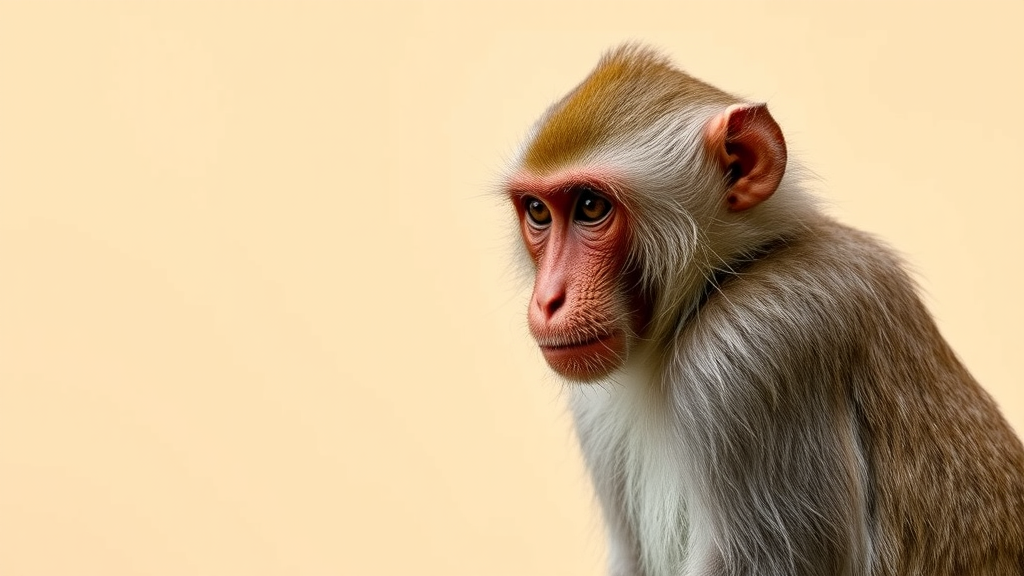
Embedded within the DNA of every crab-eating macaque lies a molecular archive of ancient viral infections, and researchers have now catalogued that archive in unprecedented detail. A team led by Wenhui Shi and Quan Shen of Jiangsu University, working with collaborators across several Chinese institutions, has carried out the first systematic, genome-wide survey of endogenous retroviruses in Macaca fascicularis, an endangered non-human primate that serves as a critical biomedical model because of its close evolutionary relationship to humans. Publishing in Molecular Genetics and Genomics, the group identified 106 relatively intact proviral loci scattered across every chromosome in the species’ highest-quality chromosome-level genome assembly, providing a reference dataset that had been conspicuously missing from primate retrovirology.
Endogenous retroviruses, or ERVs, are the fossilized remnants of retroviruses that once infected the germ-line cells of ancestral hosts. When a retrovirus inserts its provirus into the DNA of a sperm or egg cell that goes on to contribute to the next generation, the insertion can be inherited vertically, copying itself into every cell of every descendant. Over millions of years these elements accumulate mutations, deletions and recombination events, but their diagnostic architecture, including long terminal repeats flanking the core retroviral genes gag, pol and env, often remains recognizable. Because integration events are effectively permanent and their ages can be estimated, ERVs function as paleontological records of the viruses that circulated in host populations deep in evolutionary time.
To recover these viral fossils from the macaque genome, the researchers employed a homology-based, genome-wide screen designed to detect relatively intact proviruses rather than the far more numerous degraded fragments and solo long terminal repeats that litter mammalian genomes. The survey exploited the current highest-quality chromosome-level assembly available for M. fascicularis, an important practical consideration because fragmented assemblies can obscure proviral structure and misplace insertions. Candidate elements were then subjected to structural annotation and phylogenetic classification, anchoring the new macaque sequences within the broader landscape of vertebrate retroviral diversity.
Classification relied on one of the most conserved regions of the retroviral toolkit: the reverse transcriptase domain of the pol gene. Because this enzyme performs the essential step of copying viral RNA into DNA, its sequence is under strong functional constraint and retains enough phylogenetic signal to place divergent elements into their correct lineages. Building multiple alignments of the recovered reverse transcriptase domains and reconstructing their evolutionary relationships, the team found that the macaque proviruses fall into betaretroviral, gammaretroviral and unclassified lineages, with the beta and gamma groups clearly predominating. This pattern mirrors what has been observed in many other mammalian genomes, where betaretroviruses and gammaretroviruses have historically been prolific colonizers of germ lines.
The compositional result carries evolutionary weight. Betaretroviruses, relatives of modern mouse mammary tumor virus and the simian retrovirus SERV, and gammaretroviruses, relatives of murine leukemia virus, differ in their envelope biology, host receptor usage and genomic preferences. A predominance of both classes suggests that the macaque lineage experienced repeated, independent waves of retroviral germline invasion rather than a single dominant radiation. Consistent with that interpretation, dating based on the divergence between the paired long terminal repeats of each provirus, which are identical at the moment of integration and accumulate mutations thereafter, indicated that the 106 loci span a broad range of integration ages, recording multiple distinct epochs of retroviral activity in the species’ ancestry.
The macaque proviruses are also distributed across all chromosomes, a pattern consistent with the idea that integration sites reflect a combination of retroviral target-site preferences and post-insertion forces such as selection, recombination and random genetic drift. Studies in human and mouse have shown that different retroviral genera favor different genomic neighborhoods, with some elements preferentially accumulating in gene-poor regions while others insert near transcription units. The chromosome-wide coverage reported for M. fascicularis means that the new dataset can support analyses of integration preference in a primate genome at a resolution previously unavailable for this species.
The biomedical significance of the work extends beyond evolutionary curiosity. The crab-eating macaque, also known as the cynomolgus macaque, is one of the most widely used primate models in drug development, infectious disease research and transplantation studies, and its endangered status in the wild makes the genomic record it carries all the more valuable to document. ERVs in macaques are directly relevant to laboratory safety as well: previous work has identified and characterized simian endogenous retroviruses in captive macaque populations in Indonesia, raising questions about how these elements behave in breeding colonies. A curated, high-confidence catalog of intact proviral loci gives researchers a framework for tracking ERV expression, recombination and potential co-option in an animal model whose transcriptomes are routinely interrogated.
The broader context of ERV biology reinforces that relevance. In humans, endogenous retroviral sequences have been co-opted for essential functions, most famously the syncytin genes derived from retroviral envelopes that mediate placental cell fusion, and ERV-derived regulatory sequences now contribute to innate immune gene networks. Deregulated ERV expression has also been implicated in a growing list of pathologies, including systemic lupus erythematosus, Parkinson’s disease, neuronal aging and cancer immunotherapy responses, where translated retroviral products can provoke interferon signaling or serve as tumor-associated antigens. Establishing which proviruses are intact in the macaque genome is therefore a prerequisite for asking whether analogous host-virus co-option and immune interactions operate in this model species.
The authors are careful to delineate the scope of their catalog. Because the screen targeted relatively intact proviruses, the dataset deliberately excludes the vastly more abundant degraded ERV fragments and solo long terminal repeats, which form when recombination between the two LTRs of an integrated provirus excises the internal sequence. Those eroded elements represent older and numerically dominant chapters of the retroviral record, and their omission means the 106 loci described here constitute a conservative, high-confidence floor rather than a complete inventory of retroviral genetic material in the macaque genome. Even so, the team notes that the curated set provides a reference resource for investigating the evolutionary history and genomic impact of preserved proviruses in an endangered primate.
The study also joins a rapidly expanding comparative effort. Recent surveys have uncovered endogenous retroviruses in red pandas, ducks and primitive ruminants, and genome-mining approaches have shown that retroviruses have pervasively invaded vertebrate genomes across the tree of life. By adding a systematic account for a close human relative, the macaque analysis helps triangulate which retroviral lineages circulated in the common ancestors of Old World monkeys and apes, and which invasions were lineage-specific. The genome assembly data underlying the work are publicly available through the National Center for Biotechnology Information, and the researchers suggest their dataset will serve as a durable foundation for exploring how viral inheritance has shaped, and continues to shape, the genome of one of biomedical science’s most important animal models.
Subject of Research: Discovery and evolutionary characterization of endogenous retrovirus proviruses in the genome of the crab-eating macaque (Macaca fascicularis)
Article Title: Discovery and evolution of endogenous retroviruses in the genome of crab-eating macaque (Macaca fascicularis)
Article References: Shi, W., Mao, L., Chen, Y., Alfred, N., Fu, Y., Bao, Y., Wang, X., Liu, Y., Yang, S., Ji, L., Zhou, C., Xu, J., Li, W., Shan, T., Wang, J., Zhang, W., & Shen, Q. (2026). Discovery and evolution of endogenous retroviruses in the genome of crab-eating macaque (Macaca fascicularis). Molecular Genetics and Genomics, 301(1), Article 189. https://doi.org/10.1007/s00438-026-02518-9
Image Credits: AI Generated
DOI: 10.1007/s00438-026-02518-9
Keywords: endogenous retroviruses, crab-eating macaque, Macaca fascicularis, retrovirus, genome evolution, provirus, phylogenetic analysis, long terminal repeats, reverse transcriptase, genomics, non-human primate model, viral fossils
Cite Scienmag News
Juliet Wilcox. (September 12, 2026). Viral Fossils Reveal Waves of Ancient Retroviruses in the Crab-Eating Macaque Genome. Scienmag. https://scienmag.com/viral-fossils-reveal-waves-of-ancient-retroviruses-in-the-crab-eating-macaque-genome/
Juliet Wilcox. "Viral Fossils Reveal Waves of Ancient Retroviruses in the Crab-Eating Macaque Genome." Scienmag, 12 September 2026, https://scienmag.com/viral-fossils-reveal-waves-of-ancient-retroviruses-in-the-crab-eating-macaque-genome/. Accessed 5 October 2026.
Juliet Wilcox. "Viral Fossils Reveal Waves of Ancient Retroviruses in the Crab-Eating Macaque Genome." Scienmag. September 12, 2026. https://scienmag.com/viral-fossils-reveal-waves-of-ancient-retroviruses-in-the-crab-eating-macaque-genome/


