


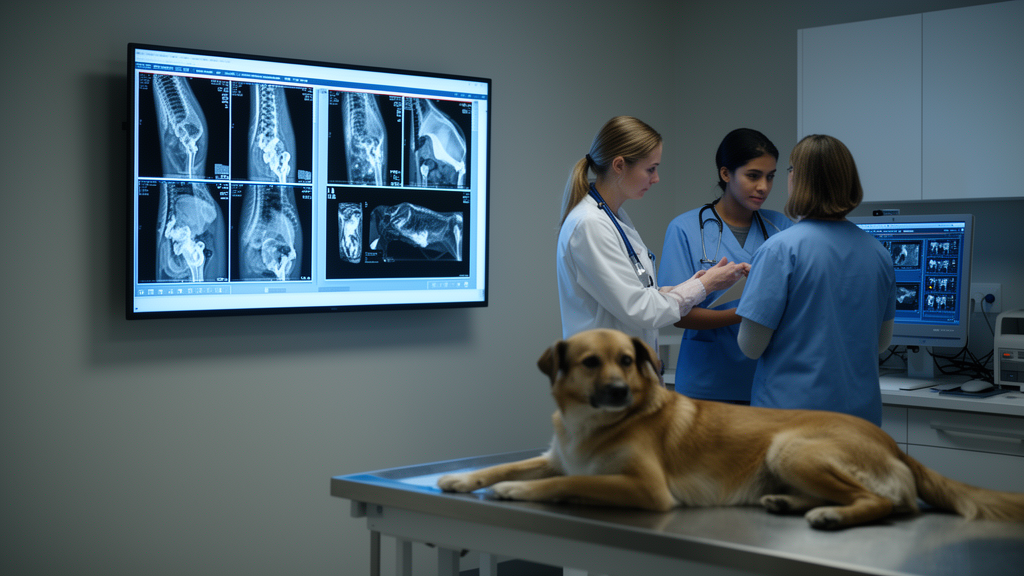
Veterinary diagnostic imaging faces a measurement problem: radiologists, general practitioners and other observers can reach different conclusions from the same images, but the causes and consequences of those differences remain only partly understood. A perspective in Frontiers in Veterinary Science argues that diagnostic error should become a distinct field of scientific investigation, with observer performance studied as systematically as diagnostic accuracy, image quality and technical quality. The authors, Silvia Burti, Alessandro Zotti, Simon Coghlan and Tommaso Banzato, propose four connected priorities: reliable measurement of diagnostic performance, investigation of the mechanisms behind errors, evaluation of interventions and development of collaborative research networks. Their proposal is not based on a new trial showing improved patient outcomes, but on an assessment of fragmented veterinary evidence and methods already established in human radiology.
The distinction matters because disagreement is not the same as error. A discrepancy occurs when two interpretations differ, whereas a diagnostic error requires an incorrect interpretation judged against an appropriate reference standard. Veterinary researchers have documented substantial inter-observer variability, examined errors in educational settings and studied factors associated with radiographic interpretation, but consensus reports or second-reader agreement cannot establish that an answer is correct if both readers share the same mistake. Suitable reference standards may include histopathology, cytology, surgical findings, laboratory or microbiological testing, follow-up, repeat imaging or alternative modalities, depending on the clinical question. In practice, these sources may be unavailable, incomplete or inaccessible to the original interpreter, limiting both assessment and feedback.
Human radiology offers a model for moving beyond counts of conflicting reports. Research over several decades established that image interpretation is a measurable process shaped by perception, cognition, environment and workflow, rather than simply a test of individual knowledge. A central distinction separates perceptual errors, in which a visible abnormality is not detected, from cognitive errors, in which a detected finding is interpreted incorrectly. Observer studies, eye tracking, search-pattern analysis, workload experiments and secondary-interpretation studies have shown how fatigue, interruptions, time pressure, case complexity, cognitive overload and organizational conditions can affect detection. Familiar mechanisms such as satisfaction of search, anchoring, framing and inattentional blindness can also alter judgments. The veterinary literature contains early work on some of these mechanisms, including satisfaction of search, visual observation skills and diagnostic reasoning, but the authors say these efforts have not yet formed an integrated observer-performance field.
Veterine practice introduces difficulties that make direct transplantation of human methods insufficient. Clinical histories are mediated through animal owners and referring veterinarians, so information reaching a radiologist may be incomplete, heterogeneous or already shaped by another person’s interpretation. The source notes that pertinent history and signalment improved diagnostic accuracy in canine thoracic radiography, illustrating the potential influence of contextual information. Reliable measurement is also complicated by differences among first-opinion clinics, referral hospitals, academic institutions and commercial teleradiology services. These environments vary in case complexity, workload, access to information and subspecialization, while acquisition, transmission, documentation and quality-control problems can affect the images available for interpretation. Species diversity, non-verbal patients and the rapid growth of remote reporting add further layers of variation that a standardized study protocol must account for.
Against that background, the perspective argues that veterinary imaging should adopt a “just culture” approach to error analysis. This model, drawn from other safety-critical fields, balances professional accountability with the need to understand why errors occur. Reckless behavior, in which a practitioner consciously disregards risk, may warrant sanction; at-risk behavior, such as failing to recognize a real danger, may call for coaching; and human error, defined as a mistake without recklessness, generally should not be treated as grounds for punishment. The approach is not an absence of accountability. Negligent or grossly incompetent conduct that risks serious harm may still require an appropriate response. Its purpose is to examine contributory factors, encourage disclosure and prevent recurrence, especially because punitive environments can suppress reporting and create psychological or professional harm for practitioners.
As the first research priority, the authors call for robust, reproducible and disease-appropriate methods for measuring diagnostic performance. Studies need consistent definitions of error, valid reference standards, transparent performance metrics and reporting practices that permit comparison across institutions, modalities and observer groups. Structured institutional discrepancy review with predefined categories could provide a practical foundation for monitoring performance over time. Double-reading and consensus protocols remain useful for identifying disagreement, but the perspective emphasizes that they cannot replace a reference standard when the question is diagnostic correctness. Standardized measures would allow the field to move from isolated reports toward benchmarks that can support quality assurance and reveal meaningful differences between readers or practice environments.
The second priority is to determine why errors occur. Multicentre observer studies could quantify the relative influence of perception, cognitive bias, experience, fatigue, workload, workflow and environmental conditions across first-opinion practices, referral centers and teleradiology services. Such work would need to avoid treating a discrepancy as an isolated outcome and should examine the conditions in which each error arises. Artificial-intelligence decision support adds a new research question: AI may improve detection or prompt observers to reconsider a judgment, but it may also encourage automation bias or over-reliance. Conversely, clinicians may inappropriately reject useful AI advice. Comparisons of unaided and AI-assisted interpretation, conducted with adequate domain expertise and human oversight, could clarify when computational support improves performance and when it creates new error pathways. The authors also propose studying how discrepancy reporting and nonpunitive feedback affect willingness to report mistakes, learning, practitioner wellbeing and performance.
The third priority is to test interventions rather than assume that education or technology will help. Candidate measures include educational programs, structured feedback, regular discrepancy-review meetings, quality-assurance systems and decision-support tools. Their effects should be assessed under routine clinical conditions to determine whether improvements seen in controlled settings persist in practice. AI should complement rather than replace diagnostic expertise: a user without enough knowledge to assess a finding independently may also struggle to recognize an incorrect AI recommendation. This transition from descriptive observer studies to interventional studies is necessary if diagnostic-error research is to produce measurable benefits in education and quality assurance. The perspective does not establish that any particular intervention improves veterinary care; it identifies where prospective evaluation is needed.
The fourth priority is a collaborative network spanning veterinary institutions, referral centers, general practices, teleradiology services and academic centers. Shared protocols for recording and classifying errors, common performance metrics, benchmarking initiatives and harmonized datasets could make multicentre studies more generalizable and create resources for future AI research. The authors also argue for multidisciplinary participation from social science, veterinary ethics, education, human factors and human-computer interaction, because cognitive, organizational, ethical and technological determinants cannot be addressed by imaging studies alone. Academic institutions are proposed as coordinating hubs capable of bringing together diverse clinical settings. This perspective ultimately presents diagnostic error as an inevitable but measurable feature of veterinary imaging. By defining methods, examining mechanisms, evaluating responses and coordinating evidence, the authors argue that the field could move beyond individual failure toward systematic learning intended to improve diagnostic performance, patient care and animal welfare, although the clinical benefits of that transition still require testing.
Subject of Research: Diagnostic error and observer performance in veterinary diagnostic imaging
Article Title: Diagnostic error in veterinary imaging: an underexplored field and future directions for observer performance research
Article References: Burti, S., Zotti, A., Coghlan, S., & Banzato, T. (2026). Diagnostic error in veterinary imaging: an underexplored field and future directions for observer performance research. Frontiers in Veterinary Science, 13, Article 1978054. https://doi.org/10.3389/fvets.2026.1978054
Image Credits: AI Generated
DOI: 10.3389/fvets.2026.1978054
Keywords: veterinary imaging, diagnostic error, observer performance, radiology, veterinary medicine, human factors, quality assurance, artificial intelligence, teleradiology, just culture, Diagnostic, error
Cite Scienmag News
William Thompson. (October 21, 2026). Veterinary imaging diagnostic errors remain poorly studied, researchers argue. Scienmag. https://scienmag.com/veterinary-imaging-diagnostic-errors-remain-poorly-studied-researchers-argue/
William Thompson. "Veterinary imaging diagnostic errors remain poorly studied, researchers argue." Scienmag, 21 October 2026, https://scienmag.com/veterinary-imaging-diagnostic-errors-remain-poorly-studied-researchers-argue/. Accessed 21 October 2026.
William Thompson. "Veterinary imaging diagnostic errors remain poorly studied, researchers argue." Scienmag. October 21, 2026. https://scienmag.com/veterinary-imaging-diagnostic-errors-remain-poorly-studied-researchers-argue/


