


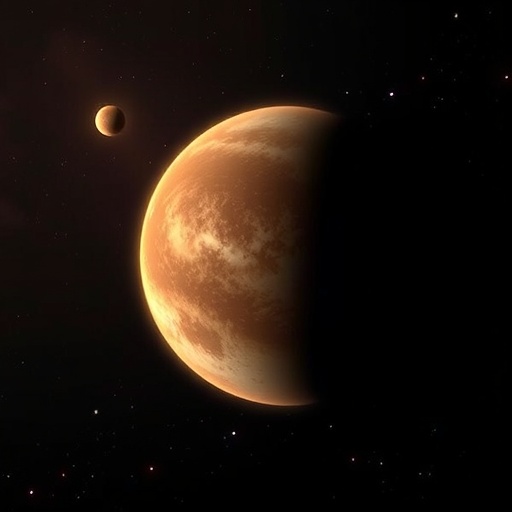
Venus, our enigmatic neighboring planet, has long intrigued scientists due to its dense cloud cover and extreme atmospheric conditions. A recent groundbreaking study spearheaded by researchers at the University of Tokyo has unveiled the origins of a massive atmospheric wave on Venus, spanning an awe-inspiring 6,000 kilometers. This unprecedented discovery points to the existence of a planetary-scale hydraulic jump, a complex fluid dynamic phenomenon rarely seen on such a scale within our solar system.
For decades, observations have shown that Venus is perpetually shrouded in thick clouds composed mainly of sulfuric acid. These clouds continuously swirl around the planet, creating a harsh and unyielding environment. Amid this almost constant haze, Venus exhibits a curious atmospheric feature known as superrotation, where its upper atmosphere spins approximately 60 times faster than the planet’s own rotation period. This phenomenon complicates our understanding of Venusian atmospheric dynamics and has left many questions unanswered.
In 2016, the Japanese spacecraft Akatsuki, equipped with a near-infrared camera, captured compelling images of the planet’s cloud tops, revealing a distinct wavelike feature moving along the equator. This atmospheric disturbance steadily travels around the planet, forming a dense, dark line in the cloud formations. However, until now, the mechanisms driving this enormous wave remained shrouded in mystery, baffling planetary scientists and atmospheric modelers worldwide.
The recent research employs advanced numerical simulations and microphysical modeling to decode this enigmatic phenomenon. The team led by Professor Takeshi Imamura demonstrated that the wave originates from a hydraulic jump in Venus’s lower cloud layer. A hydraulic jump occurs when a flowing fluid suddenly decelerates and transitions from a shallow, fast-moving state to a deeper, slower regime. This well-understood concept on Earth—commonly observed as the abrupt change in water flow in kitchen sinks—is on a planetary scale within Venus’s atmosphere.
On Venus, a Kelvin wave, a large-scale atmospheric wave moving eastward, undergoes rapid instability in the lower to middle cloud layers. This instability abruptly slows down the otherwise fast-moving air, creating a strong localized updraft. This updraft transports sulfuric acid vapor upwards to higher altitudes, where it condenses, forming the conspicuous, dense cloud line that encircles the globe. This immense hydraulic jump links horizontal atmospheric flow with vigorous vertical motion, an interaction scarcely observed in planetary atmospheres until now.
This discovery is transformative not only for understanding Venus’s atmospheric dynamics but also for how we model planetary atmospheres. Previously, global circulation models (GCMs) of Venus did not incorporate hydraulic jumps, limiting their ability to simulate complex atmospheric phenomena accurately. Professor Imamura emphasizes that integrating these fluid dynamic processes into more comprehensive climate simulations will require immense computational resources but is vital to deepen our understanding of Venus’s meteorology and climate patterns.
Moreover, the implications of this research extend beyond Venus. Given the physics underlying hydraulic jumps, similar mechanisms might be at play on Mars or even within certain layers of Earth’s and other planetary atmospheres under specific conditions. Such processes could influence cloud formation, atmospheric circulation, and weather systems throughout the solar system, reshaping our broader understanding of planetary atmospheres.
Venus’s three cloud layers—the lower, middle, and upper—pose substantial challenges for observational and theoretical studies due to their dynamic and chemical properties. The newly discovered hydraulic jump primarily affects the lower and middle layers, previously less understood due to observational difficulties. This research highlights the exciting prospect of coupling large-scale horizontal waves with localized vertical motions, offering a holistic view of atmospheric turbulence and energy transfer on Venus.
The simulation of this planetary-scale hydraulic jump used a two-pronged modeling approach: a fluid dynamic numerical model to capture the wave motion and instabilities, and a microphysical box model to track how sulfuric acid vapor behaves as it rises and condenses into clouds. The successful reproduction of the Akatsuki observations validates the model and confirms the hydraulic jump as the key driver behind the massive cloud front.
Importantly, the study reveals that the hydraulic jump helps maintain Venus’s characteristic superrotation. By connecting localized vertical winds to global horizontal flow, this mechanism facilitates angular momentum redistribution within the atmosphere. Understanding such detailed energy exchanges is essential for developing accurate climate models and can inform future exploratory missions aimed at probing Venus’s atmospheric conditions.
Looking ahead, the research team plans to incorporate the hydraulic jump into more comprehensive, coupled atmospheric models of Venus. These models would encompass additional atmospheric processes such as radiative transfer, chemical interactions, and smaller-scale turbulence. However, current computational limits pose significant challenges, requiring advances in high-performance computing to simulate such intricate flows with adequate resolution.
The revelation of this planetary-scale hydraulic jump on Venus exemplifies how cutting-edge simulations combined with spaceborne observations can unravel long-standing planetary mysteries. As spacecraft continue to explore our solar system, these integrated approaches will be essential for decoding the atmospheres of other worlds, paving the way for more informed and successful planetary exploration.
This milestone study adds a vital piece to the puzzle of how planetary atmospheres behave under extreme conditions and underscores the dynamic complexity hidden within Venus’s seemingly perpetual clouds. By unveiling this colossal hydraulic jump, researchers have opened a new window into atmospheric science, with implications reaching far beyond Venus and deep into the mechanics governing planetary weather systems across the cosmos.
News Publication Date:
24-Apr-2026
References:
Takeshi Imamura, Yasumitsu Maejima, Ko-ichiro Sugiyama, Takehiko Satoh, Javier Peralta, Kevin McGouldrick, Takeshi Horinouchi, Kohei Ikeda, “A planetary-scale hydraulic jump driving Venus’ cloud front”. Journal of Geophysical Research: Planets. April 24 2026. DOI: 10.1029/2026JE009672
Keywords
Venus atmosphere, hydraulic jump, atmospheric waves, superrotation, sulfuric acid clouds, Akatsuki mission, fluid dynamics, Kelvin wave, planetary climate, numerical simulation, cloud formation, planetary science
Cite Scienmag News
Russell Cooper. (May 8, 2026). Venus’ Atmosphere Pulses and Ripples: New Discoveries Revealed. Scienmag. https://scienmag.com/venus-atmosphere-pulses-and-ripples-new-discoveries-revealed/
Russell Cooper. "Venus’ Atmosphere Pulses and Ripples: New Discoveries Revealed." Scienmag, 8 May 2026, https://scienmag.com/venus-atmosphere-pulses-and-ripples-new-discoveries-revealed/. Accessed 3 September 2026.
Russell Cooper. "Venus’ Atmosphere Pulses and Ripples: New Discoveries Revealed." Scienmag. May 8, 2026. https://scienmag.com/venus-atmosphere-pulses-and-ripples-new-discoveries-revealed/


