


Mechanical ventilators are usually judged by a single number: mechanical power, the total energetic load they impose on a patient’s respiratory system every minute. But a new bench study argues that this global figure can hide more than it reveals. Using a hybrid respiratory simulator and a prototype ventilator, researchers in Poland showed that three different ventilation modes can deliver similar total inspiratory power while distributing that energy in markedly different ways between the elastic and resistive components of breathing. The work, published in Annals of Biomedical Engineering, suggests that the internal structure of inspiratory energy transfer, not just its total, may matter when comparing ventilatory strategies.
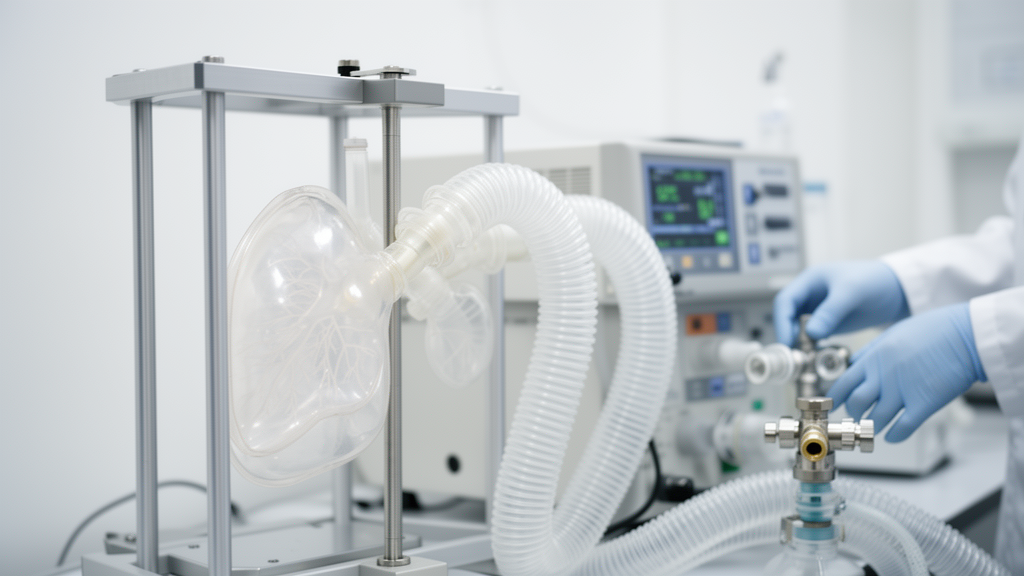
The study, led by Barbara Stankiewicz and colleagues, was an experimental bench investigation rather than a clinical trial. The team coupled a hybrid respiratory simulator developed at the Institute of Biocybernetics and Biomedical Engineering of the Polish Academy of Sciences with a ventilator they designed and built themselves. The simulator could reproduce predefined respiratory system mechanics under standardized, repeatable conditions, recording airway pressure and flow signals during each simulated breath. Crucially, the simulated respiratory system was passive: no respiratory-muscle pressure source was activated, and compliance and resistance were held fixed within each experimental condition, so only the ventilator’s output varied.
Four respiratory system conditions were simulated: normal adult mechanics, defined by a compliance of 60 mL/cmH2O, and three ARDS-like states of progressively worsening elastic impairment, with compliance reduced stepwise to 50, 40, and 30 mL/cmH2O. Resistance was deliberately kept constant at 10 cmH2O/L/s across all conditions. The authors stress that this stepwise reduction was intended to create reproducible mechanical phenotypes rather than to reproduce the full clinical spectrum of ARDS. The adult patient model was set to a body weight of 65 to 70 kg, and minute ventilation was held at approximately 6.6 L/min across all settings, with an inspiratory-to-expiratory ratio of 1:2.
Three ventilation modes were compared at respiratory rates of 10, 15, and 20 breaths per minute. Volume-controlled ventilation, in which tidal volume is the controlled variable, and pressure-controlled ventilation, in which inspiratory pressure is controlled, served as the conventional reference modes. The third was an investigational mechanical power-controlled mode, in which the ventilator adjusts the inspiratory pressure and flow trajectory to deliver a target tidal volume while constraining instantaneous inspiratory mechanical power and airway pressure. The optimization relied on a lumped resistance-compliance model and dynamic programming, seeking to minimize inspiratory time within the prescribed energetic and pressure limits. The authors emphasize that this mode was evaluated as an experimental control strategy, not as a clinically proven protective approach.
The experimental design was a complete factorial structure: four lung conditions, three respiratory rates, and three ventilation modes yielded 36 unique settings, each repeated ten times for a total of 360 experimental runs. No formal a priori power analysis was performed; the sample size followed the pre-specified design, with repetitions used to account for technical repeatability. From the recorded pressure and flow signals, the researchers calculated four component-level variables for each condition: maximal and mean elastic inspiratory mechanical power, and maximal and mean resistive inspiratory mechanical power, all expressed in joules per minute.
Because normality diagnostics showed departures from normality, the team used rank-based statistics. Friedman’s repeated-measures ANOVA tests compared the three ventilation modes across all simulated conditions, with Kendall’s W as the effect size measure and Wilcoxon signed-rank tests with Bonferroni correction for post hoc contrasts. Ventilation mode significantly affected every analyzed power component. The mode effect was large for maximal and mean resistive power and for mean elastic power, with Kendall’s W values of 1.000, 0.992, and 0.968 respectively, and moderate for maximal elastic power, at 0.418.
The headline result concerned maximal elastic power. Mechanical power-controlled ventilation produced the lowest pooled value of the three modes, at 20.50 plus or minus 5.61 J/min, compared with 24.45 plus or minus 8.02 J/min for volume-controlled and 27.09 plus or minus 16.74 J/min for pressure-controlled ventilation. That corresponded to a 16.2 percent reduction relative to volume-controlled ventilation and a 24.3 percent reduction relative to pressure-controlled ventilation, both statistically significant. However, this advantage was not uniform. It was most evident at lower respiratory rates and under more severe elastic impairment. At 10 breaths per minute, the mechanical power-controlled mode generated lower maximal elastic power than pressure-controlled mode in all simulated lung conditions, with the relative difference growing from 10.4 percent in normal mechanics to 54.3 percent in severe impairment. By 20 breaths per minute, the between-mode differences had largely converged, with the power-controlled mode remaining lower only in the severe ARDS-like condition.
The resistive component told a different and more stable story. Pressure-controlled ventilation produced the highest resistive power, volume-controlled ventilation the lowest, and the energy-targeted mode consistently occupied an intermediate position. Pooled maximal resistive power was 34.20 plus or minus 14.55 J/min under pressure control, 17.22 plus or minus 2.81 J/min under power control, and 7.72 plus or minus 0.44 J/min under volume control. When compliance was progressively reduced, maximal elastic power rose in all modes, but by very different amounts: a 191.8 percent increase under pressure control, from 15.62 to 45.57 J/min, versus increases of 76.7 percent under volume control and 70.4 percent under power control. The gap between the energy-targeted and pressure-controlled modes widened as mechanics worsened, reaching 41.3 percent in severe impairment when averaged across respiratory rates.
The authors are careful about what these numbers do and do not mean. The elastic and resistive components are global analytical descriptors of mechanical loading, not direct measurements of regional tissue stress or injury. The elastic term represents the rate of potential energy storage associated with volume-dependent deformation of the modeled respiratory system, while the resistive term represents flow-dependent energy dissipation. The analysis was also restricted to mechanical energy transfer and did not constitute a complete thermodynamic balance, since heat transfer and thermal-state changes were not modeled. Because the hybrid model was passive, without respiratory-muscle pressure or neural feedback, the component-level analysis should be read as a model-based description of ventilator-to-respiratory-system energy transfer rather than anything sensed or regulated by a biological control system.
Limitations are explicit. Resistance was intentionally held constant while compliance fell, an idealized and mechanically decoupled representation of ARDS-like impairment; in clinical ARDS, reduced compliance may coexist with elevated resistance that varies with airway closure, lung volume, and PEEP. The model did not reproduce regional time-constant inequalities, recruitment-derecruitment, nonlinear tissue behavior, or patient-ventilator interaction, and the study assessed only global airway-opening signals, not regional power distribution within the lung. The authors also note that the study does not establish whether modulating the elastic-resistive balance is protective; it provides mechanistic evidence that power-controlled ventilation can alter the structure of inspiratory energy transfer. Whether such modulation translates into clinically meaningful protection will require further experimental, translational, and ultimately clinical investigation. Within those boundaries, the message stands: similar total mechanical power values should not automatically be interpreted as mechanically equivalent, and strategies aimed at reducing ventilator-induced lung injury may need to consider how inspiratory energy is distributed, not merely how much of it is delivered.
Subject of Research: Elastic and resistive partitioning of inspiratory mechanical power during conventional and energy-targeted ventilation in a hybrid respiratory simulator
Article Title: Model-Based Elastic–Resistive Partitioning of Inspiratory Mechanical Power During Conventional and Energy-Targeted Ventilation in a Hybrid Respiratory Simulator
Article References: Stankiewicz, B., Darowski, M., Pasledni, R., Pałko, K. J., Kozarski, M., Zieliński, K., & Urbankowski, T. (2026). Model-Based Elastic–Resistive Partitioning of Inspiratory Mechanical Power During Conventional and Energy-Targeted Ventilation in a Hybrid Respiratory Simulator. Annals of Biomedical Engineering. https://doi.org/10.1007/s10439-026-04414-0
Image Credits: AI Generated
DOI: 10.1007/s10439-026-04414-0
Keywords: mechanical ventilation, mechanical power, elastic power, resistive power, ARDS, respiratory simulator, ventilation modes, bench study, energy-targeted ventilation, respiratory mechanics, ventilator-induced lung injury, biomedical engineering
Cite Scienmag News
Denise Maddox. (October 27, 2026). Ventilation Modes Split Breathing Energy Differently, Bench Simulator Study Finds. Scienmag. https://scienmag.com/ventilation-modes-split-breathing-energy-differently-bench-simulator-study-finds/
Denise Maddox. "Ventilation Modes Split Breathing Energy Differently, Bench Simulator Study Finds." Scienmag, 27 October 2026, https://scienmag.com/ventilation-modes-split-breathing-energy-differently-bench-simulator-study-finds/. Accessed 27 October 2026.
Denise Maddox. "Ventilation Modes Split Breathing Energy Differently, Bench Simulator Study Finds." Scienmag. October 27, 2026. https://scienmag.com/ventilation-modes-split-breathing-energy-differently-bench-simulator-study-finds/


