


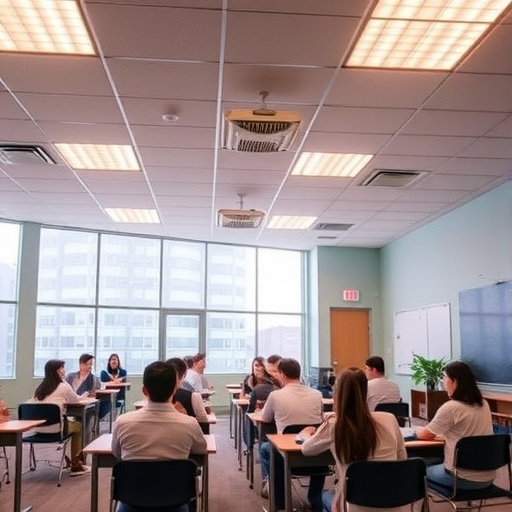
As the world slowly recovers from the grips of the COVID-19 pandemic, one critical insight emerging from public health and environmental science circles is the paramount importance of indoor air quality, not only for infection control but also for cognitive well-being. A groundbreaking new study published in the Journal of Exposure Science and Environmental Epidemiology thrusts ventilation back into the spotlight by revealing compelling links between enhanced outdoor air ventilation in classrooms and improved cognitive performance among university students. The research, led by Dedesko, Pendleton, Young, and colleagues, goes beyond the well-trodden conversation of virus transmission to explore the profound effects of indoor air exposures on mental acuity and learning outcomes.
Indoor air quality, traditionally overshadowed by outdoor pollution concerns, has long presented a complex challenge due to the multitude of chemical, biological, and physical agents circulating in enclosed spaces. While ventilation standards set forth by building codes are designed with a baseline of health and comfort in mind, the COVID-19 pandemic exposed serious limitations in these codes, particularly regarding their capacity to mitigate airborne viral spread. In response, health authorities recommended substantial increases in ventilation rates and improved filtration mechanisms, a move primarily intended to reduce infection risks. However, as this new research reveals, the benefits of enhanced ventilation extend far beyond pathogen control, touching upon fundamental aspects of cognitive function rarely considered in building design.
The study involved a rigorous examination of indoor air parameters and cognitive testing among university students attending classes conducted in spaces with elevated ventilation rates specifically introduced during the pandemic. By comparing cognitive test scores with measurements of volatile organic compounds (VOCs), carbon dioxide (CO2) levels, particulate matter, and other indoor pollutants, the researchers found statistically significant associations. Notably, students exposed to classrooms with higher rates of outdoor air exchange demonstrated better performance on complex cognitive tasks including memory recall, attention, and problem-solving when contrasted with peers in less ventilated environments.
At the heart of these findings lies the role of CO2 as a proxy indicator for indoor air quality and ventilation efficacy. Elevated indoor CO2 concentrations, often a result of insufficient outdoor air delivery, have been linked with diminished cognitive function due to reduced oxygen availability and accumulation of human bioeffluents that may cause discomfort or neuroinflammatory responses. By augmenting ventilation rates beyond traditional code minimums, the study demonstrates a direct reduction in indoor CO2 levels, thereby fostering an environment conducive to heightened cognitive alertness and mental clarity.
Beyond CO2, the research team meticulously tracked other indoor air constituents known to negatively impact neurological and respiratory health. Volatile organic compounds—emitted from cleaning agents, building materials, and occupant activities—present hazards that often accumulate indoors due to limited air turnover. The increased ventilation effectively dilutes these compounds, reducing exposure and potentially alleviating subclinical effects on brain function. This insight opens new avenues for considering indoor air management strategies as integral components of academic performance optimization and occupational health standards.
These revelations carry profound implications for educational environments, prompting a reevaluation of ventilation protocols and building design criteria in schools and universities worldwide. Traditionally, HVAC systems have prioritized thermal comfort, safety, and energy efficiency, yet this study underscores the necessity to elevate cognitive health as a primary design objective. The integration of enhanced ventilation not only supports immediate health benefits but could also translate to tangible gains in learning efficiency, retention, and overall academic success.
The timing of the study is particularly salient, emerging amidst a global reckoning with indoor environment quality spurred by COVID-19. While pandemic-era changes initially focused on infection control, this research advocates for maintaining and refining such improvements to serve dual purposes: safeguarding health and bolstering cognitive function. It challenges policymakers, architects, and engineers to reconsider what constitutes adequate ventilation standards in the post-pandemic era, promoting a holistic approach that balances pathogen mitigation with cognitive ergonomics.
Technologically, the findings inspire innovations in HVAC system design that prioritize dynamic ventilation control responsive to occupancy and pollutant levels, reducing energy consumption without sacrificing air quality. The study’s data-driven methodology supports the development of smart ventilation systems linked to real-time sensors for CO2 and VOC monitoring, enabling adaptive responses that optimize indoor environments for enhanced cognitive performance. This approach signals a new frontier where environmental engineering converges with neuroscience to elevate human productivity.
Moreover, the implications extend beyond academic settings to workplace environments, healthcare facilities, and residential buildings. As knowledge workers increasingly recognize the influence of environmental factors on mental acuity and fatigue, employers may find value in investing in improved ventilation systems as a practical strategy to enhance employee well-being and performance. This aligns with broader trends toward creating “healthy buildings” that integrate air quality considerations with psychological and physiological health outcomes.
The potential macroeconomic ramifications are equally notable. Improved cognitive function across populations could influence educational attainment, labor productivity, and even healthcare costs related to neurocognitive decline or respiratory diseases aggravated by poor indoor air. By quantifying the relationship between air quality and cognitive scores, this research lays groundwork for policy frameworks that assign explicit economic value to investments in ventilation infrastructure and indoor environmental quality management.
Crucially, the research also illuminates disparities in indoor air exposure, which often correlate with socioeconomic status and building infrastructure quality. Enhancing ventilation in environments serving vulnerable populations—such as underfunded schools or overcrowded apartments—could serve as an environmental justice intervention with wide-reaching educational and health benefits. The study thereby engages with broader societal debates regarding equitable access to healthy indoor environments.
As the authors acknowledge, while the observed associations are compelling, further research is needed to delineate causal mechanisms linking specific indoor pollutants with neurophysiological changes. Longitudinal studies and randomized controlled trials will be essential to validate these findings and guide optimized ventilation strategies tailored to diverse building typologies and occupant profiles. Nevertheless, the clear signal highlighted in this study represents a paradigm shift in the recognition of air quality as a significant determinant of cognitive health.
In summary, this study spearheaded by Dedesko and colleagues represents a landmark advancement elucidating how enhanced outdoor air ventilation in classrooms significantly benefits cognitive performance beyond pandemic-related infection control. It challenges entrenched assumptions about indoor air standards and sets the stage for interdisciplinary collaboration across environmental science, neuroscience, architecture, and public health. As societies seek to build back better in the post-COVID world, embracing superior indoor air quality may prove one of the most accessible yet transformative steps toward fostering healthier, smarter, and more resilient communities.
Cite Scienmag News
Russell Cooper. (May 22, 2025). Ventilation Boosts Classroom Air Quality, Enhances Student Cognition. Scienmag. https://scienmag.com/ventilation-boosts-classroom-air-quality-enhances-student-cognition/
Russell Cooper. "Ventilation Boosts Classroom Air Quality, Enhances Student Cognition." Scienmag, 22 May 2025, https://scienmag.com/ventilation-boosts-classroom-air-quality-enhances-student-cognition/. Accessed 9 September 2026.
Russell Cooper. "Ventilation Boosts Classroom Air Quality, Enhances Student Cognition." Scienmag. May 22, 2025. https://scienmag.com/ventilation-boosts-classroom-air-quality-enhances-student-cognition/


