


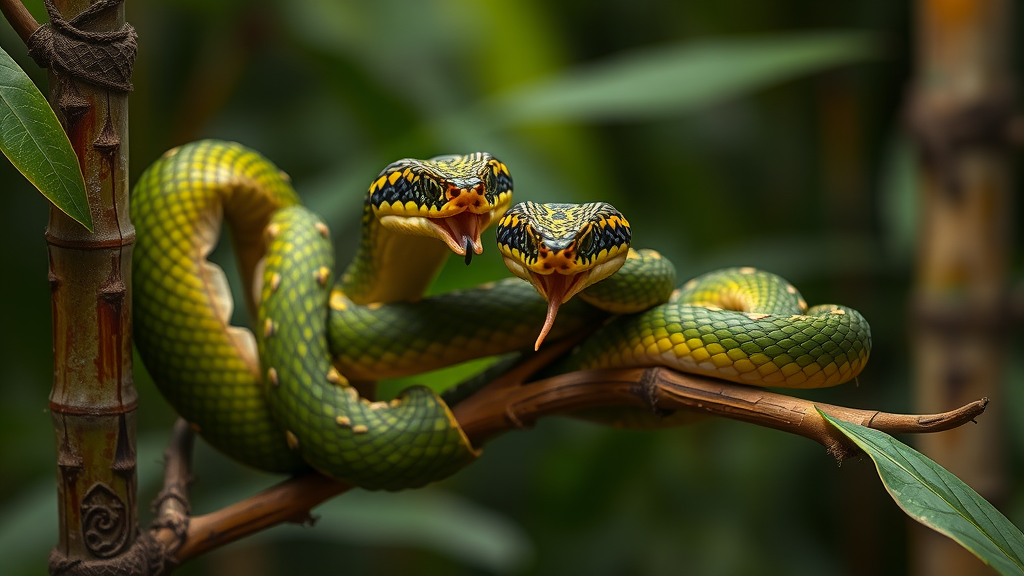
Deep in the forested hills of Gujarat’s Dangs District, a vivid green snake spends its nights coiled on exposed tree roots and bamboo branches, waiting motionless for prey to pass within striking distance. New research now reveals just how attached these snakes are to their hunting perches, and how vulnerable they may be to the growing pressures of habitat destruction and illegal wildlife trade. The Bamboo Pitviper, Trimeresurus (Craspedocephalus) gramineus, is the only pitviper species found in Gujarat, and the new study suggests that its Least Concern status on the IUCN Red List may mask a far more precarious reality.
The study, conducted by Dikansh S. Parmar of the Leibniz-Institut zur Analyse des Biodiversitätswandels, Museum Koenig in Bonn, and Hinrich Kaiser of Victor Valley College, was published in the journal Discover Ecology. Between January 2022 and May 2025, the researchers carried out intermittent road-based visual encounter surveys along two forest roads in Dangs District, documenting 44 individual Bamboo Pitvipers. The species reaches the northern limit of its range in this part of western India, making the local population particularly significant for conservation.
The survey corridors were chosen for a practical reason: the roads are flanked by steep, eroding cut slopes whose near-vertical faces are studded with vegetation jutting out into open air. This arrangement offered researchers what amounted to a two-dimensional view of an otherwise cryptic arboreal snake, with the animals visible against a dark earthen background. Corridor α, a 7.7-kilometre road connecting the villages of Dhulda and Mahal, and Corridor β, a 15.2-kilometre route linking Mahal and Subir, became the study’s focal landscapes. Surveyors rode slowly along the roads at night on a motorcycle, scanning the slopes with a powerful searchlight.
The results revealed a striking pattern in how these snakes use their habitat. Of the 44 individuals recorded, 25 were perched on exposed tree roots, 13 on dry or green shrubs and bushes, and 6 on bamboo. The vast majority, 77 percent, were found at heights of 3 to 7 metres above road level, with some perches extending as much as 3 metres out from the slope face. Only 16 percent were seen at low heights of 1 to 3 metres, and just 7 percent at heights of 7 to 9 metres. The snakes emerged from subterranean shelters shortly after dusk, around 19:00 hours, and were never observed during the daytime.
Perhaps the most remarkable finding involved site fidelity, a behaviour never before specifically investigated in arboreal pitvipers. The researchers confirmed that six snakes reliably remained on their respective perches for a one-month period, then collected them, recorded their morphology, and kept them in captivity for 48 hours before releasing them at knee height on seemingly suitable perches roughly 6 metres below their original positions. Every single snake returned to its exact original perch. One individual was back within 24 hours, four returned after 48 hours, and one took up to 72 hours to find its way home.
Statistical analysis showed that the two corridors differed dramatically in snake abundance. Corridor α recorded an encounter rate of 3.38 snakes per kilometre, nearly three times the 1.18 snakes per kilometre logged along Corridor β. A Mann-Whitney U-test confirmed the difference was statistically significant, and Cliff’s Delta revealed a large effect size of 0.71, indicating an 85 percent probability that any random survey on Corridor α would yield higher encounter rates than on Corridor β. A generalized linear mixed model with a Poisson error distribution further confirmed that per-survey encounter frequencies differed significantly between the corridors. The researchers suggest that differences in slope height, vegetation density, and the extent of habitat fragmentation along Corridor β may explain the disparity.
Behavioural observations painted a picture of a patient, ambush-oriented predator. The snakes emerged exclusively at night, between 19:00 and 03:00 hours, and were rarely seen moving. They typically rested on branches or roots facing cracks in the packed earth that could serve as retreat sites, never straying more than two feet from a potential shelter. When threatened, they adopted the classic coiled strike-ready posture of vipers, sometimes accompanied by tail vibrations. During handling, the researchers documented an unexpected and previously unreported behaviour: the snakes alternately extended and retracted their fangs while presenting a gaping mouth, a defensive display not previously described in any pitviper species.
The study also yielded intriguing insights into reproduction. Between February and June, before the monsoon rains arrived, 18 of the 44 individuals, some 41 percent, were observed in pairs consisting of one male and one female, perched within 1 to 2 metres of each other. The same pairs were detected repeatedly at the same locations throughout the survey period, leading the researchers to propose that the species may practice seasonal monogamy, with males and females locating each other via pheromonal cues and remaining together until the female produces offspring. A gravid female observed in late April 2023, along with juvenile sightings during June and July, provided the first evidence of the breeding season for pitvipers in Gujarat.
Seasonality proved to be a defining feature of the species’ ecology. During the monsoon months from June to September, and throughout the post-monsoon and winter seasons, the snakes became virtually undetectable on their dry-season perches. The researchers received more frequent rescue calls during the monsoon regarding pitvipers found in human habitations, suggesting the snakes move to drier and warmer microhabitats when the rains arrive. In winter, when temperatures in the Dangs forest drop significantly, the snakes likely retreat into wood or bamboo clusters to hibernate. The researchers predict that as climate change increases aridity in the region, these arboreal pitvipers may adjust their seasonal movements, potentially remaining on perches for longer periods each year.
The conservation implications of the study are sobering. The species’ IUCN assessment, last conducted 13 years ago, noted no significant threats, yet the researchers documented landslides, soil erosion from deforestation, forest fires, and illegal wildlife trade as growing dangers. In May 2023, the first author encountered snake smugglers equipped with flashlights, snake bags, hooks, knives, and a jeep searching the slopes; investigation via their vehicle and social media revealed involvement in trafficking snakes from regions as far afield as Northeast India, Maharashtra, and Goa. Because the species displays strong site fidelity and slow movement, it is especially vulnerable to such pressures. Discussions with the Deputy Conservator of Forests, North Division, Dangs, have prompted efforts to designate the two corridors as no-cut zones for bamboo and trees, a measure expected to reduce soil erosion and protect pitviper habitat. The researchers argue that the Bamboo Pitviper’s predictable habits make it an ideal model species for studying arboreal pitviper ecology, and that targeted conservation, combined with village education programs, offers the best hope for its survival at the edge of its range.
Subject of Research: Ecology, site fidelity, and conservation threats of the Bamboo Pitviper in the Dangs Forest of Gujarat, India
Article Title: Hanging in the balance: an ecological and conservation assessment reveals growing threats to the Bamboo Pitviper, Trimeresurus (Craspedocephalus) gramineus (Shaw, 1802), in the Dangs Forest of Gujarat, India
Article References: Parmar, D. S., & Kaiser, H. (2026). Hanging in the balance: an ecological and conservation assessment reveals growing threats to the Bamboo Pitviper, Trimeresurus (Craspedocephalus) gramineus (Shaw, 1802), in the Dangs Forest of Gujarat, India. Discover Ecology, 2(1), Article 9. https://doi.org/10.1007/s44396-026-00025-0
Image Credits: AI Generated
DOI: 10.1007/s44396-026-00025-0
Keywords: Bamboo Pitviper, Trimeresurus gramineus, Gujarat, Dangs Forest, site fidelity, habitat fragmentation, wildlife trafficking, arboreal snakes, pitviper ecology, IUCN Red List, monsoon seasonality, ambush predation
Cite Scienmag News
Margaret Porter. (September 22, 2026). Venomous Bamboo Pitvipers Show Fierce Loyalty to Their Perches as Traffickers Close In. Scienmag. https://scienmag.com/venomous-bamboo-pitvipers-show-fierce-loyalty-to-their-perches-as-traffickers-close-in/
Margaret Porter. "Venomous Bamboo Pitvipers Show Fierce Loyalty to Their Perches as Traffickers Close In." Scienmag, 22 September 2026, https://scienmag.com/venomous-bamboo-pitvipers-show-fierce-loyalty-to-their-perches-as-traffickers-close-in/. Accessed 7 October 2026.
Margaret Porter. "Venomous Bamboo Pitvipers Show Fierce Loyalty to Their Perches as Traffickers Close In." Scienmag. September 22, 2026. https://scienmag.com/venomous-bamboo-pitvipers-show-fierce-loyalty-to-their-perches-as-traffickers-close-in/


