


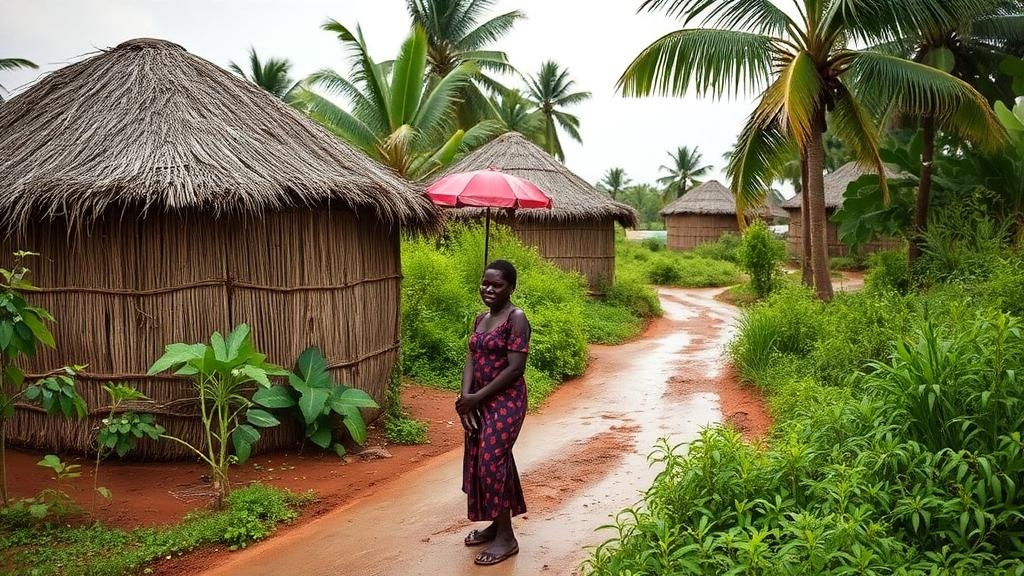
When the rains arrive in The Gambia each May, they bring relief from the scorching dry season, replenish wells and water points, and green the farmland of West Kiang. But a new thirteen-year analysis of clinic records from rural Gambia suggests the relationship between rainfall and health is far more complicated than a simple story of wet weather breeding disease. Moderate weekly rainfall, it turns out, is associated with a measurable rise in clinic visits for both diarrheal diseases and skin infections, while the heaviest downpours appear to confer no additional risk at all, and may even be protective once temperature is taken into account.
The study, published in Environmental Advances, drew on electronic health records from the Medical Research Council Unit The Gambia clinic in Keneba, a facility that has provided free healthcare to residents of the surrounding West Kiang region for decades. Between January 2010 and December 2022, the clinic recorded 11,331 visits for diarrheal diseases and 29,420 visits for skin infections. Roughly seven in ten diarrheal visits involved children under five, while skin infections were more evenly distributed across age groups. The researchers aggregated these visits into weekly counts and matched them against weekly rainfall and temperature data from the European Centre for Medium-Range Weather Forecasts ERA5-Land reanalysis dataset, extracted at roughly ten kilometre resolution for the grid cell containing the clinic.
Because the relationship between weather and disease is rarely linear, the team employed distributed lag non-linear models, a statistical framework that can capture both curved exposure-response relationships and effects that unfold over time. Weekly counts of clinic visits were highly overdispersed, so negative binomial regression was used, with natural cubic splines of time flexibly adjusting for long-term trends and seasonality. The models allowed rainfall effects to emerge across a zero-to-three-week lag window, chosen to encompass the incubation periods of the major pathogens involved as well as the time needed for environmental exposure, pathogen replication and the decision to seek care.
The headline finding is a threshold effect. For diarrheal disease, the cumulative risk of a clinic visit rose steadily as weekly rainfall increased, peaking somewhere between 35 and 40 millimetres of rain per week, after which the risk plateaued and drifted back toward null. A week with 20 millimetres of rainfall, roughly the 75th percentile of the full series, was associated with a 20 percent increase in diarrheal visits compared with dry weeks, after adjusting for temperature. Without that temperature adjustment, the apparent risk was 41 percent higher, a difference that proved to be one of the study’s most methodologically important observations.
Skin infections told a similar but not identical story. Risk climbed with rainfall up to a threshold of about 30 millimetres per week, then declined at heavier totals. Twenty millimetres of weekly rainfall was associated with a 39 percent increase in skin infection visits once temperature was accounted for, and the effect persisted across lags of one, two and three weeks, longer than the one-to-two-week window over which diarrheal risks appeared. The researchers suggest this may reflect different underlying mechanisms: diarrheal pathogens are typically ingested after relatively rapid contamination of water sources, while skin infections may follow slower routes of environmental exposure, crowding during wet weather and changes in hygiene practices when water becomes scarce or contaminated.
Stratifying the data by pathogen category revealed a striking asymmetry. Bacterial diarrheal visits carried the strongest rainfall association, with a 66 percent increase in risk at 20 millimetres of weekly rainfall after temperature adjustment, whereas viral diarrheal visits showed no clear evidence of a rainfall effect at all. A parallel pattern emerged for skin disease: bacterial skin infections were the most rainfall-sensitive category, though fungal and clinically classified local skin infections also showed elevated risks. This aligns with a growing body of evidence from other settings that rainfall and temperature shape the transmission of bacterial and viral enteric pathogens in fundamentally different ways, with wetter conditions generally favouring bacterial spread.
Age modified the risks in unexpected directions. For diarrheal disease, the rainfall association was stronger among patients aged five and over, with a 63 percent increase in risk at 20 millimetres of weekly rainfall, than among children under five, for whom no significant association was detected after temperature adjustment. The authors note that the vast majority of under-five diarrheal visits were classified as viral, which may partly explain the difference. For skin infections the pattern reversed: children under five bore the greater rainfall-associated burden, with a 77 percent increase in visits at 20 millimetres of rain, consistent with the idea that young children crawling and playing in contaminated standing water face heightened exposure. Sex-stratified analyses suggested slightly higher risks among females for both outcomes, though the evidence for modification by sex was weaker than for age.
Perhaps the most counterintuitive result concerns heavy rainfall events, defined as days receiving more than 21.05 millimetres of rain, the 95th percentile of rainy days between 2000 and 2022. In unadjusted models, weeks containing at least one such event were associated with substantially increased risks of both diarrheal and skin infection visits. But once maximum temperature was included in the models, those associations vanished entirely. And when total weekly rainfall was additionally controlled for, a heavy rainfall event was actually associated with a modest decrease in diarrheal risk. The authors propose that competing mechanisms may be at work: heavy rain can flush and dilute pathogens in water sources, while also improving water availability for hygiene, offsetting the contamination and infrastructure damage such events can cause.
The confounding role of temperature deserves emphasis, because many prior studies of rainfall and diarrheal disease have not adjusted for it at all. In The Gambia, temperature and rainfall are strongly inversely related, with the hottest weeks falling just before the onset of the rainy season. Failing to account for this coupling can therefore inflate or distort apparent rainfall effects. The sensitivity analyses were reassuring on other fronts: results held up under alternative methods of seasonal adjustment, different spline configurations, shorter and longer lag windows, and explicit adjustment for the sharp decline in diarrheal visits after rotavirus vaccine introduction in 2014. Crucially, rainfall showed no comparable association with clinic visits for routine child health checks, toothache or hypertension, outcomes that lie outside any plausible rainfall-transmission pathway, suggesting the findings are not simply an artefact of weather-driven changes in health-seeking behaviour.
The study has limitations the authors acknowledge. Clinic visits are a proxy for disease incidence rather than a direct measure, pathogen classifications rest on clinical assessment rather than laboratory confirmation, and reanalysis weather data averaged over ten-kilometre grid cells may smooth out the local extremes of rainfall that matter most. Even so, the work offers one of the most detailed pictures to date of how rainfall shapes water-related disease in West Africa, a region where such evidence has been sparse and where climate projections point toward greater rainfall variability and more intense wet-season events. As the authors conclude, the non-linear risks they document, together with the anticipated shifts in West African rainfall, argue for strengthening the climate resilience of water, sanitation and hygiene services, and for studying rainfall and temperature jointly rather than in isolation if early-warning systems for climate-sensitive diseases are to become a reality.
Subject of Research: The association between weekly rainfall, temperature and clinic visits for diarrheal diseases and skin infections in rural Gambia
Article Title: The impact of weekly rainfall on water-related diseases in The Gambia: a time-series analysis of health facility data
Article References: Bose, I., Part, C., Moirano, G., Murray, K. A., Green, R., Cerami, C., Mistry, M. N., & Kovats, S. (2026). The impact of weekly rainfall on water-related diseases in The Gambia: a time-series analysis of health facility data. Environmental Advances, 26, Article 100757. https://doi.org/10.1016/j.envadv.2026.100757
Image Credits: AI Generated
DOI: 10.1016/j.envadv.2026.100757
Keywords: rainfall, diarrheal disease, skin infections, The Gambia, time-series analysis, climate and health, heavy rainfall events, distributed lag non-linear models, water-related diseases, WASH, temperature confounding, West Africa
Cite Scienmag News
Sloane Callahan. (October 7, 2026). Rainfall’s Hidden Threshold: Moderate Wet Weeks Drive Diarrhea and Skin Infections in Rural Gambia. Scienmag. https://scienmag.com/rainfalls-hidden-threshold-moderate-wet-weeks-drive-diarrhea-and-skin-infections-in-rural-gambia/
Sloane Callahan. "Rainfall’s Hidden Threshold: Moderate Wet Weeks Drive Diarrhea and Skin Infections in Rural Gambia." Scienmag, 7 October 2026, https://scienmag.com/rainfalls-hidden-threshold-moderate-wet-weeks-drive-diarrhea-and-skin-infections-in-rural-gambia/. Accessed 7 October 2026.
Sloane Callahan. "Rainfall’s Hidden Threshold: Moderate Wet Weeks Drive Diarrhea and Skin Infections in Rural Gambia." Scienmag. October 7, 2026. https://scienmag.com/rainfalls-hidden-threshold-moderate-wet-weeks-drive-diarrhea-and-skin-infections-in-rural-gambia/


