


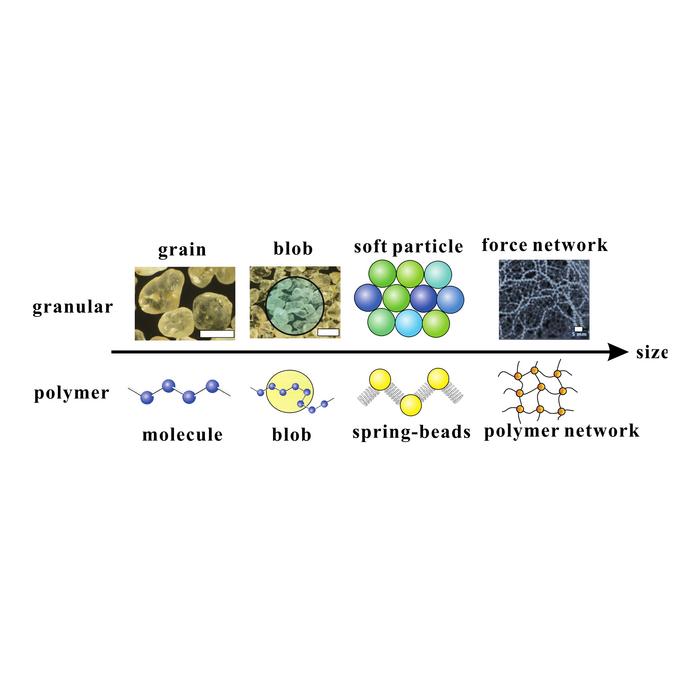
Tokyo, Japan – Scientists from Tokyo Metropolitan University have created a new model for disordered materials to study how amorphous materials resist stress. They treated groups of atoms and molecules as squishy spheres with varying softness. Putting their model under a load, they discovered unexpected disparities between harder regions and where forces were concentrated, with areas in between such regions “hardening” to produce elongated “force chains”. Their findings promise new insights into designing better materials.

Credit: Tokyo Metropolitan University
Tokyo, Japan – Scientists from Tokyo Metropolitan University have created a new model for disordered materials to study how amorphous materials resist stress. They treated groups of atoms and molecules as squishy spheres with varying softness. Putting their model under a load, they discovered unexpected disparities between harder regions and where forces were concentrated, with areas in between such regions “hardening” to produce elongated “force chains”. Their findings promise new insights into designing better materials.
When it comes to building hard materials, using hard ingredients is not enough. For example, when concrete fails during earthquakes, the forces which are generated become focused in certain places, causing cracks to form. The transmission of forces through amorphous solids like concrete and cement is known to follow well-defined paths known as “force chains.” Deciphering how they emerge would go a long way to understanding how such solids behave under stress, but it is not yet known how they emerge, and how they relate to material properties.
This inspired a team of researchers from Tokyo Metropolitan University led by Professor Rei Kurita to build simple, tractable models of amorphous materials which might teach us how force chains form. Instead of simply simulating the motion of all atoms in some material, they decided to represent groups of atoms with spheres of varying stiffness, reflecting how those groups respond to forces. The materials they studied were then characterized by how much the stiffnesses varied over space, and how broad the patterns of hard and soft regions were.
Deforming their array of squishy particles, they firstly looked for whether local stiffness correlated with force chain transmission. Initially, it seemed like there was a clear correlation between harder regions and force chains. However, further analysis reveals that force chains are more string-like in their shape, and don’t correlate as well with isolated hard regions. To understand this discrepancy, the team studied a simpler model of two stiff regions separated by a softer region, finding that the softer region becomes denser, generating the high forces required to keep the chain going. This is a first glimpse into the fundamental mechanics of how force chains connect.
But how do these variations affect the properties of the material? It turns out that larger variations in softness and broader soft/hard regions both lead to consistently softer materials, as does larger variations in local density. The conclusion we can draw is that even with the same building blocks, amorphous materials with a more uniform stiffness gives a harder material due to more even distribution of the force chains.
While the emergence of stiffness variations in real materials remains unexplored, the team hope their new model and mechanism pave the way for design principles to make better materials.
This work was supported by JSPS KAKENHI Grant Numbers 20K14431 and 20H01874.
Journal
Scientific Reports
Article Title
Formations of force network and softening of amorphous elastic materials from a coarsen-grained particle model
Article Publication Date
17-Apr-2024
Cite Scienmag News
Bethany Barker. (May 4, 2024). Variety in building block softness makes for softer amorphous materials. Scienmag. https://scienmag.com/variety-in-building-block-softness-makes-for-softer-amorphous-materials/
Bethany Barker. "Variety in building block softness makes for softer amorphous materials." Scienmag, 4 May 2024, https://scienmag.com/variety-in-building-block-softness-makes-for-softer-amorphous-materials/. Accessed 4 September 2026.
Bethany Barker. "Variety in building block softness makes for softer amorphous materials." Scienmag. May 4, 2024. https://scienmag.com/variety-in-building-block-softness-makes-for-softer-amorphous-materials/

