


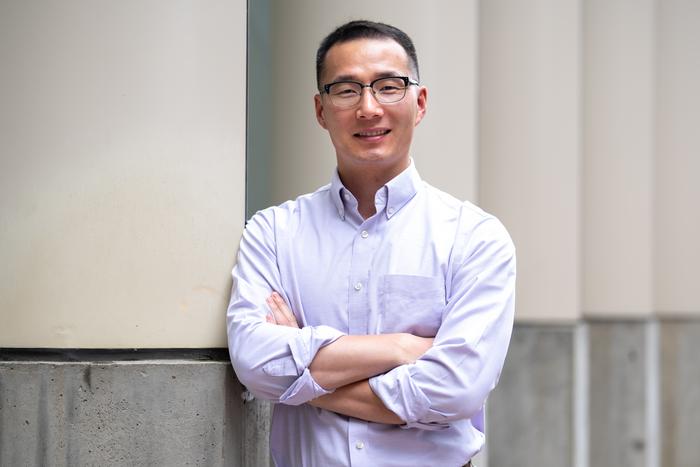
University of Virginia assistant engineering professor Liheng Cai has earned the Maximizing Investigator’s Research Award from the National Institutes of Health. His work holds significant implications for the future of personalized biomedicine, including the possibility of repairing living tissue, perhaps even replacing whole organs.

Credit: Photo by Sanjay Suchak for UVA Engineering
University of Virginia assistant engineering professor Liheng Cai has earned the Maximizing Investigator’s Research Award from the National Institutes of Health. His work holds significant implications for the future of personalized biomedicine, including the possibility of repairing living tissue, perhaps even replacing whole organs.
The NIH honor, bestowed by its National Institute of General Medical Sciences, signals its support for researchers performing breakthrough research. The associated grant will infuse his lab at the UVA School of Engineering and Applied Science with $1.9 million over the next five years.
The grant will allow Cai to further his study of tissue repair and disease progression through the advanced living cellular structures his team in the Soft Biomatter Lab creates. Cai holds a joint appointment in the Departments of Chemical Engineering and Materials Science and Engineering, and a courtesy appointment in the Department of Biomedical Engineering.
For now, the structures exist outside of the human body. But the lab will continue to improve upon how the structures mimic human biology. One of Cai’s major aspirations is to someday integrate healthy, bio-printed cells into the human body.
“One of the major components of the award is to develop biomaterials that can be constructed from tiny, basic modules,” said Cai, who joined the UVA Engineering faculty in 2018. “The mechanical properties of the modules will mimic the mechanical properties of human tissue. This approach is built on a class of polymers — bottlebrush polymers — my lab has been pioneering.”
He added, “I would like to thank the Institute for this very substantial investment and show of faith in our lab’s potential. I credit the superb, supportive environment here at UVA for making this award possible.”
The award builds on his National Science Foundation CAREER Award and ACS Petroleum Research Fund Doctoral New Investigator Award. He also received the UVA Research Excellence Award last year.
The new announcement raises Cai’s sponsored funds at UVA to over $4 million.
Bioprinting Inspired by Minecraft®
His lab’s new polymer — named for its special architecture resembling a bottlebrush for cleaning glassware — can be chemically or physically linked to form extremely soft material that mimics biological tissues.
These tissue mimics are also part of the team’s strategy to make 3D printing of biological materials possible.
Cai’s lab recently proved the concept for “voxelated bioprinting.” It’s a form of programmable cell assembly inspired by the online game Minecraft®, Cai noted.
“The popular video game uses individual 3D cubes as ‘voxels’ to create a virtual world,” he said. “We developed voxelated bioprinting technologies in the real world. Our technology assembles cell-encapsulated droplets into a specially designed printer. During the printing process, we create 3D cell assemblies with the exact architecture and functions that we programmed.”
Cai believes that this technology could pave the way for printing organs on demand — truly personalized medicine.
He said he and his team are “extending our design strategy to engineer modular cell-instructive biomaterials.” They believe the bottlebrush architecture holds the potential for encoding the complexities that exist in our bodies’ own various tissues.
En route to that goal, the lab aspires to print 3D cell-based models that function similar to human tissue, so as to study disease progression. In one project, the team is creating what Cai calls a “micro-human airway device” to capture the geometric and biological features of human airways.
“We are investigating the interactions between mucus and three indispensable components of the microenvironment: cilia, cells and bacteria,” he said. “The idea is to exploit this biologically similar device to study human lung defense, without having to cause harm to living beings.”
First Organs Might Be Vocal Cords
Cai’s current career journey has been built on his other explorations into the fundamental nature of polymers, which can be defined by their source (natural or synthetic), chemical structure or method by which they’re made.
Natural polymers are integral to our bodies. They are essential for maintaining the structure, function and regulation of various tissues and organs. Their ability to self-assemble and interact with other molecules and cells allows them to perform complex biological functions that are crucial for life.
A goal of Cai’s has been to learn how cells best respond over time to precision treatments using his specially engineered polymers. He and his team recently developed “soft-yet-dry elastomers,” which are very stretchable and soft polymers.
Cai also noted the striking similarity between the material and human vocal cords, which currently can’t be replaced if they are too severely damaged.
Soft-yet-dry elastomers could potentially have many uses though, he said, including as more durable and compliant medical devices, and in wearable electronics and soft robots.
Creating ‘Self-Healing’ Polymers
Cai has also extensively researched associative polymers, which can be water-soluble and are found within the natural biopolymers in the extracellular matrix that surrounds and supports cells and tissues in the body. They carry many “stickers,” or chemical structures that form easy-to-break, reversible bonds, Cai explained.
Researchers have long been in pursuit of understanding the stickiness attribute because they believed this function held the key to recreating biomaterials that match the behavior of living tissue.
In a related research project, Cai and colleagues recently discovered through experiments that such stickiness is controlled by the density of the bonding structures, upending more than three decades of theory.
Polymer physicists had previously believed that the mechanical behavior of associative polymer networks — including their stickiness and reversibility — was governed by the sticker bond strength. The scientists thought so because of what they observed. When bonding associations are maintained, a shape change called a “rubbery plateau” occurs.
Cai’s team had to create new classes of associative polymers, “carrying unprecedentedly high number of stickers,” he said, to prove their own theory.
“We experimentally showed that reversible bonds significantly slow down the polymer dynamics but hardly change shape as they relax over time ,” Cai said related to the influential June 2023 paper in Physical Review Letters. He collaborated with Shiwang Cheng of Michigan State University and others on the paper.
“This new discovery is critical to the development of biomaterials that match how biological tissues respond to stress over time,” Cai added.
Putting It All Together
Cai’s department heads said they have been excited to see the elements of his MIRA research come together: a modular bottlebrush structure underlying new biomaterials and a bioprinting technology that can precisely assemble the materials to create 3D tissue mimics.
William Epling, chair of the Department of Chemical Engineering, congratulated Cai on his award and shared his thoughts on the significance.
“There’s no doubt in my mind that Liheng’s research in polymers and soft matter will impact, and ultimately lead to, the development of designer biomaterials that guide cell function,” Epling said.
Epling is an expert in materials characterization and surface and interface science, among other facets of chemical engineering.
Elzabeth J. Opila, chair of the Department of Materials and Science Engineering, said, “Professor Cai is doing transformative work that bridges materials science, soft materials and biomedical engineering. I’m looking forward to the breakthrough science enabled by this prestigious award.”
The award follows a “Rising Star” designation Cai and fellow UVA Engineering assistant professor of chemical engineering Rachel Letteri received in March. ACS Polymers Au featured Cai and Letteri as just two of 14 early-career researchers from around the world who are leaders in polymer science and engineering.
He also recently received the 2024 PMSE Early Investigator Award and the 2020 Soft Matter Emerging Investigator Award.
Cai’s research dovetails with the Precision Medicine/Health component of the University’s “Grand Challenges,” which exist to help solve some of the world’s most urgent problems.
Cite Scienmag News
Denise Maddox. (August 6, 2024). UVA engineering professor lands $1.9 million NIH award to maximize biomedical research. Scienmag. https://scienmag.com/uva-engineering-professor-lands-1-9-million-nih-award-to-maximize-biomedical-research/
Denise Maddox. "UVA engineering professor lands $1.9 million NIH award to maximize biomedical research." Scienmag, 6 August 2024, https://scienmag.com/uva-engineering-professor-lands-1-9-million-nih-award-to-maximize-biomedical-research/. Accessed 4 September 2026.
Denise Maddox. "UVA engineering professor lands $1.9 million NIH award to maximize biomedical research." Scienmag. August 6, 2024. https://scienmag.com/uva-engineering-professor-lands-1-9-million-nih-award-to-maximize-biomedical-research/

