


A biology researcher at The University of Texas at Arlington has received a prestigious grant to continue and expand his research on how pollution affects wildlife.

Credit: Photo courtesy Jordan Brown, UT Arlington
A biology researcher at The University of Texas at Arlington has received a prestigious grant to continue and expand his research on how pollution affects wildlife.
Jordan Brown, a postdoctoral research associate in biology, was awarded a Postdoctoral Research Fellowship from the National Science Foundation’s (NSF) Directorate for Biological Sciences. The award supports researchers whose work focuses on how environmental changes affect animals.
Dr. Brown works in the lab of Shane DuBay, UTA assistant professor of biology, who studies evolutionary ecology, environmental science, and natural history to better understand the consequences of environmental change on the world.
“I was always very confident that I would somehow be able to complete all my research plans for the next few years, especially with Dr. DuBay’s help, but having NSF support is going to remove so many barriers and provide so many new opportunities to expand my research,” said Brown.
“It’s really exciting to see the NSF support the innovative research that Jordan has been developing—it’s a huge accomplishment,” DuBay said. “His work has incredible potential to advance our knowledge about pollution histories and the diverse and uneven impacts of environmental pollution.”
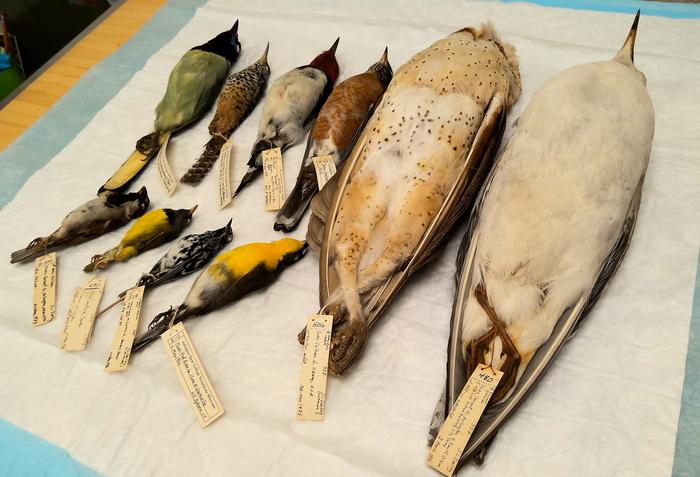
One of Brown’s projects involves analyzing bird specimens from museum collections in Europe to assess whether they can be used as indicators of air pollution between the mid-1800s and the present day. Many older bird samples were collected in industrialized areas and are notably darker in their plumage than those from areas without as much industrialization. This is due to the presence of black carbon particles emitted by factories during the 19th and early 20th centuries.
This research builds and expands on previous work done by DuBay that looked at bird specimens from U.S. museums to help reconstruct historical levels of soot pollution and, ultimately, provide a better understanding of the role black carbon plays in climate change. Brown will use image analysis software on photographs of bird samples from European museums to determine whether the level of air pollution from the time and place the specimens were collected can be measured.
Brown developed a fascination with nature early in his life. “I realized that nature is not just interesting, it’s also important. I found myself wanting to know more about biological and ecological systems,” he said. His dissertation focused on detecting and characterizing the microbes that live inside concrete, with the goal of demonstrating that unexpected ecosystems can develop in places that are made specifically by and for humans.
Brown joined DuBay’s lab in fall 2023 to continue researching urban ecology and industrial pollution.
“I am excited to finally have a chance to focus on pollution,” he said. “Every instance of pollution has a story behind it as well as unknown consequences for the future. We’re going to figure out how basic ecology and industrial activities have interacted to produce some of the pollution problems we’re dealing with now.”
Cite Scienmag News
Drew Townsend. (July 16, 2024). UTA biologist wins national fellowship to study historic pollution. Scienmag. https://scienmag.com/uta-biologist-wins-national-fellowship-to-study-historic-pollution/
Drew Townsend. "UTA biologist wins national fellowship to study historic pollution." Scienmag, 16 July 2024, https://scienmag.com/uta-biologist-wins-national-fellowship-to-study-historic-pollution/. Accessed 8 September 2026.
Drew Townsend. "UTA biologist wins national fellowship to study historic pollution." Scienmag. July 16, 2024. https://scienmag.com/uta-biologist-wins-national-fellowship-to-study-historic-pollution/

