


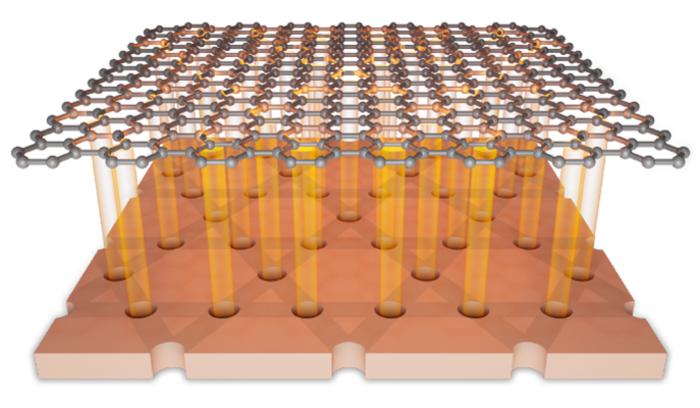
A research team led by Prof. ZENG Changgan from the University of Science and Technology of China (USTC) of the Chinese Academy of Sciences (CAS), collaborated with Prof. SHENG Junyuan from Wuhan University and Pro. Francisco Guinea from IMDEA Nanociencia in Spain, has introduced a novel method for selectively tuning electronic bands in graphene. Their findings, published in Physical Review Letters and featured by APS Physics, showcase the potential of artificial superlattice potential fields for manipulating different types of band dispersions in graphene.

Credit: Shuai Wang et.al
A research team led by Prof. ZENG Changgan from the University of Science and Technology of China (USTC) of the Chinese Academy of Sciences (CAS), collaborated with Prof. SHENG Junyuan from Wuhan University and Pro. Francisco Guinea from IMDEA Nanociencia in Spain, has introduced a novel method for selectively tuning electronic bands in graphene. Their findings, published in Physical Review Letters and featured by APS Physics, showcase the potential of artificial superlattice potential fields for manipulating different types of band dispersions in graphene.
Traditional band engineering methods, such as heterostructures, interfacial strain, and alloying, have limitations, particularly in providing in situ and continuous control over the engineered band structures. The advent of van der Waals (vdW) materials, especially graphene, has opened new avenues for band structure engineering through gating and moirée heterostructures, which can modify energy bands and lead to various emergent physical phenomena.
The primary challenge lies in the precise control and manipulation of band structures to achieve specific electronic properties. Previous methods have been less flexible and lacked the ability to actively and selectively modify dispersion characteristics of bands.
To address the challenges, this research introduces a paradigm-shifting method of band engineering by creating an artificial kagome superlattice to manipulate the Dirac bands in graphene. The kagome superlattice is designed with a large period of 80 nm, which is pivotal for folding and compressing various high-energy bands into a low-energy regime that can be experimentally observed and manipulated.
The study’s key innovation lies in the use of a high-order potential within the kagome superlattice. This potential allows for the reconstruction of band structures through different contributions, leading to dispersion-selective band modulation. The researchers fabricated the artificial lattice device using standard van der Waals assembly techniques and electron beam lithography, creating a kagome-lattice pattern that functions as a local gate for the graphene.
By independently adjusting the voltage applied to the local gate and the doped silicon substrate, the researchers were able to finely control both the strength of the artificial potential and the carrier density in the graphene. The high-order kagome potential enabled the researchers to observe and manipulate the redistribution of spectral weight among multiple Dirac peaks.
Furthermore, the application of a magnetic field was shown to effectively weaken the superlattice’s impact on the band structure, reactivating the intrinsic Dirac band. This finding provides an additional knob for controlling the electronic properties of the material.
In conclusion, the innovative approach presented in the study, leveraging an artificial kagome superlattice, offers unprecedented control over band structure engineering. This method not only advances the field’s capacity for precise manipulation of electronic properties but also opens new avenues for the discovery of novel physical phenomena and materials with designed functionalities. APS Physics highlighted the study as “laying the groundwork for on-demand electronic band design,” emphasizing its impact on advancing band structure engineering.
Journal
Physical Review Letters
Article Title
Dispersion-Selective Band Engineering in an Artificial Kagome Superlattice
Article Publication Date
6-Aug-2024
Cite Scienmag News
Denise Maddox. (August 27, 2024). USTC realizes dispersion-selective band engineering in artificial kagome superlattice. Scienmag. https://scienmag.com/ustc-realizes-dispersion-selective-band-engineering-in-artificial-kagome-superlattice/
Denise Maddox. "USTC realizes dispersion-selective band engineering in artificial kagome superlattice." Scienmag, 27 August 2024, https://scienmag.com/ustc-realizes-dispersion-selective-band-engineering-in-artificial-kagome-superlattice/. Accessed 5 September 2026.
Denise Maddox. "USTC realizes dispersion-selective band engineering in artificial kagome superlattice." Scienmag. August 27, 2024. https://scienmag.com/ustc-realizes-dispersion-selective-band-engineering-in-artificial-kagome-superlattice/

