


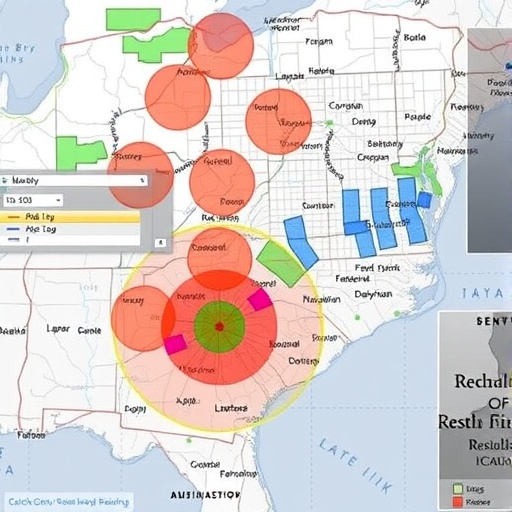
In a groundbreaking study published in Nature Cities, researchers Renninger, O’Clery, and Arcaute offer new insights into the spatial and socioeconomic fabric of urban landscapes across the United States. Their analysis illuminates how urban areas are not homogenously integrated but are clearly delineated into distinct rings and pockets, each marked by limited socioeconomic mixing. This nuanced understanding revolutionizes traditional perspectives on urban organization and challenges assumptions about social integration within metropolitan regions.
The study employs advanced computational techniques paired with geographic and socioeconomic data to dissect the spatial patterns of US cities. By leveraging a multi-dimensional analysis of income, demographic composition, and geographic positioning, the authors reveal that cities are partitioned into concentric zones—rings that correspond to varying socioeconomic statuses—as well as discrete pockets that underscore localized segregation. This sophistication in spatial structuring signifies the persistent fragmentation of urban environments despite the perceived trend toward metropolitan diversity.
One of the pivotal technical advancements in this study lies in the application of network theory to urban spatial analysis. Rather than relying solely on traditional administrative boundaries, which often fail to capture the lived reality of neighborhoods, the researchers constructed a network model based on socioeconomic interactions and spatial proximity. This approach allows for the identification of ‘communities’ within cities that share common socioeconomic traits while being physically or socially isolated from others. Such a model reveals the complex layering and boundaries that govern urban social dynamics.
The findings paint a vivid picture of urban division. Central areas, typically associated with high economic activity, are often surrounded by rings of varying affluence. Outside these rings lie pockets of poverty or wealth, clustered and insulated. This configuration highlights the difficulty of bridging socioeconomic divides, as daily social interactions tend to remain constrained within these enclaves. Such spatial social stratification informs not just where people live, but also how they experience access to resources, employment opportunities, and social mobility.
Renninger and colleagues also delve into the implications of these patterns on urban policy and planning. The persistence of limited mixing implies that urban renewal and integration efforts, if not carefully designed, may inadvertently reinforce existing divides. Policies promoting mixed-income housing, public transportation development, and inclusive public spaces must account for these inherent spatial organizations to be truly effective. The study therefore underscores the need for data-driven policy interventions that acknowledge and address the embedded socio-spatial configurations.
From a methodological angle, the research utilizes high-resolution census tract data paired with mobility and interaction datasets to validate the network models. This integrative method ensures the robustness of the findings, presenting a comprehensive overview of urban socioeconomic dynamics. Particularly compelling is the use of community detection algorithms within the network, which operationalize the concept of social pockets as measurable and distinct units within the urban fabric.
The socio-spatial divisions elucidated by the study challenge the narrative of cities as melting pots of culture and socioeconomic status. Instead, urban environments emerge as mosaics of exclusivity and separation, where socioeconomic mixing is the exception rather than the norm. This reality forces a reconsideration of how urban social cohesion can be fostered and maintained in the face of structural segregation.
Importantly, the study also identifies variations in these patterns across different metropolitan areas. While the concentric ring model holds generally true, some cities exhibit more pronounced pockets of socioeconomic differentiation, pointing to the influence of local history, geographic constraints, and policy decisions. This heterogeneity suggests that while structural patterns are widespread, the specifics of urban segregation continue to be locally contingent.
Another salient point addressed by the authors is the dynamic nature of these urban configurations over time. The rings and pockets are not static; they evolve under pressures of gentrification, economic shifts, and migration trends. By providing a framework to monitor these transformations, the study offers a valuable tool for tracking the success of integration policies and the emergence or dissolution of socioeconomic enclaves.
By applying this novel analytical framework, the research contributes to a deeper understanding of urban inequality’s spatial dimensions. It highlights the spatial mechanisms by which disparities perpetuate, from residential sorting to limited cross-neighborhood interaction. Such understanding is crucial for comprehending the broader societal challenges linked to uneven urban development and social equity.
The interdisciplinary nature of the work—bridging urban studies, sociology, and computational modeling—opens pathways for further exploration. This integrative perspective enables a more holistic approach to urban research, capable of yielding actionable insights for planners, policymakers, and community advocates alike. The study thus occupies a prominent position at the intersection of data science and urban policy innovation.
In conclusion, Renninger, O’Clery, and Arcaute’s research lays bare the intricate socio-spatial architectures of US cities, underscoring the systemic segregation that defines them. Their revelations about rings and pockets of socioeconomic activity call for a reimagining of how urban systems are understood and managed. As American cities continue to grow and diversify, addressing the spatial and social divides documented here becomes a critical challenge for sustainable and equitable urban futures.
Moving forward, this study sets a benchmark for integrating computational sophistication with urban theory to decode the complexities of city life. By shedding light on the subtle yet powerful ways space and society intertwine, it enriches our conceptual and practical grasp of urban dynamics. The importance of this research cannot be overstated, as it equips stakeholders with the empirical foundation necessary to foster more inclusive and connected urban communities across the nation.
Cite Scienmag News
Denise Maddox. (December 12, 2025). US Cities: Rings and Pockets Limit Socioeconomic Mixing. Scienmag. https://scienmag.com/us-cities-rings-and-pockets-limit-socioeconomic-mixing/
Denise Maddox. "US Cities: Rings and Pockets Limit Socioeconomic Mixing." Scienmag, 12 December 2025, https://scienmag.com/us-cities-rings-and-pockets-limit-socioeconomic-mixing/. Accessed 3 September 2026.
Denise Maddox. "US Cities: Rings and Pockets Limit Socioeconomic Mixing." Scienmag. December 12, 2025. https://scienmag.com/us-cities-rings-and-pockets-limit-socioeconomic-mixing/


