


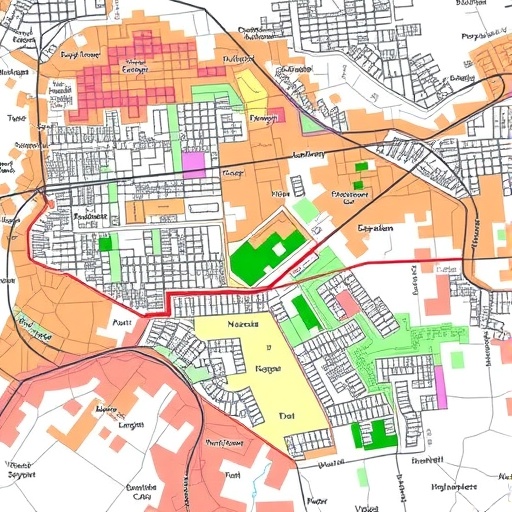
Urbanization is surging across the globe, particularly in developing regions, where cities are expanding at an unprecedented rate. This phenomenon presents multifaceted challenges, including environmental degradation, infrastructural pressure, and social inequalities. The case of Naqamte City in Ethiopia exemplifies these struggles, where rapid urban sprawl threatens the delicate balance of ecological and social systems. Recent research by M.D. Nagasa has unveiled a nuanced framework that integrates Cellular Automata (CA) and Markov modeling with advanced machine learning classifiers and spatial metrics to comprehensively analyze urban expansion in this burgeoning city.
Flooded with data, urban sprawl studies often rely on a mix of traditional methods and innovative techniques. Nagasa’s work ambitiously seeks to bridge this gap by utilizing CA-Markov Modeling, a spatially explicit approach that captures the dynamics of land use changes over time. By examining the historical land use patterns in Naqamte, the model predicts future growth and helps identify areas at risk of unsustainable development. This modeling technique allows researchers and urban planners to visualize potential scenarios and plan interventions accordingly.
Nagasa’s research does not stop at mere predictions. It further incorporates machine learning classifiers, including Decision Trees, Random Forests, and Support Vector Machines. These classifiers enhance the predictive power of the CA-Markov model by processing large datasets and recognizing complex relationships among variables such as socio-economic factors, land topography, and proximity to essential services. The integration of machine learning enables more accurate projections of urban growth and helps guide policy decisions more effectively.
To enrich the predictive model, spatial metrics are employed to quantify urban form and structure. Metrics such as patch density, land use diversity, and fragmentation rate provide insights into the environmental impacts of urban expansion. By applying these metrics to the data processed by the CA-Markov model, Nagasa’s analysis reveals the underlying patterns of sprawl in Naqamte City, allowing for a comprehensive overview of spatial dynamics. Such detailed spatial analysis is critical for identifying areas of concern and prioritizing strategic urban planning efforts.
Incorporating these sophisticated tools and methodologies presents a significant advantage in tackling urban sprawl. Nagasa’s research highlights that traditional methods alone are often inadequate for grasping the complexities of modern urban development. By using a multi-faceted approach, the study emphasizes the importance of robust data analysis frameworks in urban policy formulation. Predictive modeling technologies offer diverse stakeholders insights into land use planning, resource allocation, and environmental conservation objectives.
Additionally, Nagasa emphasizes the need for continuous data monitoring and updating within urban planning. The landscape of urbanization is continually evolving, influenced by political, economic, and social changes. Thus, the development of real-time data integration systems can ensure that city planners remain adaptable and can anticipate future challenges. This proactive approach can mitigate the adverse effects of unregulated urban growth, promoting more sustainable urban environments.
The broader implications of Nagasa’s findings extend beyond Naqamte City. The methodologies developed can be adapted and applied to other rapidly urbanizing regions in Ethiopia and beyond. As cities worldwide grapple with the consequences of urban sprawl, replicating such integrative research can catalyze improved urban governance and sustainable development practices, marking a significant step towards resilient urban ecosystems.
A salient aspect of the study is its commitment to interdisciplinary collaboration. Through partnerships among urban planners, environmental scientists, and data analysts, Nagasa’s approach fosters a comprehensive understanding of urban issues. Engaging various experts not only amplifies the knowledge base but also encourages diverse perspectives in addressing urbanization challenges, intertwining technological advancement with grounded community experiences.
Public engagement also plays a vital role in the research. By including community feedback in planning processes, urban stakeholders can ensure that developments reflect the needs and aspirations of local populations. Nagasa’s research advocates for participatory planning as a critical element in managing urban expansion while preserving the rich cultural heritage and social fabrics of cities like Naqamte.
As populations continue to rise and urban centers grow, the challenge of urban sprawl will only intensify. The methodologies described in Nagasa’s work signify a leap forward in analytical capabilities, equipping urban planners with vital tools to navigate this intricate landscape. The potential for real-time analysis and responsive planning offers a ray of hope for urban sustainability, ensuring that as cities evolve, they do so in harmony with the environment and community well-being.
In summary, Nagasa’s pioneering research effectively merges CA-Markov modeling, advanced machine learning techniques, and spatial analytics to dissect urban sprawl in Naqamte City, Ethiopia. This innovative approach not only enhances our understanding of urban dynamics but also paves the way for more effective and sustainable urban planning strategies. As cities face the challenge of accommodating growing populations, studies like this offer invaluable frameworks for fostering resilient urban futures.
This research underscores the importance of a tailored, multifaceted approach in urban studies, ensuring that predictive techniques can evolve alongside changing urban landscapes. By highlighting the interconnectedness of social, economic, and environmental factors in urban planning, Nagasa’s work sets a precedent for future research initiatives aimed at tackling the global issue of urban sprawl. As our understanding deepens, so too does our ability to forge sustainable pathways forward for cities around the world.
In conclusion, the research by M.D. Nagasa represents a significant step forward in the quest to understand and manage urban sprawl effectively. By integrating advanced modeling techniques with machine learning and spatial metrics, it offers a compelling blueprint for future studies and interventions in urban planning. This approach promises to yield fruitful insights into sustainable urban development, geography, and the overall quality of life within rapidly growing cities.
Nagasa, M.D. Integrating CA-Markov Modeling, machine learning classifiers, and spatial metrics for urban sprawl analysis in Naqamte City, Ethiopia.
Discov Cities 2, 114 (2025). https://doi.org/10.1007/s44327-025-00147-2
Cite Scienmag News
Courtney Benton. (November 19, 2025). Urban Sprawl in Naqamte: CA-Markov and AI Insights. Scienmag. https://scienmag.com/urban-sprawl-in-naqamte-ca-markov-and-ai-insights/
Courtney Benton. "Urban Sprawl in Naqamte: CA-Markov and AI Insights." Scienmag, 19 November 2025, https://scienmag.com/urban-sprawl-in-naqamte-ca-markov-and-ai-insights/. Accessed 3 September 2026.
Courtney Benton. "Urban Sprawl in Naqamte: CA-Markov and AI Insights." Scienmag. November 19, 2025. https://scienmag.com/urban-sprawl-in-naqamte-ca-markov-and-ai-insights/


