


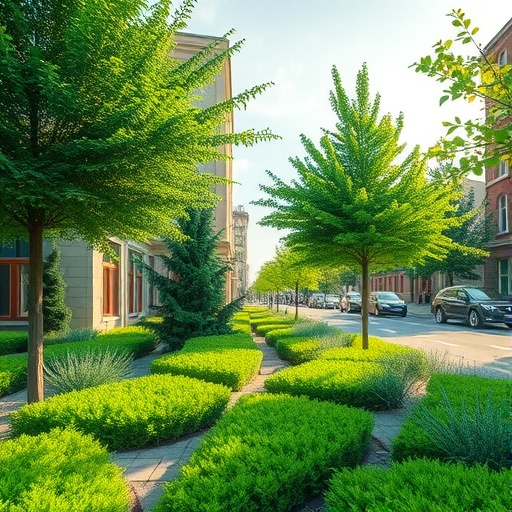
Perceptions of Mobile Green in urban spaces with contrasting visibility and green context are being brought into focus by a new study from Sakamoto and colleagues, published in npj Urban Sustainability (2026). The research tackles a subtle question for city design: when “green” is present but its visibility changes, how do pedestrians actually perceive it?
Urban planners often treat greenery as a static feature—fixed parks, planted buffers, or street trees. But people experience cities dynamically, with sights blocked by buildings, street furniture, traffic, and crowding. This study examines how mobile forms of green—such as portable planting elements or greenery that can be positioned and repositioned—may influence perception differently depending on whether the greenery is readily visible.
Using “contrasting visibility” alongside “green context,” the team explores two interacting factors. One is how clearly people can see the mobile greenery. The other is the surrounding environmental backdrop—whether the immediate urban setting already contains greenery or instead is visually dominated by built surfaces. Together, these conditions allow researchers to distinguish whether visibility alone drives perceived benefits or whether context amplifies—or undermines—those effects.
Technically, the work draws on experimental comparisons designed to isolate perceptual responses. Participants evaluate urban scenes while the mobile greenery’s presence and visibility are systematically varied. Such controlled design helps prevent confounding from lighting, layout complexity, and overall street character—issues that often blur results in real-world field studies.
The findings suggest that even when green elements are identical, perception shifts when visibility changes. When greenery is more salient, it tends to be associated with stronger feelings of comfort, pleasantness, and potentially restorative potential—qualities frequently linked to urban nature exposure. Conversely, when greenery is present but harder to notice, its psychological impact appears weaker, implying that “hidden” sustainability may not deliver the same benefits.
Importantly, green context moderates these effects. In greener surroundings, mobile greenery may be perceived as coherent and supportive of an already natural atmosphere. In less green contexts, visible mobile greenery can stand out as an intentional intervention, but if it is obscured, its distinctiveness may be lost.
From a science-news perspective, the viral takeaway is straightforward: putting greenery in cities is not enough—making it visible may determine whether people feel the benefits. This has direct implications for placemaking strategies that rely on flexible, temporary, or relocatable green installations.
In the long run, the study encourages evidence-based design for greener streetscapes that work with human perception, not just with botany. By aligning mobile green deployment with visibility and context, cities may enhance well-being outcomes more efficiently—turning “green” into something people can actually experience.
Cite Scienmag News
Courtney Benton. (July 27, 2026). Urban Mobile Green Perception Varies With Visibility and Surrounding Green Context. Scienmag. https://scienmag.com/urban-mobile-green-perception-varies-with-visibility-and-surrounding-green-context/
Courtney Benton. "Urban Mobile Green Perception Varies With Visibility and Surrounding Green Context." Scienmag, 27 July 2026, https://scienmag.com/urban-mobile-green-perception-varies-with-visibility-and-surrounding-green-context/. Accessed 4 September 2026.
Courtney Benton. "Urban Mobile Green Perception Varies With Visibility and Surrounding Green Context." Scienmag. July 27, 2026. https://scienmag.com/urban-mobile-green-perception-varies-with-visibility-and-surrounding-green-context/


