


Urban farming has moved from a niche hobby to a serious candidate for feeding the world’s expanding cities. A new review published in Innovations in Agriculture argues that the practice, which includes community gardens, indoor plant factories, rooftop plots and vertically stacked farms, could play a central role in food security as urban populations swell. The authors estimate that by 2050 roughly two-thirds of humanity will live in cities, while arable land continues to be converted into buildings and roads. Producing fresh food inside the city, they contend, is no longer optional but increasingly necessary.
The review synthesizes scientific literature with interviews of urban farmers in Malaysia, and it arrives at a nuanced picture. Urban agriculture can reduce water consumption, cut pesticide use, shorten supply chains and lower the greenhouse gas emissions associated with transporting food over long distances. It also supports two United Nations Sustainable Development Goals directly: Zero Hunger and Sustainable Cities and Communities. Yet the authors are careful to note that sustainability and yield remain major obstacles. Without deliberate strategies, many urban farms struggle to survive beyond their initial enthusiasm.
The market data cited in the review underline how quickly interest has grown. The global urban farming market was valued at approximately 139 billion US dollars in 2022 and is projected to reach about 219 billion dollars by 2028, a compound annual growth rate of 7.88 percent. A separate market report estimates revenue rose from 146.21 billion dollars in 2023 to 159.92 billion dollars in 2024. The COVID-19 pandemic accelerated this trend, as movement restrictions disrupted food supply chains and exposed the fragility of relying on distant producers for perishable goods.
Technically, urban farming is not a single method but a family of models built around four main techniques. Aeroponics suspends plant roots in air and mists them with nutrient solution. Hydroponics grows plants directly in nutrient-rich water without soil. Aquaponics couples hydroponic plant beds to fish tanks, using fish waste as fertilizer while plants clean the water. Vertical farming stacks these systems in multiple layers, often inside warehouses or purpose-built towers, to multiply yield per unit of land. In commercial settings, these techniques are frequently combined to maximize output from tight urban footprints.
The review organizes urban farms into four broad models, each with distinct strengths. Community farms, typically outdoor and collaborative, provide fresh produce while strengthening social bonds, repurposing vacant land and improving residents’ psychological well-being. Common crops include long beans, okra, eggplant, pumpkins, cucumbers and spinach. Their weaknesses are equally clear: affordable land is scarce, land-use regulations can be restrictive, and participation often depends on transportation access and socioeconomic status. Many community farms also rely on volunteer labor and donations, making long-term resource allocation precarious.
Indoor farms sit at the opposite end of the technological spectrum. By controlling temperature, humidity, light and nutrients, they enable year-round production regardless of season and dramatically reduce pest pressure. LED lighting, climate control systems, sensors and automation allow precise optimization of growth conditions, which translates into higher yields and consistent quality. Leafy greens such as lettuce, cabbage, mustard and broccoli, along with high-value herbs, dominate indoor production. The trade-offs are substantial capital costs for infrastructure and lighting, heavy reliance on automation, and a need for specialized technical expertise that many aspiring growers lack.
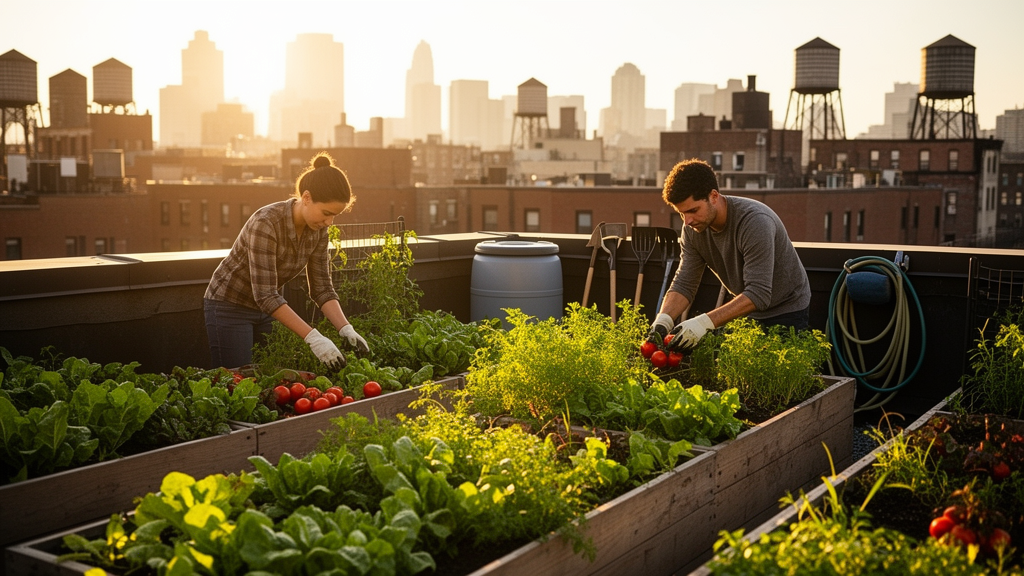
Rooftop farms occupy a middle ground, exploiting underused building surfaces in dense cities. The review notes that rooftops constitute roughly one quarter of all urban surfaces worldwide, an enormous untapped area for food production. Rooftop operations range from small residential gardens to large commercial installations and can use soil beds, hydroponics or aquaponics. They offer co-benefits beyond food, including improved air quality, better building energy performance and mitigation of the urban heat island effect. But because they remain exposed to the elements, growers must select crops that tolerate fluctuating sunlight, wind, temperature and precipitation, and they often need irrigation systems and wind barriers to protect yields.
Vertical farms push intensification furthest, growing crops in stacked layers inside controlled environments ranging from shipping containers to multi-storey facilities. This approach suits cities where land is scarce and expensive, and it shares the year-round reliability of indoor farming while achieving higher output per square foot. The review highlights reduced water consumption, shorter cultivation cycles and lower pesticide dependence as key advantages. However, the integration of aeroponics, hydroponics and aquaponics within complex vertical systems creates demanding operational requirements. Standard operating procedures and skilled technicians are essential, and the authors identify technical knowledge as one of the most pressing bottlenecks for this model.
The review also surveys the global policy landscape driving adoption. Around 800 million urban residents were already engaged in farming by the mid-1990s according to the United Nations Development Program, and roughly 5,290 companies worldwide now participate in urban farming systems, materials or produce, concentrated in the United States, India and Western Europe. In the United States, the Urban Agriculture Act of 2016 provides grants, technical assistance and research funding, while many cities lease land and support community gardens. India’s National Urban Livelihoods Mission and Smart Cities Mission integrate urban agriculture into development planning. European Union policies promoting local food systems, combined with city-level incentives for rooftop and vertical farms, have fostered a diverse regulatory environment across Western Europe.
Despite this momentum, the review identifies five persistent challenges. Access to affordable land remains the first barrier, which the authors suggest addressing through government partnerships, community land trusts and agriculture-friendly zoning. Water management follows, particularly in water-stressed regions; drip irrigation, rainwater harvesting, greywater recycling and smart monitoring systems can reduce waste. Pests and diseases pose a third problem, intensified by the close proximity of crops and human habitation, and chemical pesticides are often unsuitable in soilless systems where they could contaminate water or harm fish and beneficial microbes. The authors recommend integrated pest management, biological controls, membrane filtration, ozone or UV treatment, quarantine protocols and AI-driven pest detection as safer alternatives.
Financial constraints form a fourth obstacle. The review cites Food and Fertilizer Technology Center data indicating that a warehouse plant factory of at least 2,400 square feet, capable of holding 22,000 seedlings, requires an initial investment of roughly 166,667 US dollars, covering construction, lighting, control systems and equipment. Operational costs for land, utilities and labor add further pressure, and uncertain returns can deter investors. The authors propose microloans, grants, crowdfunding, public-private partnerships, tax incentives and subsidies as mechanisms to lower entry barriers, alongside automation to reduce labor costs.
The fifth challenge is human and institutional. Knowledge gaps in system maintenance, water quality management, nutrient balancing and troubleshooting equipment failures can derail projects, while many growers also lack training in market dynamics, business management and regulatory compliance. The review calls for targeted vocational training, extension services and capacity-building programs. Equally important, it highlights weak networking among universities, governments and industries, which leads to duplicated effort, isolated knowledge and slower innovation. Stronger interdisciplinary partnerships, the authors argue, would create an enabling environment for entrepreneurship and community engagement.
Taken together, the review presents urban farming as a technology with genuine potential but not a plug-and-play solution. Its success depends on matching the right model to local space, resources and skills, and on coordinated action across financing, policy, education and research. As cities continue to grow and supply chains face repeated shocks, the authors conclude that a multifaceted approach, combining technological integration, supportive regulation and stronger stakeholder networks, will determine whether urban farming fulfills its promise as a pillar of sustainable urban food security.
Subject of Research: Urban farming models, their benefits, challenges and strategies for sustainable city food production
Article Title: A review on urban farming: Potential, challenges and opportunities
Article References: Teoh, S. H., Wong, G. R., & Mazumdar, P. (2024). A review on urban farming: Potential, challenges and opportunities. Innovations in Agriculture, 7, 1-11. https://doi.org/10.3897/ia.2024.127816
Image Credits: AI Generated
Keywords: urban farming, food security, vertical farming, hydroponics, aquaponics, rooftop farms, community gardens, indoor farming, sustainable agriculture, urban agriculture policy, pest management, controlled environment agriculture
Cite Scienmag News
Alan Morgan. (October 17, 2026). Urban Farming Grows Fast, But Land, Money and Skills Hold It Back. Scienmag. https://scienmag.com/urban-farming-grows-fast-but-land-money-and-skills-hold-it-back/
Alan Morgan. "Urban Farming Grows Fast, But Land, Money and Skills Hold It Back." Scienmag, 17 October 2026, https://scienmag.com/urban-farming-grows-fast-but-land-money-and-skills-hold-it-back/. Accessed 17 October 2026.
Alan Morgan. "Urban Farming Grows Fast, But Land, Money and Skills Hold It Back." Scienmag. October 17, 2026. https://scienmag.com/urban-farming-grows-fast-but-land-money-and-skills-hold-it-back/


