


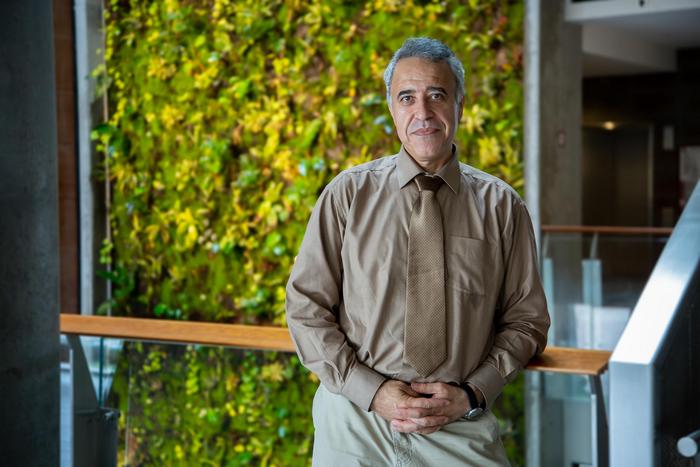
How will climate change impact Canada, home to the largest number of lakes in the world?

Credit: University of Ottawa
How will climate change impact Canada, home to the largest number of lakes in the world?
A recent study by the University of Ottawa and Laval University shows that climate change may cause many areas in Canada to experience significant droughts by the end of the century. In response, the researchers have introduced an advanced AI-based method to map drought-prone regions nationwide.
The research was conducted by a dedicated team of highly qualified personnel (HQP) under the supervision of Associate Professor Hossein Bonakdari, from uOttawa’s Department of Civil Engineering, in collaboration with Professor Silvio Gumiere from Laval University. The project is supported by funding from the Natural Sciences and Engineering Research Council of Canada (NSERC) through the Discovery Grant program and the Québec government’s Fonds de Recherche du Québec – Nature et Technologies.
“Drought is a significant threat to Canada, impacting agriculture, water resources and ecosystems,” explains Professor Bonakdari, lead researcher on the project. “Our research provides a detailed analysis of historical drought patterns and projections for future drought trends, allowing for more informed decision-making in climate resilience planning.”
The study offers a crucial and detailed understanding of how climate change will reshape Canada’s environmental landscape, particularly with respect to precipitation patterns, temperature increases and drought frequency. The findings reveal that:
- Northern (Nunavut, Northwest Territories, Yukon) and central regions (Saskatchewan, Alberta) are projected to face the most severe drought conditions.
- Coastal and eastern provinces may experience less severe, but still significant, changes.
- Under extreme climate scenarios, nearly half of Canada could be affected by severe drought by 2100.
This study uses deep-learning techniques and integrates data from the Canadian Drought Monitor (CDM) and ERA5-Land to analyze historical drought patterns and to project future trends up to 2100. According to Professor Bonakdari, “this innovative approach fills data gaps and enables robust projections under different climate change scenarios outlined by the sixth Intergovernmental Panel on Climate Change (IPCC) report. The ability to accurately forecast drought areas in Canada using AI is a significant advancement in climate resilience planning.”
Key messages for the public include:
- Surprising fact: Drought in Canada isn’t just a southern problem. Northern areas, like Nunavut, Northwest Territories, and Yukon, are expected to face severe drought conditions in the coming decades.
- Myth debunked: Stable precipitation does not mean no drought. Even with stable precipitation, rising temperatures will exacerbate drought conditions across Canada.
- Critical insight: The severity of future droughts and temperature increases will depend on current actions. Robust climate policies and adaptation strategies are urgently needed to mitigate these impacts.
- Urgency in Northern regions: Northern regions, often overlooked in climate discussions, are among the most vulnerable. The projected temperature increases and intensified droughts in these areas highlight the need for targeted climate action.
This study, published in Climate Journal, offers useful insights for policymakers, resource managers and stakeholders throughout Canada. By recognizing differences in regional drought risks and the impact of rising temperatures, they can take proactive steps to safeguard Canadian communities and ecosystems amidst a changing climate.
Journal
Climate
Method of Research
Meta-analysis
Subject of Research
Not applicable
Article Title
Advanced Forecasting of Drought Zones in Canada Using Deep Learning and CMIP6 Projections
Article Publication Date
10-Aug-2024
Cite Scienmag News
Sloane Callahan. (August 21, 2024). uOttawa researcher and partners design AI approach to drought zoning. Scienmag. https://scienmag.com/uottawa-researcher-and-partners-design-ai-approach-to-drought-zoning/
Sloane Callahan. "uOttawa researcher and partners design AI approach to drought zoning." Scienmag, 21 August 2024, https://scienmag.com/uottawa-researcher-and-partners-design-ai-approach-to-drought-zoning/. Accessed 4 September 2026.
Sloane Callahan. "uOttawa researcher and partners design AI approach to drought zoning." Scienmag. August 21, 2024. https://scienmag.com/uottawa-researcher-and-partners-design-ai-approach-to-drought-zoning/

