

Thursday, August 13, 2026
Science
No Result
View All Result
  • Login
  • HOME
  • SCIENCE NEWS
  • CONTACT US
  • HOME
  • SCIENCE NEWS
  • CONTACT US
No Result
View All Result
Scienmag
No Result
View All Result
Home Science News Chemistry

Unveiling the Metallic Secrets of an Ancient Bio-Metal Maw

July 14, 2026
in Chemistry
Reading Time: 2 mins read
0
Unveiling the Metallic Secrets of an Ancient Bio-Metal Maw

Unveiling the Metallic Secrets of an Ancient Bio-Metal Maw

65
SHARES
587
VIEWS
Share on FacebookShare on Twitter
ADVERTISEMENT

Researchers Unveil “Bio-Metals”: Ancient Sea Worm Jaws Reveal Metal-Like Mechanical Phenomena

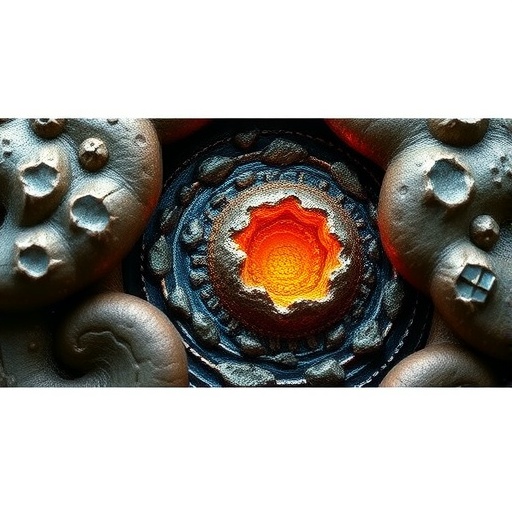
In an intriguing discovery bridging biology and materials science, researchers from TU Wien and the University of Vienna have unveiled extraordinary properties in the jaws of the predatory bristle worm Perinereis cultrifera. These ancient sea worms possess jaws composed of structural proteins integrated with metal ions, displaying characteristics reminiscent of metals — yet they remain biologically unique. This has led scientists to coin a new category: bio-metals.

The team’s study, recently published in Biophysics Reviews, utilized nanoindentation, a method that applies microscopic mechanical probes to measure hardness and elasticity. Their analysis showed a higher concentration of metal ions localized near the jaw tips, correlating with increased hardness. This spatial variation in composition suggests a natural optimization strategy enhancing the worm’s ability to bite and crush.

A remarkable finding emerged when researchers observed the Nix-Gao nanoindentation size effect, often seen in crystalline metals like copper and silver. This size effect means that smaller regions within the worm’s jaw become significantly harder to indent due to complex strain distributions at the atomic scale, resulting in enhanced fracture resistance. The identification of this effect in a biological material is unprecedented, highlighting the sophistication of natural bio-metals.

However, bio-metals diverge from traditional metals in a critical way: their elasticity also depends on size. Unlike standard crystalline metals, bristle worm jaws exhibit size-dependent elasticity, introducing a new dimension to the mechanical behavior of natural composites. This distinct characteristic suggests that bio-metals operate under multifaceted micromechanical principles.

Theoretical modeling revealed that at the atomic level, the interplay between protein structures and metal ions governs these size-dependent mechanical effects. These insights propel the understanding of bio-metals beyond descriptive analysis, offering a framework to mathematically capture their complex behavior.

This research opens exciting avenues for biomimetic material design, potentially inspiring innovative composites that combine hardness with adaptable elasticity. The team aims to extend their investigations across other species and explore the genetic pathways controlling bio-metal formation, possibly enabling tailored bio-inspired materials through genetic engineering.

By revealing nature’s mastery in fabricating materials with nano-scale precision and metal-like traits, this study not only enriches biomaterials science but also challenges established paradigms in materials mechanics. As Christian Hellmich, leading author, emphasizes, this is just the beginning of uncovering the elegant complexity encoded in natural bio-metals.

Subject of Research:
Article Title: Bio-metals’: Ancient biological materials with nanoindentation size effects: Experiments and elements of manifold micromechanics
News Publication Date: 14-Jul-2026
Web References: https://doi.org/10.1063/5.0325367
Image Credits: Zelaya-Lainez et al.

Keywords

Biophysics, Bio-metals, Nanoindentation, Bristle worm, Materials science, Mechanical properties, Size effect, Elasticity

Tags: bio-inspired materials science and biomimicryBio-metal integration in marine organism jawsbridgingdiscovery of bio-metals in evolutionary contextimplications for bio-inspired engineering and materials designmechanical phenomena in ancient predatory marine wormsmetal-like mechanical properties in ancient sea worm jawsnanoindentation analysis of biological materialsnatural optimization of biological hardness and elasticityNix-Gao size effect in bio-materialsstructural proteins with metal ions in biological tissuesunique properties of biological metal ion incorporation
Share26Tweet16
Previous Post

Neurological Symptoms Linked to Hantavirus Infection Revealed

Next Post

New Insights into Liver Cancer Gene Signatures for Prognosis and Therapy

Related Posts

New Emmy Noether Group Builds Theoretical Foundations for Geometric Quantum Matter
Chemistry

New Emmy Noether Group Builds Theoretical Foundations for Geometric Quantum Matter

August 13, 2026
Optical Fiber Sensors Enable Breakthrough Real-Time Sodium-Ion Battery State-of-Charge Measurement
Chemistry

Optical Fiber Sensors Enable Breakthrough Real-Time Sodium-Ion Battery State-of-Charge Measurement

August 13, 2026
Compact BIC Laser Produces Highly Pure Linearly Polarized Emission
Chemistry

Compact BIC Laser Produces Highly Pure Linearly Polarized Emission

August 13, 2026
Three Water Molecules Reveal the Minimal Switch Enabling Ultrafast Proton Transport
Chemistry

Three Water Molecules Reveal the Minimal Switch Enabling Ultrafast Proton Transport

August 13, 2026
Recyclable Energy Storage Device Designed for Sustainability
Chemistry

Recyclable Energy Storage Device Designed for Sustainability

August 13, 2026
Eco-friendly processing lowers costs of novel material for water decontamination
Chemistry

Eco-friendly processing lowers costs of novel material for water decontamination

August 13, 2026
Next Post
New Insights into Liver Cancer Gene Signatures for Prognosis and Therapy

New Insights into Liver Cancer Gene Signatures for Prognosis and Therapy

  • Mothers who receive childcare support from maternal grandparents show more

    Mothers who receive childcare support from maternal grandparents show more parental warmth, finds NTU Singapore study

    27656 shares
    Share 11059 Tweet 6912
  • University of Seville Breaks 120-Year-Old Mystery, Revises a Key Einstein Concept

    1061 shares
    Share 424 Tweet 265
  • Bee body mass, pathogens and local climate influence heat tolerance

    682 shares
    Share 273 Tweet 171
  • Researchers record first-ever images and data of a shark experiencing a boat strike

    546 shares
    Share 218 Tweet 137
  • Groundbreaking Clinical Trial Reveals Lubiprostone Enhances Kidney Function

    531 shares
    Share 212 Tweet 133
Science

Embark on a thrilling journey of discovery with Scienmag.com—your ultimate source for cutting-edge breakthroughs. Immerse yourself in a world where curiosity knows no limits and tomorrow’s possibilities become today’s reality!

RECENT NEWS

  • U.S. Public Institutions Driving Cleantech Commercialization
  • AI-Enhanced CRISPR/Cas12a Biosensor Identifies Biomarkers for Neurodegenerative Movement Disorders
  • Climate change widens adaptation gaps across China’s expressway network
  • New Battery Design Promises Safer, Repairable, More Sustainable Electric Vehicles

Categories

  • Agriculture
  • Anthropology
  • Archaeology
  • Athmospheric
  • Biology
  • Biotechnology
  • Blog
  • Bussines
  • Cancer
  • Chemistry
  • Climate
  • Earth Science
  • Editorial Policy
  • Marine
  • Mathematics
  • Medicine
  • Pediatry
  • Policy
  • Psychology & Psychiatry
  • Science Education
  • Social Science
  • Space
  • Technology and Engineering

Subscribe to Blog via Email

Enter your email address to subscribe to this blog and receive notifications of new posts by email.

Join 5,149 other subscribers

© 2025 Scienmag - Science Magazine

Welcome Back!

Login to your account below

Forgotten Password?

Retrieve your password

Please enter your username or email address to reset your password.

Log In
No Result
View All Result
  • HOME
  • SCIENCE NEWS
  • CONTACT US

© 2025 Scienmag - Science Magazine

Discover more from Science

Subscribe now to keep reading and get access to the full archive.

Continue reading
