


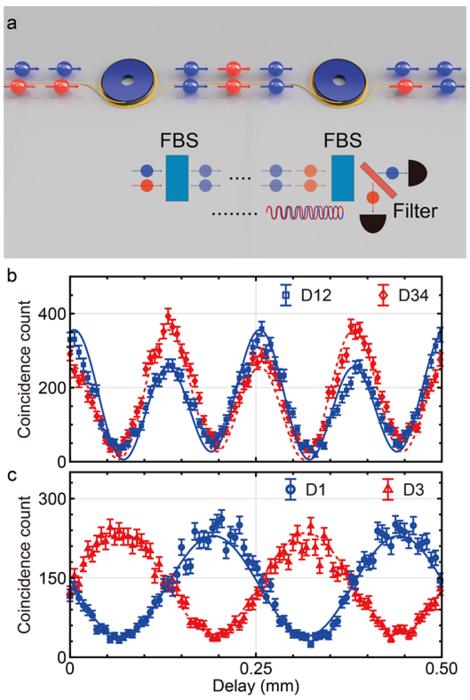
Scientists have introduced a groundbreaking form of quantum entanglement known as frequency-domain photon number-path entanglement. This leap in quantum physics involves an innovative tool called a frequency beam splitter, which has the unique ability to alter the frequency of individual photons with a 50% success rate.

Credit: by Dongjin Lee, Woncheol Shin, Sebae Park, Junyeop Kim, and Heedeuk Shin
Scientists have introduced a groundbreaking form of quantum entanglement known as frequency-domain photon number-path entanglement. This leap in quantum physics involves an innovative tool called a frequency beam splitter, which has the unique ability to alter the frequency of individual photons with a 50% success rate.
For years, the scientific community has delved into spatial-domain photon number-path entanglement, a key player in the realms of quantum metrology and information science. This concept involves photons arranged in a special pattern, known as NOON states, where they’re either all in one pathway or another, enabling groundbreaking applications like super-resolution imaging that surpasses traditional limits, the enhancement of quantum sensors, and the development of quantum computing algorithms designed for tasks requiring exceptional phase sensitivity.
In a new paper published in Light Science & Application, a team of scientists, led by Professor Heedeuk Shin from Department of Physics, Pohang University of Science and Technology, Korea, have developed an entangled states in the frequency domain, a concept akin to spatial-domain NOON states but with a significant twist: instead of photons being divided between two paths, they’re distributed between two frequencies. This advancement has led to the successful creation of a two-photon NOON state within a single-mode fiber, showcasing an ability to perform two-photon interference with double the resolution of its single-photon counterpart, indicating remarkable stability and potential for future applications.
“In our research, we transform the concept of interference from occurring between two spatial paths to taking place between two different frequencies. This shift allowed us to channel both color components through a single-mode optical fiber, creating an unprecedented stable interferometer,” Dongjin Lee, the first author of this paper, added.
This discovery not only enriches our understanding of the quantum world but also sets the stage for a new era in quantum information processing in the frequency domain. The exploration of frequency-domain entanglement signals promising advancements in quantum technologies, potentially impacting everything from quantum sensing to secure communication networks.
Journal
Light Science & Applications
Cite Scienmag News
Katie Riggs. (April 26, 2024). Unveiling a new quantum frontier: frequency-domain entanglement. Scienmag. https://scienmag.com/unveiling-a-new-quantum-frontier-frequency-domain-entanglement/
Katie Riggs. "Unveiling a new quantum frontier: frequency-domain entanglement." Scienmag, 26 April 2024, https://scienmag.com/unveiling-a-new-quantum-frontier-frequency-domain-entanglement/. Accessed 5 September 2026.
Katie Riggs. "Unveiling a new quantum frontier: frequency-domain entanglement." Scienmag. April 26, 2024. https://scienmag.com/unveiling-a-new-quantum-frontier-frequency-domain-entanglement/

