

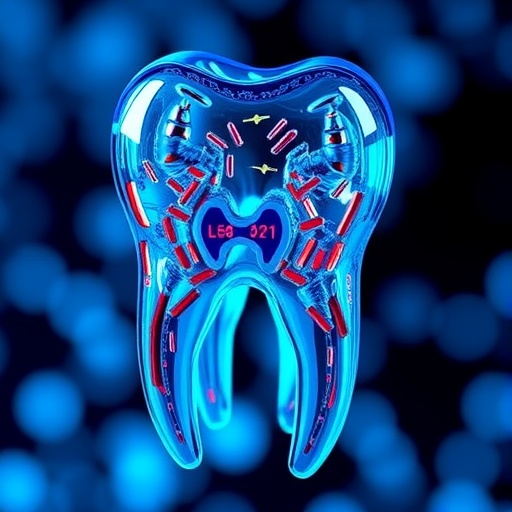
In a groundbreaking study that unravels one of nature’s microscopic architectural marvels, researchers from Masaryk University in the Czech Republic have elucidated the cellular dynamics behind the formation of the enamel’s intricate decussation pattern. Tooth enamel, the hardest and most mineralized tissue in the human body, owes much of its unparalleled strength and resilience to a highly organized microstructural arrangement of enamel prisms. These prisms, arranged in complex crisscross or “decussation” patterns, create a robust lattice that defies mechanical wear and tear, yet their precise developmental origins have long remained an enigma.
This pioneering work, led by Associate Professor Jan Krivanek of Masaryk University’s Department of Histology and Embryology, employed the rodent incisor as a model to illuminate how enamel’s microscopic patterns arise through cellular behavior. Rodent incisors present an ideal experimental system due to their continuous growth and exceptional resilience, allowing dynamic studies of enamel formation in vivo. By leveraging cutting-edge genetic lineage tracing and live imaging methodologies, the study unmasked a rare population of dental epithelial stem cells expressing the Sox10 gene, localized specifically within the enamel-producing labial epithelium.
The researchers discovered that these Sox10-positive dental progenitor cells clonally proliferate and give rise to ameloblasts—the specialized cells tasked with fabricating enamel. Ameloblasts secrete a proteinaceous enamel matrix that mineralizes into the crystalline enamel prisms. Crucially, the precise spatial and temporal organization of these cells dictates the formation of enamel rods, with each ameloblast responsible for one distinct prism. Understanding how this cellular choreography unfolds was the central challenge addressed by the team.
Dr. Krivanek’s group demonstrated that the decussation pattern originates from a mechanism of directional epithelial sliding and coordinated collective cell migration. Initial ameloblast clusters derived from progenitor clones undergo a near-equal bifurcation, with groups migrating oppositely in tightly coupled, organized sheets. This bidirectional sliding causes interweaving of the ameloblast cohorts, manifesting as the characteristic microscopic crisscross pattern within the enamel’s microstructure. The controlled cellular intercalation and rearrangement facilitate the enamel’s remarkable toughness by creating a crack-resistant architecture.
Using advanced 3D and 4D live imaging, the team captured the dynamic progression of ameloblasts as they rearranged, intercalated, and slid past each other. Each ameloblast leaves behind a single, mineralized prism, collectively producing a densely packed, interwoven enamel framework. This biological patterning reflects a sophisticated evolutionary adaptation to withstand immense masticatory forces and environmental insult, revealing the elegant precision with which developmental biology sculpts functional biomaterials.
Beyond clarifying enamel microstructure formation, this study reshapes the broader understanding of dental stem cell niches and progenitor dynamics within continually growing teeth. The identification of Sox10-positive epithelial stem cells as orchestrators of enamel development provides new insights into how dental tissues maintain homeostasis, yet also opens promising avenues for regenerative dentistry. Harnessing the mechanisms of ameloblast migration and organization could inspire innovative biomimetic materials and strategies to promote enamel regeneration—a longstanding challenge in oral healthcare.
The implications of this work extend into biomaterials science and tissue engineering, where the enamel’s decussation pattern offers a blueprint for synthesizing tough, crack-resistant composites. By mimicking the directional sliding and intercalation observed in ameloblasts, material scientists could design advanced layers with stratified fiber orientations that emulate enamel’s resilience. Such bioinspired approaches have potential applications in dental restorations, prosthetics, and beyond.
Moreover, the detailed mechanistic insights into cellular migration and epithelial sliding enrich the fundamental knowledge of developmental morphogenesis. The findings highlight how collective cellular movements can engineer complex tissue microstructures in a reproducible and highly organized manner. This concept may transcend dental biology, influencing broader studies on epithelial dynamics, organ development, and regenerative processes.
Published in the International Journal of Oral Science on February 3rd, 2026, this landmark research represents a leap forward in dental biology and biomaterials innovation. The study was supported by the Czech Science Foundation and Masaryk University’s Faculty of Medicine, underpinning the vital role of sustained research funding in advancing medical science. Dr. Jan Krivanek’s interdisciplinary team combined mouse genetics, molecular biology, and high-resolution imaging to elucidate the cellular basis of enamel’s extraordinary architecture.
Importantly, the research also affirms the absence of competing interests, emphasizing transparency and scientific integrity. It builds upon a growing body of literature exploring dental stem cells and tissue engineering, establishing a foundational understanding that will inform future clinical and technological advancements. As dental diseases such as caries and enamel erosion continue to challenge public health, studies like this pave the way for novel therapeutic interventions rooted in developmental biology.
In conclusion, the meticulous work by Masaryk University researchers illuminates how nature ingeniously assembles one of the body’s toughest materials through spatiotemporally coordinated cellular movements. By decoding the origin of enamel’s decussation pattern, the study provides a rare glimpse into the microscopic machinery underpinning dental tissue resilience. This breakthrough not only deepens the scientific community’s grasp of enamel biology but also catalyzes future innovation in dental medicine, regenerative therapies, and biomaterials science—heralding a new era of biomimetic solutions inspired by the humble tooth.
Subject of Research: Animals
Article Title: Enamel decussation pattern originates from directional sliding of ameloblasts
News Publication Date: February 3, 2026
References: DOI: 10.1038/s41368-025-00412-5
Image Credits: Dr. Jan Krivanek, Masaryk University, Czech Republic
Keywords: tooth enamel, enamel prisms, decussation pattern, ameloblasts, dental epithelial stem cells, Sox10, tooth development, enamel microstructure, collective cell migration, epithelial sliding, biomaterials, regenerative dentistry


