


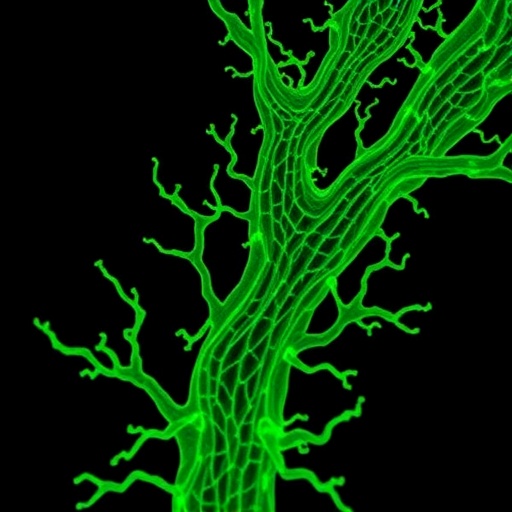
An international consortium of researchers, including key contributors from the Institute of Molecular and Cellular Plant Biology (IBMCP)—a collaboration between the Universitat Politècnica de València and the Spanish National Research Council—has unveiled a groundbreaking molecular mechanism that orchestrates the formation of vascular tissues in plants. Through meticulous experimental investigation, the team has elucidated how the small polyamine molecule, thermospermine, functions as a pivotal biological switch governing the synthesis of proteins crucial for xylem development. Xylem tissue, integral for water conduction and plant structural integrity, emerges as the center of this newly deciphered regulatory pathway, providing fresh molecular insights into plant developmental biology.
The study, recently published in the renowned journal Science, reveals a nuanced mechanism: the regulatory capacity of thermospermine is critically dependent on a precise chemical modification of the ribosome’s RNA. Ribosomes, the cellular machineries responsible for translating mRNA into functional proteins, were traditionally viewed as uniform entities. However, the team demonstrates that their functionality is modulated by methylation events catalyzed by the OVAC enzyme, conferring an additional regulatory layer that enables thermospermine’s targeted control over translation. This chemical modification primes ribosomes to selectively modulate the synthesis of key vascular regulators, markedly advancing the understanding of translational control in plants.
Miguel Ángel Blázquez, a researcher at IBMCP and a co-author of the paper, emphasizes that while this breakthrough fundamentally enhances basic biological knowledge, it possesses transformative potential applications in agriculture and plant biotechnology. By intricately controlling xylem tissue formation through manipulating thermospermine pathways and ribosomal methylation states, future strategies might optimize critical crop traits. These improvements could affect root architecture, storage organ development, water transport efficiency, and biomass accumulation, thereby contributing to more resilient and productive crops under diverse environmental conditions.
The IBMCP team played an instrumental role in experimentally validating the dependency of thermospermine action on ribosome methylation, leveraging a sophisticated translational efficiency assay in Arabidopsis protoplasts—the widely accepted model system for plant cell biology. By dissecting the interplay between thermospermine, ribosomal modifications, and translational output, the researchers uncovered how ribosome heterogeneity can dictate the selective synthesis of proteins governing vascular differentiation, highlighting a new dimension in translational regulation beyond canonical gene expression paradigms.
Specifically, thermospermine selectively regulates the production of two master regulators of vascular development: SACL and LHW. These transcription factors determine the developmental fate of vascular cells, steering them towards either xylem vessel formation for water conduction or into storage cell lineages. Alejandro Ferrando, another IBMCP researcher involved in the study, elucidates that the methylation state of ribosomes by OVAC is indispensable for thermospermine-mediated modulation of SACL and LHW protein levels. This finely tuned balance is paramount for proper vascular tissue patterning and functionality in plants.
The team’s discovery challenges the prevailing dogma that ribosomes serve solely as passive molecular machines dedicated to routine protein synthesis. Instead, this evidence supports an emerging concept of ribosomes as dynamic sensors capable of integrating metabolic signals—such as the presence of regulatory molecules like thermospermine—and modulating translation in a context-dependent manner. This paradigm shift fosters a more refined appreciation of translational control mechanisms as pivotal determinants of cellular fate and tissue specification in multicellular organisms.
Intriguingly, the study demonstrates that ribosome chemical modifications can induce functional specialization within these molecular complexes. Such specialization allows plants to dynamically reprogram protein synthesis in response to developmental cues and environmental stimuli, adding a novel layer of gene expression control that acts immediately at the translational level. This discovery significantly expands the scope of plant molecular biology and suggests potential analogies in other eukaryotic systems where ribosomal heterogeneity might regulate cell differentiation and function.
The research was a collaborative effort led by the University of Cambridge and the University of Helsinki, uniting expertise across continents including Europe, Asia, and North America. The participation of IBMCP and the Spanish National Research Council highlights the strength of international scientific cooperation in tackling fundamental questions in biology. Their collective findings open promising avenues for harnessing ribosome-mediated translational control to improve plant development and agricultural productivity.
From an applied perspective, the ability to modulate xylem formation through molecular interventions targeting ribosome modification pathways and thermospermine signaling might enable the engineering of crops with optimized vascular systems. Enhanced water transport efficiency could yield plants more tolerant to drought and other abiotic stresses, while fine-tuning cell fate decisions may increase biomass production or improve storage organ quality. Such advances underscore the far-reaching implications of this fundamental research in addressing global food security and sustainable agriculture challenges.
On a technical level, the researchers employed state-of-the-art molecular biology techniques, combining genetic, biochemical, and translational profiling approaches. By analyzing methylation patterns of ribosomal RNA and assessing the downstream translational impact on key vascular regulators, the team constructed an integrated model whereby thermospermine acts as both a metabolic signal and a modulator of ribosomal specificity. This dual functionality exemplifies the intricate regulatory networks orchestrating plant development at multiple levels.
This pioneering work not only redefines the role of ribosomes in plant biology but also provides a template for exploring similar translational control mechanisms in other organisms. Future research may delve deeper into molecular determinants that guide ribosomal modifications and their physiological consequences. The implications extend to synthetic biology and bioengineering fields, where harnessing ribosome specialization may facilitate the design of bespoke protein synthesis systems with tailored functional outcomes.
In conclusion, the discovery of thermospermine’s recruitment to methylated ribosomes as a regulatory nexus directing xylem fate revolutionizes our understanding of how plants coordinate tissue differentiation at the molecular level. This research bridges metabolic signaling and translational control, revealing a sophisticated mechanism that transcends traditional views of ribosome uniformity. It sets the stage for innovative strategies in plant biotechnology aimed at improving crop traits by manipulating fundamental molecular processes governing vascular development.
News Publication Date: 12-Feb-2026
Web References: DOI: 10.1126/science.adx2867
Cite Scienmag News
Drew Townsend. (April 2, 2026). IBMCP Team Uncovers “Molecular Switch” Governing Plant Vascular Tissue Formation. Scienmag. https://scienmag.com/ibmcp-team-uncovers-molecular-switch-governing-plant-vascular-tissue-formation/
Drew Townsend. "IBMCP Team Uncovers “Molecular Switch” Governing Plant Vascular Tissue Formation." Scienmag, 2 April 2026, https://scienmag.com/ibmcp-team-uncovers-molecular-switch-governing-plant-vascular-tissue-formation/. Accessed 4 September 2026.
Drew Townsend. "IBMCP Team Uncovers “Molecular Switch” Governing Plant Vascular Tissue Formation." Scienmag. April 2, 2026. https://scienmag.com/ibmcp-team-uncovers-molecular-switch-governing-plant-vascular-tissue-formation/


