

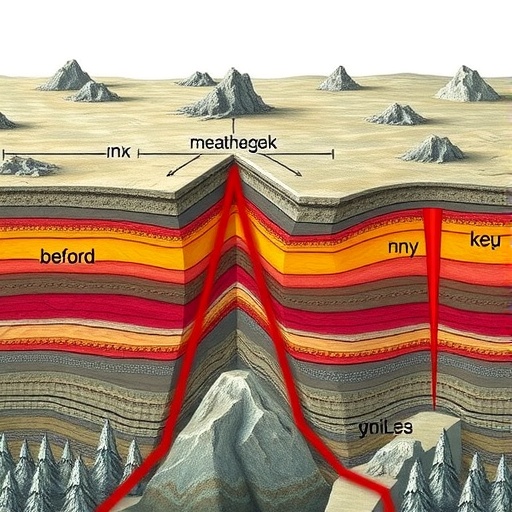
In recent years, the scientific community has amplified efforts to understand seismic activity induced by anthropogenic factors, especially those linked to deep geological structures. A groundbreaking study led by Mu, Z., Jiang, C., Shi, M., and colleagues sheds new light on the complex mechanisms driving seismicity caused by fractures in extra-thick strata at high geological positions. Published in Environmental Earth Sciences, this comprehensive research elucidates the intricate interplay between geological stressors and human interventions, offering novel insights crucial for earthquake risk mitigation strategies in regions characterized by substantial overburden layers.
The study meticulously explores how fractures occurring within exceedingly thick strata, particularly those positioned at considerable depths, can act as critical fault lines triggering localized seismic events. This is of paramount importance because the mechanical behavior of these strata influences the stress redistribution in surrounding rock masses, which may culminate in unexpected seismic accelerations. What sets this research apart is its multidisciplinary approach, combining field observations, geomechanical modeling, and real-time seismic monitoring to present a cohesive understanding of these phenomena.
Earth’s crust is inherently complex, with stress fields varying significantly across different geological formations. The researchers highlight that extra-thick strata—rock layers surpassing standard thickness benchmarks—possess unique structural attributes that render them especially susceptible to fracturing under certain stress conditions. When fractures propagate in these formations, they often generate abrupt changes in pressure and displacement, destabilizing the regional stress equilibrium. This disruption can initiate a cascade of microseismic events, sometimes escalating to perceptible tremors.
One pivotal aspect accentuated by this study is the vertical positioning of these strata layers. Positioned at high geological elevations, these strata experience compounded mechanical influences from overlying and underlying materials, as well as fluid pressures within pore spaces. Such conditions amplify the potential for sudden fracture development. In particular, the researchers emphasize the role of tectonic stress accumulation coupled with anthropogenic activities like mining, reservoir impoundment, and hydrocarbon extraction, all of which provoke environmental perturbations affecting stress regimes.
The methodology employed integrates numerical simulations with historical seismicity data to validate hypotheses regarding fracture-induced seismic events. Advanced modeling techniques allowed the team to replicate fracture propagation patterns within these thick strata under varying stress scenarios. This simulation capability proved critical to dissecting the nuances of how fractures evolve and influence seismic risk in real-world settings. Results demonstrated that fracture networks do not grow uniformly but instead favor zones with pre-existing weaknesses and stress concentrations.
Another remarkable finding revealed by the research concerns the mechanisms by which fluid pressures within these strata contribute to fracture development and seismicity. Elevated pore fluid pressures can significantly reduce effective normal stresses on fault planes, facilitating slip activation and propagation of fractures. The interplay between mechanical stress and hydraulic pressure underlines a critical factor that must be considered in regions undergoing fluid injection or extraction. The implications resonate strongly for industries reliant on subsurface liquid management.
Prevention strategies form a cornerstone of the study’s contributions. By identifying early warning signs associated with fracture genesis in extra-thick strata, engineers and geologists can implement targeted interventions to mitigate seismic hazards. The authors advocate for enhanced monitoring protocols that integrate microseismic event detection with real-time analysis of mechanical stress changes. This proactive approach could provide critical lead times for communities and infrastructure vulnerable to induced seismicity.
Moreover, the research explores engineered solutions to minimize fracture propagation risks. Controlled pressure management within the strata, stress redistribution measures, and improved reservoir depletion techniques are among the proposed methods. These interventions aim to decrease the likelihood of catastrophic fracture-induced seismic events while maintaining the operational effectiveness of subsurface resource extraction or storage projects. The study’s insights offer a promising framework for balancing economic development and environmental safety.
Crucially, this work underscores the importance of interdisciplinary collaboration between geophysicists, petroleum engineers, seismologists, and environmental scientists. Addressing seismic risks linked to extra-thick strata fractures necessitates a fusion of expertise bridging geomechanics, hydrology, and technological innovation in seismic instrumentation. The study stands as a testament to the advances achievable through such concerted efforts, catalyzing safer subsurface practices worldwide.
The temporal evolution of seismicity in response to fracturing was another focus area. Continuous monitoring revealed that seismic activities often precede large-scale fracture events by discernible intervals, suggesting potential predictive capabilities. These temporal correlations enable better forecasting of seismic hazards and contribute to the formulation of dynamic risk management models. Leveraging machine learning algorithms to process seismic datasets could further enhance detection and prediction prospects.
Looking ahead, the implications of this research extend beyond academic interest, with tangible societal and industrial benefits. Regions with extensive extra-thick strata can now refine their seismic hazard maps by incorporating the newly elucidated fracture-seismicity mechanisms. Policymakers and regulatory agencies may employ these findings to formulate stricter guidelines for subsurface operations, safeguarding public safety without stifling technological progress in energy and mineral sectors.
Environmental stewardship also finds a strong ally in the study’s outcomes. Recognizing how induced seismicity arises from fracture dynamics helps prevent unintended ecological disruptions, such as groundwater contamination or surface subsidence. This holistic understanding encourages sustainable development models that harmonize resource utilization with environmental preservation, a pressing need amid escalating global demands.
In conclusion, the work by Mu, Z., Jiang, C., Shi, M., and their collaborators injects vital knowledge into the discourse on seismic risk management connected to extra-thick strata fractures. The thorough mechanistic analyses, prevention strategies, and integrative methodologies embody a pioneering contribution poised to influence seismic research and practical interventions for years to come. As societies increasingly rely on subsurface resources, such foundational scientific breakthroughs play an indispensable role in ensuring safety and resilience against seismic hazards emerging from deep earth processes.
Subject of Research: Mechanisms and prevention of seismicity caused by fractures in extra-thick geological strata at high positions.
Article Title: Study on the mechanism and prevention of seismicity caused by fracture of Extra-thick strata at high positions.
Article References:
Mu, Z., Jiang, C., Shi, M. et al. Study on the mechanism and prevention of seismicity caused by fracture of Extra-thick strata at high positions. Environ Earth Sci 85, 53 (2026). https://doi.org/10.1007/s12665-025-12765-5
Image Credits: AI Generated


