


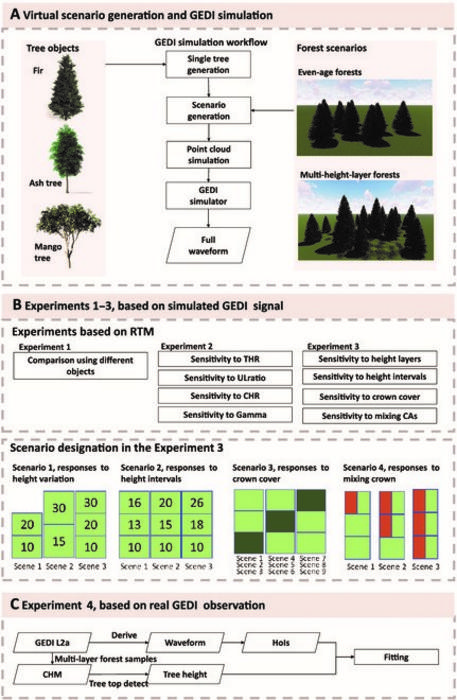
A team of researchers has unveiled a novel approach to accurately characterizing tree height composition in forests using the Global Ecosystem Dynamics Investigation (GEDI) Light Detection and Ranging (LiDAR) technology. This study marks a significant advancement in our understanding of forest ecosystems, shedding light on the intricacies of tree height variability and its implications for ecological studies and climate change mitigation efforts.

Credit: Journal of Remote Sensing
A team of researchers has unveiled a novel approach to accurately characterizing tree height composition in forests using the Global Ecosystem Dynamics Investigation (GEDI) Light Detection and Ranging (LiDAR) technology. This study marks a significant advancement in our understanding of forest ecosystems, shedding light on the intricacies of tree height variability and its implications for ecological studies and climate change mitigation efforts.
Tree height composition, a vital ecological attribute, plays a significant role in influencing forest ecosystems, impacting biodiversity, carbon storage, and energy fluxes. The challenge of accurately mapping this structural diversity has historically been hindered by limitations in scale and detail. However, the advent of recent advancements in remote sensing technologies, particularly the introduction of the spaceborne Light Detection and Ranging (LiDAR) technology known as the Global Ecosystem Dynamics Investigation (GEDI), has opened new pathways for detailed canopy height mapping. Highlighted in a study (DOI: 10.34133/remotesensing.0132) published in the Journal of Remote Sensing on April 3, 2024, this technological breakthrough facilitates more precise assessments of forest structure, thereby enriching our comprehension of forest dynamics, carbon sequestration capabilities, and the overarching influence of forests on climate regulation and biodiversity conservation.
Leveraging GEDI LiDAR, a pinnacle of spaceborne technology, the research delved into the complexities of forest canopies with an accuracy never before achieved. Through the use of advanced radiative transfer models paired with an innovative technique for generating virtual forest objects, the researchers endeavored to simulate the interaction between GEDI’s laser pulses and various forest landscapes. This method allowed for the accurate mapping of tree heights and canopy structures across a spectrum of forest conditions, showcasing the tool’s ability to capture the nuanced details of forest structures, from the towering trees to the dense underbrush. A key innovation of the study was the development of Tree generation based on Asymmetric Generalized Gaussian (TAG) method, which markedly improved the modeling of forest scenes by precisely replicating the physical characteristics of trees within diverse ecosystems. The simulation results confirmed that GEDI waveforms are capable of reflecting complex variations within forest stands, including the differences in tree heights and canopy layer density. This revelation holds profound implications for our understanding of forest structure providing a fresh perspective on forest biodiversity, carbon sequestration, and ecosystem processes with a level of detail previously beyond reach.
Dr. Yao Zhang, the lead author of the study, emphasized the critical nature of understanding tree height composition in efforts to preserve biodiversity and tackle climate change. “The precision offered by GEDI LiDAR technology,” Dr. Zhang stated, “heralds new possibilities for ecological research and forest management, unveiling the vertical complexity of forests in a manner that was once impossible.”
The implications of this research are vast, touching upon ecosystem research, land surface modeling, and climate change studies. By offering a more accurate estimate of aboveground biomass and carbon storage, the findings promise to deepen our understanding of the crucial role forests play in the global carbon cycle, guiding strategies for biodiversity conservation and climate change mitigation.
###
References
Original Source URL
Funding information
This study is supported by the National Science Foundation of China (42141005). This work is also supported by the High-performance Computing Platform of Peking University.
About Journal of Remote Sensing
The Journal of Remote Sensing, an online-only Open Access journal published in association with AIR-CAS, promotes the theory, science, and technology of remote sensing, as well as interdisciplinary research within earth and information science.
Journal
Journal of Remote Sensing
Subject of Research
Not applicable
Article Title
Exploring the Potential of GEDI in Characterizing Tree Height Composition Based on Advanced Radiative Transfer Model Simulations
Article Publication Date
3-Apr-2024
COI Statement
The authors declare that they have no competing interests.
Cite Scienmag News
Denise Maddox. (April 15, 2024). Unlocking the secrets of forest heights: the role of GEDI LiDAR technology. Scienmag. https://scienmag.com/unlocking-the-secrets-of-forest-heights-the-role-of-gedi-lidar-technology/
Denise Maddox. "Unlocking the secrets of forest heights: the role of GEDI LiDAR technology." Scienmag, 15 April 2024, https://scienmag.com/unlocking-the-secrets-of-forest-heights-the-role-of-gedi-lidar-technology/. Accessed 5 September 2026.
Denise Maddox. "Unlocking the secrets of forest heights: the role of GEDI LiDAR technology." Scienmag. April 15, 2024. https://scienmag.com/unlocking-the-secrets-of-forest-heights-the-role-of-gedi-lidar-technology/

