


For realizing lithium-ion batteries (LIBs) with higher energy density (350 Wh kg−1), silicon-based anode materials such as nano-Si, SiOx, and Si-C with high specific capacity (3579 mAh g−1 for nano-Si) and low working potential (~0.4 V vs Li/Li+), together with being cost effectiven, are becoming the main force in the iteration of LIBs. However, the huge volume expansion (300% for Si) results in the formation of solid electrolyte interface (SEI) fractures and subsequent regrowth, which consumes a significant amount of active Li+ leading to low initial coulombic efficiency (ICE, the initial capacity loss exceeds 20% for Si). Considering the root cause of low ICE and poor electrochemical cycle performance is the insufficient lithium source, pre-lithiation technology is emerging as a better choice.

Credit: Hongqiang Zhang, Taisheng Bai.
For realizing lithium-ion batteries (LIBs) with higher energy density (350 Wh kg−1), silicon-based anode materials such as nano-Si, SiOx, and Si-C with high specific capacity (3579 mAh g−1 for nano-Si) and low working potential (~0.4 V vs Li/Li+), together with being cost effectiven, are becoming the main force in the iteration of LIBs. However, the huge volume expansion (300% for Si) results in the formation of solid electrolyte interface (SEI) fractures and subsequent regrowth, which consumes a significant amount of active Li+ leading to low initial coulombic efficiency (ICE, the initial capacity loss exceeds 20% for Si). Considering the root cause of low ICE and poor electrochemical cycle performance is the insufficient lithium source, pre-lithiation technology is emerging as a better choice.
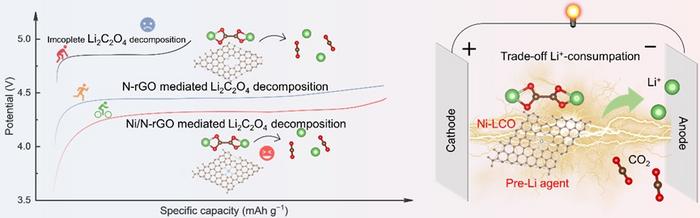
Lithium oxalate (Li2C2O4) with high theoretical capacity, low cost and air stability has shown promise as a lithium compensation material. However, its inherently low electronic conductivity and sluggish decomposition kinetics pose a challenge on its further development. Therefore, a highly efficient, highly conductive, lightweight, and reliable catalyst should be excavated for pushing forward the practical application of Li2C2O4.
In a study published in the KeAi journal Advanced Powder Materials, a team of researchers from Harbin Institute of Technology (Shenzhen) in China proposed a catalytic strategy based on a recrystallization treatment.
“A recrystallization strategy combined with our prepared atomic Ni catalysts (Ni/N-rGO) can be used to modulate the mass transport and decomposition reaction kinetics of Li2C2O4.,” shares corresponding author Deping Li. “For instance, the decomposition potential of Li2C2O4 is significantly decreased from 4.90V to 4.30V with a high compatibility with the current battery systems.”
The researchers found that single-atom Ni sites with high catalytic activity realize a significantly promoted decomposition kinetics of the Li2C2O4. The adsorption model and the underlying decomposition mechanisms of Ni/N-rGO with Li2C2O4 were further revealed by spin-polarized density functional theory (DFT) calculations.
“These findings highlight the potential of our proposed catalytic strategy for promoting the practical applications of pre-lithiation technologies,” says Li.
Notably, the decomposition efficiency of Li2C2O4 was significantly increased from 14.6% to 100%, and the corresponding decomposition potential was modulated from 4.90 V to 4.30 V.
“Meanwhile, the assembled NCM811//SiOx full cell with Ni-LCO delivered a 30.4% increase in the reversible capacity and a 21.5% higher capacity retention ratio,” adds Li.
“This work opens up a new direction for designing highly efficient pre-lithiation technology and offers a promising pathway towards a more sustainable and reliable energy future.”
###
Contact the author: Jingyu Lu (lujingyu@hit.edu.cn)2, Lijie Ci (cilijie@hit.edu.cn)1, Deping Li (lideping@hit.edu.cn)1.
1 State Key Laboratory of Advanced Welding and Joining, School of Materials Science and Engineering, Harbin Institute of Technology (Shenzhen), Shenzhen 518055, China;
2 School of Science, Harbin Institute of Technology (Shenzhen), Shenzhen 518055, China;
The publisher KeAi was established by Elsevier and China Science Publishing & Media Ltd to unfold quality research globally. In 2013, our focus shifted to open access publishing. We now proudly publish more than 100 world-class, open access, English language journals, spanning all scientific disciplines. Many of these are titles we publish in partnership with prestigious societies and academic institutions, such as the National Natural Science Foundation of China (NSFC).
Journal
Advanced Powder Materials
Method of Research
Experimental study
Subject of Research
Lab-produced tissue samples
Article Title
Unlocking the decomposition limitations of the Li₂C₂O₄ for highly efficient cathode preliathiations
COI Statement
The authors declare that they have no known competing financial interests or personal relationships that could have appeared to influence the work reported in this paper.
Cite Scienmag News
Bethany Barker. (September 4, 2024). Unlocking the decomposition limitations of the Li₂C₂O₄ for highly efficient cathode preliathiations. Scienmag. https://scienmag.com/unlocking-the-decomposition-limitations-of-the-li%e2%82%82c%e2%82%82o%e2%82%84-for-highly-efficient-cathode-preliathiations/
Bethany Barker. "Unlocking the decomposition limitations of the Li₂C₂O₄ for highly efficient cathode preliathiations." Scienmag, 4 September 2024, https://scienmag.com/unlocking-the-decomposition-limitations-of-the-li%e2%82%82c%e2%82%82o%e2%82%84-for-highly-efficient-cathode-preliathiations/. Accessed 5 September 2026.
Bethany Barker. "Unlocking the decomposition limitations of the Li₂C₂O₄ for highly efficient cathode preliathiations." Scienmag. September 4, 2024. https://scienmag.com/unlocking-the-decomposition-limitations-of-the-li%e2%82%82c%e2%82%82o%e2%82%84-for-highly-efficient-cathode-preliathiations/

