

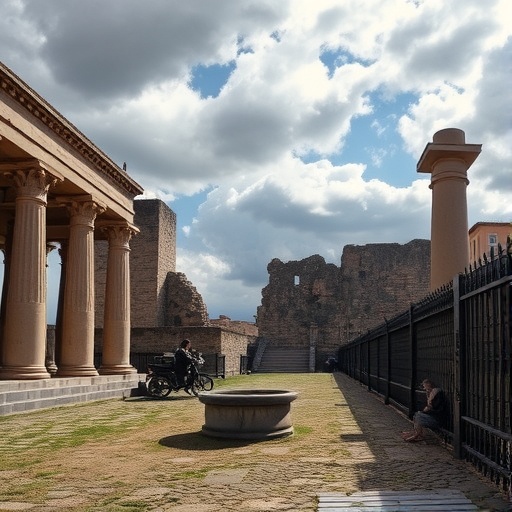
In a groundbreaking study published in 2026, an international consortium of archaeologists and chemists has unveiled unprecedented findings regarding the domestic religious practices of Pompeii, the ancient Roman city famously buried by the catastrophic eruption of Mount Vesuvius in 79 AD. By employing advanced chemical and microscopic analytical techniques on ash residues recovered from excavated incense burners, the researchers have identified exotic aromatic substances that illuminate Pompeii’s integration into a vast and complex trade network spanning continents.
The preservation of Pompeii and its artifacts under volcanic ash provides an extraordinary snapshot of Roman life almost two millennia ago. Among the items extensively researched are household altars, which contained incense burners—vessels used by inhabitants to offer fragrances to their gods in domestic rituals. Prior to this study, the exact substances burned in these everyday religious contexts remained speculative. Through meticulous residue analysis, the team has produced direct molecular evidence, revealing not only a variety of local botanicals but also exotic resins imported from distant tropical regions of Africa and Asia.
Key to this research was the identification of distinct chemical markers emblematic of tree resins known today to originate from tropical rainforests. The analysis demonstrated that these substances were not indigenous to the Italian peninsula, thereby substantiating the notion that Pompeian inhabitants had access to luxury goods from far-flung regions. This discovery significantly reshapes our understanding of the scope and reach of Roman trade routes, suggesting that Pompeii’s economy and culture were directly connected to global commerce nearly two thousand years ago.
Complementing the identification of exotic resins, the study uncovered molecular signatures indicative of grape-derived products, likely wine, within the incense burners. This aligns with Roman literary and iconographic sources that describe the use of wine in ritualistic contexts, yet provides the first physical corroboration of these ethnographic accounts. The presence of wine residues alongside burnt aromatic substances reveals a complex ritual practice involving multi-component offerings, thus enriching the historical narrative of domestic cult activities.
The interdisciplinary nature of the study cannot be overstated. By integrating chemical analysis techniques such as gas chromatography-mass spectrometry (GC-MS), Fourier-transform infrared spectroscopy (FTIR), and scanning electron microscopy (SEM), the team could characterize organic molecules at an unprecedented resolution. These methods allowed for the discrimination of overlapping chemical profiles from mixed botanical sources, revealing a mosaic of ritual substances once thought lost to antiquity.
Moreover, microscopic examination uncovered microremains—tiny fragments of plant tissues and resins adhered to the internal surfaces of the burners—which further authenticated the molecular findings. The combination of molecular and physical evidence creates a robust framework, contextualizing the domestic religiosity of Pompeii within its wider economic and cultural milieu.
The implications extend beyond the realm of archaeology. This empirical evidence reinforces broader models of ancient globalization, demonstrating how everyday religious practices were materially influenced by the long-distance exchange of goods. These findings imply a sophisticated consumer economy, where ritual consumption mirrored wider socioeconomic trends, integrating local and exotic elements into daily life.
Pompeii Archaeological Park, responsible for preserving this UNESCO World Heritage site, accentuates the value of such scientific explorations. According to the park’s director, Gabriel Zuchtriegel, contemporary archaeological methodologies that embrace interdisciplinary collaboration are transforming our comprehension of Roman urbanism and culture. This research exemplifies how combining state-of-the-art science with excavation data unlocks secrets hidden for centuries.
The study also highlights the importance of reexamining previously-excavated materials using modern analytical approaches. As older collections are reanalyzed, we can expect further revelations that challenge and refine the historical record. The volatile history of Pompeii, rather than limiting our knowledge, provides a uniquely preserved repository ripe for new scientific interrogations.
Ultimately, these findings amplify understanding of the symbolic and economic dimensions of ritual in ancient societies. The detection of imported incense and wine in domestic altars attests to a nuanced interaction between local tradition and global influences, embodied through the sensory experience of scent and taste in sacred contexts. Such insights open up new avenues for exploring the interconnectedness of ancient peoples and their world.
This research not only enhances archaeological interpretations of Pompeii but also inspires broader reflections on globalization, culture, and religion in antiquity. As the scientific techniques employed continue to advance, future studies will doubtless unearth more about the intricate tapestry of human history, linking tiny ash residues to expansive narratives of trade, belief, and identity.
Subject of Research: Analysis of incense burner residues to understand domestic cult practices and trade networks in ancient Pompeii.
Article Title: Ashes from Pompeii: incense burners, residue analyses and domestic cult practices
News Publication Date: 30-Mar-2026
Web References: http://dx.doi.org/10.15184/aqy.2026.10320
Keywords: Pompeii, Roman domestic cults, incense burners, residue analysis, ancient trade networks, exotic resins, archaeological chemistry, biomolecular archaeology, Mount Vesuvius, ancient globalization, ritual wine, interdisciplinary research


