


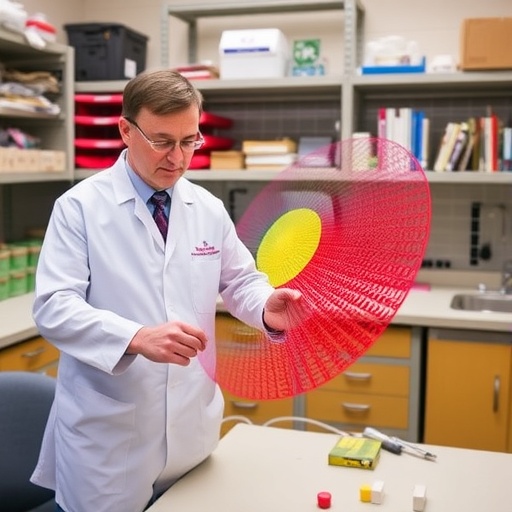
In a groundbreaking advancement poised to redefine the domain of radiation detection, researchers at the University of Oklahoma have pioneered an innovative class of hybrid materials by reimagining the fundamental principles that govern light emission in perovskite compounds. Their work, recently published in the prestigious Journal of the American Chemical Society, has unveiled a sophisticated method of leveraging organic-inorganic layered perovskites that promise unprecedented enhancements in both the speed and efficiency of scintillation processes crucial for fast radiation detectors.
Perovskites, renowned for their unique crystalline framework defined by an orderly atomic arrangement, have long captivated the attention of materials scientists. Traditionally, the scientific community has concentrated primarily on the inorganic framework within these hybrids, as it was assumed to be the primary contributor to desirable photonic and electronic properties. However, this conventional viewpoint has been challenged rigorously by the OU team led by graduate student M S Muhammad, whose research overturns this assumption by meticulously exploiting the organic component’s potential within these layered perovskite architectures.
The novelty of this study lies in the strategic incorporation of organic molecules, specifically stilbenes, into the perovskite lattice. This molecular integration is not merely a cosmetic modification but an essential design principle that profoundly enhances the material’s photoluminescence capabilities. Notably, the organic moiety is responsible for rapid light emission, a fundamental characteristic for applications involving fast scintillation – a critical attribute for detectors meant to capture high-energy radiation like neutrons, X-rays, and gamma rays with maximum temporal resolution and minimal lag.
This research confronts the inherent differences in emission dynamics between the inorganic and organic parts of the material. Inorganic components typically exhibit slower emission lifetimes, which hampers their utility in fast radiation detection scenarios that require rapid response times. Conversely, the organic components usher in ultrafast emissions due to their distinct electronic structures and relaxation mechanisms. By synthesizing a hybrid system that harmonizes these two disparate yet complementary properties, the OU researchers have demonstrated a remarkable fivefold increase in light emission efficiency relative to the organic molecules utilized in isolation.
Dr. Bayram Saparov, the senior author of the study, emphasizes the transformative potential of this discovery: “Traditional perovskite research has largely sidelined the organic components as secondary or inert. Our approach refocuses the narrative by showcasing that organic molecules are not merely passive participants but can actively drive scintillation at speeds unparalleled by their inorganic counterparts.” This insight shifts the paradigm, opening avenues for the design of next-generation scintillators that are both highly efficient and exhibit rapid photon emission.
Beyond speed and efficiency, the study also tackles a perennial challenge faced by radiation detection materials – environmental stability. Many existing scintillators degrade rapidly when exposed to ambient air, necessitating costly and cumbersome encapsulation methods to preserve their functional integrity. Intriguingly, the new hybrid perovskite materials developed at OU have demonstrated robust stability, maintaining their structural and photonic properties over a span exceeding one year without any protective coverings. This resilience in open-air conditions dramatically reduces maintenance complexities and broadens the scope for practical deployment in diverse environments.
The implications for fast neutron and gamma-ray detection are profound. Detectors must not only be sensitive and efficient but also capable of rapid recovery for successive events in high-flux radiation fields. The organic component’s expedited luminescence lifetime empowers these hybrid materials to meet such stringent requirements. Muhammad’s research suggests that this class of materials can rival, if not surpass, the performance metrics of current state-of-the-art scintillators, offering a strategic edge in applications ranging from medical imaging and nuclear security to high-energy physics experiments.
Technically speaking, the enhancement arises from the synergistic retention of excitons – bound states of electrons and holes – within the layered perovskite geometry, modulated by the presence of stilbene molecules. This synergy fosters radiative recombination pathways that are more rapid and efficient than those found in conventional inorganic perovskites. The team’s methodical exploration of interlayer chemical environments and organic molecular design has opened new frontiers in the control of quantum phenomena that dictate photoemission kinetics.
Moreover, this work underscores a broader scientific message about the importance of hybrid material systems in transcending the limitations inherent to singular organic or inorganic platforms. By bridging molecular chemistry with solid-state physics, the research illustrates the profound benefits of materials engineering at the nanoscale, where interfacial interactions and layered structuring yield emergent properties unattainable by individual constituents alone.
As the field moves forward, this pioneering approach invites further refinement and optimization. Muhammad and colleagues anticipate that with detailed molecular tuning and structural engineering, luminescence efficiency can be pushed even further, potentially eclipsing all existing radiation detector materials. Such progress could usher in a new era of ultra-fast, highly sensitive radiation detection technologies integral to both scientific inquiry and practical safety monitoring.
In conclusion, the University of Oklahoma’s breakthrough represents a milestone for materials science and applied physics, demonstrating that the intersection of organic and inorganic chemistry in layered perovskites can deliver superior photoemission characteristics. As these organic-stabilized hybrid perovskites transition from laboratory innovation toward real-world devices, their impact will likely resonate across multiple sectors where rapid, reliable radiation detection is paramount.
News Publication Date: 13-Jan-2026
Web References: http://dx.doi.org/10.1021/jacs.5c20638
Keywords
Perovskites, Crystallography, Materials Science, Materials Engineering
Cite Scienmag News
Bethany Barker. (February 18, 2026). University of Oklahoma Scientists Create Durable Hybrid Materials to Accelerate Radiation Detection. Scienmag. https://scienmag.com/university-of-oklahoma-scientists-create-durable-hybrid-materials-to-accelerate-radiation-detection/
Bethany Barker. "University of Oklahoma Scientists Create Durable Hybrid Materials to Accelerate Radiation Detection." Scienmag, 18 February 2026, https://scienmag.com/university-of-oklahoma-scientists-create-durable-hybrid-materials-to-accelerate-radiation-detection/. Accessed 3 September 2026.
Bethany Barker. "University of Oklahoma Scientists Create Durable Hybrid Materials to Accelerate Radiation Detection." Scienmag. February 18, 2026. https://scienmag.com/university-of-oklahoma-scientists-create-durable-hybrid-materials-to-accelerate-radiation-detection/


