


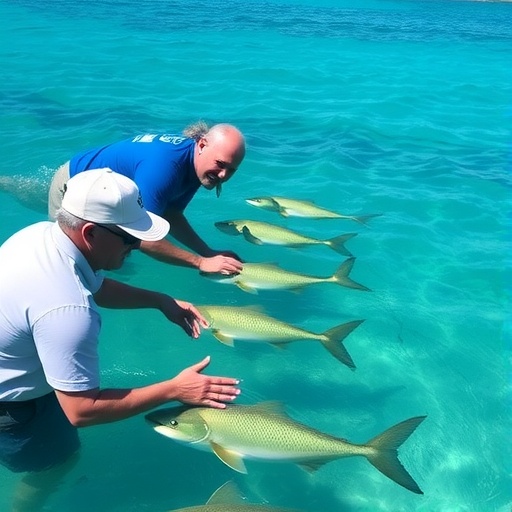
The University of Miami Rosenstiel School of Marine, Atmospheric, and Earth Science has become a pivotal partner in a groundbreaking national initiative aimed at revolutionizing the United States’ seafood production through advanced aquaculture research and technology. This collaborative effort, known as the Cooperative Institute Fostering Aquaculture Research and Markets (CIFARM), is spearheaded by the University of New Hampshire and was established with substantial funding from the National Oceanic and Atmospheric Administration (NOAA). CIFARM represents a significant leap forward in addressing the pressing need for sustainable and domestically sourced seafood, encompassing a multifaceted approach that integrates ocean science, environmental forecasting, and innovative aquaculture techniques.
The inception of CIFARM marks a concerted response to the vulnerabilities exposed in the global seafood supply chain, particularly the U.S. reliance on imported seafood, which amounts to over $24 billion annually. This dependency presents both economic and food security challenges, underscoring the urgent necessity to enhance domestic aquaculture capabilities. The institute’s establishment followed a rigorous selection process, reflecting the high stakes and the strategic importance placed on developing cost-effective, resilient, and environmentally responsible seafood production systems. Initial funding of approximately $13.5 million underscores NOAA’s commitment to fostering innovation that can yield tangible impacts on the U.S. seafood industry.
At the heart of CIFARM’s mission is the advancement of cutting-edge technologies designed to optimize aquaculture operations. This includes the application of artificial intelligence (AI) to refine production systems, which promises to increase efficiency, reduce waste, and minimize environmental footprints. Researchers will also undertake demonstration-scale projects to validate new methodologies and infrastructure designs suitable for both nearshore and offshore farming. These efforts are complemented by comprehensive evaluations of oceanographic conditions that directly influence aquaculture outcomes, including water quality parameters, temperature fluctuations, and ecosystem health indicators, ensuring that production methods align with ecological realities.
The University of Miami Rosenstiel School brings to CIFARM a wealth of expertise spanning marine ecosystems, ocean observing systems, environmental forecasting, and coastal resilience. This multidisciplinary knowledge base is essential for projecting the impacts of changing ocean conditions on aquaculture productivity and for developing adaptive management strategies. As Ben Kirtman, dean of the Rosenstiel School, articulated, the integration of scientific data and predictive models will underpin the sustainable expansion of U.S. aquaculture, ensuring that industry growth proceeds without compromising ocean ecosystem integrity or coastal community well-being.
The research led by John Stieglitz, a research associate professor and director of Sustainable Seafood Research and Development at the Rosenstiel School, further highlights the institute’s dual emphasis on science and workforce development. His work focuses on pioneering sustainable marine aquaculture practices while simultaneously cultivating the next generation of professionals equipped to navigate the technical and regulatory complexities of the seafood production sector. This educational dimension is critical, given the industry’s expanding role in meeting consumer demand and contributing to national food security.
CIFARM’s consortium extends beyond academia, including partnerships with industry stakeholders and nonprofit organizations such as New Hampshire Sea Grant, Florida Sea Grant, the University of Southern Mississippi, Mississippi-Alabama Sea Grant Consortium, Hubbs-SeaWorld Research Institute, California Sea Grant, the University of Hawaiʻi, and Hawaiʻi Sea Grant. This broad coalition ensures a comprehensive approach that not only fosters innovation across diverse marine environments but also facilitates knowledge exchange and technology transfer to practitioners across different regions and market segments.
The institute is committed to addressing the multifarious challenges facing U.S. seafood producers through an integrated research agenda. Oceanographic monitoring systems deployed as part of CIFARM’s activities will provide real-time data essential for anticipating environmental stresses and optimizing operational decisions. Furthermore, market analytics will identify barriers and opportunities within the seafood value chain, enabling strategic interventions that enhance competitiveness and supply chain resilience.
A significant aspect of CIFARM’s program is its focus on offshore aquaculture, a domain with immense potential but fraught with technical and regulatory complexities. Offshore farming systems must contend with harsher environmental conditions, requiring robust engineering solutions and precise environmental monitoring to maintain productivity and sustainability standards. CIFARM’s research aims to push the boundaries of offshore aquaculture technology, potentially transforming vast ocean spaces into viable production zones while safeguarding marine biodiversity.
Environmental forecasting integrated with aquaculture practices represents another frontier that CIFARM is pioneering. By leveraging predictive models that assimilate oceanographic, meteorological, and biological data, operators can make informed decisions that mitigate risks such as harmful algal blooms, hypoxia events, and temperature anomalies. This predictive capacity is essential for enhancing the resilience of aquaculture infrastructures and ensuring uninterrupted seafood supply amidst climatic and oceanographic variability.
In response to the accelerating demand for high-quality seafood, CIFARM’s coordinated efforts highlight the intersection of science, technology, and policy. The institute’s work informs not only technological innovation but also regulatory frameworks that balance economic growth with ecological stewardship. By fostering a science-based approach to policy development, CIFARM supports the establishment of standards and guidelines conducive to sustainable industry expansion.
Moreover, CIFARM’s outreach and education initiatives aim to disseminate knowledge beyond the research community, promoting best practices and facilitating public understanding of aquaculture’s role in food security and environmental sustainability. These activities are designed to build societal acceptance and support for aquaculture, addressing common misconceptions and highlighting the industry’s contribution to reducing pressure on wild fish stocks.
The University of Miami Rosenstiel School’s involvement in CIFARM exemplifies the strategic alignment between academic research excellence and national priorities in marine resource management. Through interdisciplinary collaboration and innovative research methodologies, CIFARM is poised to catalyze advancements that could redefine the future of seafood production in the United States, fostering an industry that is both economically viable and environmentally responsible.
The launch of CIFARM stands as a testament to the transformative potential of cooperative research in addressing complex, multifaceted challenges. By integrating environmental science, technology innovation, and market analysis, the institute sets a precedent for holistic approaches to resource development. As demands on marine resources intensify globally, CIFARM offers a model for sustainable stewardship that balances growth, resilience, and ecosystem health, promising to secure America’s position as a leader in sustainable seafood production for decades to come.
News Publication Date: June 9, 2026
Web References: Not provided in the source.
References: Not provided in the source.
Cite Scienmag News
Violet Maxwell. (June 9, 2026). University of Miami Partners with NOAA Cooperative Institute to Propel Sustainable Aquaculture in the US. Scienmag. https://scienmag.com/university-of-miami-partners-with-noaa-cooperative-institute-to-propel-sustainable-aquaculture-in-the-us/
Violet Maxwell. "University of Miami Partners with NOAA Cooperative Institute to Propel Sustainable Aquaculture in the US." Scienmag, 9 June 2026, https://scienmag.com/university-of-miami-partners-with-noaa-cooperative-institute-to-propel-sustainable-aquaculture-in-the-us/. Accessed 4 September 2026.
Violet Maxwell. "University of Miami Partners with NOAA Cooperative Institute to Propel Sustainable Aquaculture in the US." Scienmag. June 9, 2026. https://scienmag.com/university-of-miami-partners-with-noaa-cooperative-institute-to-propel-sustainable-aquaculture-in-the-us/


