

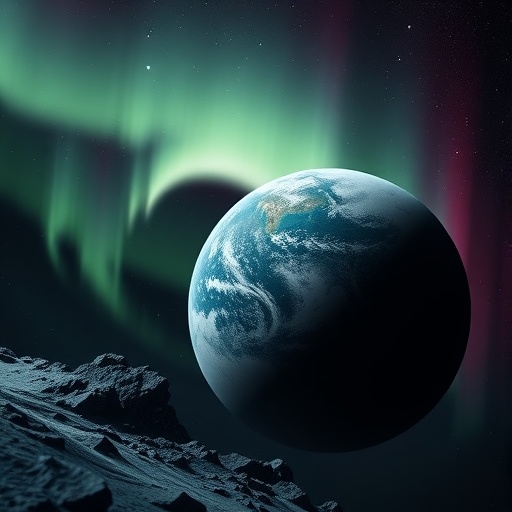
In a breakthrough that deepens our understanding of magnetic phenomena beyond Earth, an international team of astrophysicists has revealed striking similarities between the auroras on Ganymede—Jupiter’s largest moon—and those observed on our home planet. Led by researchers at the University of Liège, this pioneering study unveils that despite vastly different environmental conditions, the underlying physical processes giving rise to auroral displays are remarkably universal, extending their reach to celestial bodies beyond planets.
Auroras have enchanted humanity for centuries, painting polar skies with ethereal hues of red, green, purple, and blue. On Earth, these luminous phenomena typically emerge at high latitudes, where energetic particles from the solar wind collide with the planet’s magnetic field and precipitate into the atmosphere. This interaction excites atmospheric oxygen and nitrogen, resulting in visible light shows known as the aurora borealis and aurora australis. Yet, auroral activity is not exclusive to Earth; it also graces the skies of various planetary bodies in our solar system, including Venus, Mars, Jupiter, Saturn, and Uranus.
Ganymede stands apart as the only moon in the solar system possessing its own significant intrinsic magnetic field, closely mirroring that of Earth. This distinct characteristic allows Ganymede to host auroras generated by electron precipitation in its tenuous oxygen atmosphere. However, until recently, spatial resolution limitations in observations—with ground-based instruments struggling to resolve fine auroral details—meant that scientists could not fully decipher the intricate structure of these light emissions on Ganymede.
The game-changer came with NASA’s Juno spacecraft, which has been orbiting Jupiter since 2016. While primarily focused on Jupiter itself, Juno executed a high-speed flyby of Ganymede on July 7, 2021, equipped with an ultraviolet spectrograph (UVS) capable of capturing auroral details at spatial resolutions of just a few kilometers. Unlike previous observations that treated auroras as uniform curtains of light, Juno’s high-resolution UV imaging revealed a complex assemblage of discrete auroral patches, aligned in a chain-like configuration across Ganymede’s poles.
These auroral “beads” observed on Ganymede are strikingly reminiscent of features seen in Earth’s auroras, where they are associated with magnetospheric substorm activity and dawn storms—powerful rearrangements in Earth’s magnetic environment that unleash massive amounts of energy. Correspondingly, Jupiter’s own auroras have displayed similar patchy structures, suggesting a shared magnetospheric dynamic underpinning auroral behavior across disparate celestial environments. This finding emphasizes that the coupling between a planetary magnetic field, its atmosphere, and external plasma flows may universally induce such patchy auroral forms.
The implications of discovering these parallels are profound. Ganymede’s interaction with Jupiter’s magnetosphere mimics in many ways how Earth’s magnetic field interfaces with the solar wind. The presence of analogous auroral microstructures suggests that despite differences in scale, atmospheric composition, and magnetospheric configuration, the fundamental plasma physics driving auroras remains consistent. This universality helps astrophysicists better model space weather processes and plasma interactions in varied astrophysical settings.
Despite Juno’s groundbreaking observations, the spacecraft’s rapid flyby lasting less than 15 minutes comprised a fleeting glimpse of Ganymede’s auroras. As Juno will not revisit Ganymede, the temporal evolution and global variability of these auroral beads remain largely unknown. Fortunately, new frontiers lie ahead with the European Space Agency’s (ESA) Jupiter Icy Moons Explorer (JUICE) mission, set to arrive in the Jovian system in 2031. JUICE will carry an ultraviolet spectrograph akin to Juno’s UVS, but with the advantage of prolonged and targeted observations across Ganymede’s auroral latitudes.
The JUICE mission promises to systematically monitor the spatial and temporal dynamics of Ganymede’s auroras, providing unprecedented insights into the magnetospheric environment and plasma interactions at one of the solar system’s most intriguing moons. Understanding these auroral processes in detail can shed light on Ganymede’s magnetic field strength, atmospheric composition, and their interplay with Jupiter’s enormous magnetosphere, augmenting our knowledge of planetary magnetism and its consequences.
By studying Ganymede’s auroras, scientists also gain valuable comparative perspectives on Earth’s magnetosphere. The surprisingly common presence of auroral beads across distinct planetary environments challenges existing models and encourages the refinement of theories describing magnetosphere-ionosphere coupling, plasma instabilities, and energy transfer mechanisms. These insights hold significance not only for space physics but also for understanding magnetic fields around exoplanets and their potential habitability.
This research was meticulously conducted by the Laboratory of Atmospheric and Planetary Physics (LPAP) at the University of Liège, where the expertise in interpreting infrared and ultraviolet data from Juno’s instruments has been instrumental in advancing our grasp of auroral phenomena. Philippe Gusbin, whose master’s thesis laid the foundation for this study, emphasized the leap forward provided by Juno’s UVS instrument in resolving auroras at such fine spatial scales, while post-doctoral researcher Alessandro Moirano highlighted the physical parallels with terrestrial and Jovian auroral substorm activities.
Released in the peer-reviewed journal Astronomy & Astrophysics, this study titled “Juno’s high spatial resolution ultraviolet observations of Ganymede’s auroral patches” delivers a comprehensive account of the discovery and its significance. The findings underline the importance of coordinated space missions equipped with advanced spectrographic instruments, and they serve as a call to further explore the magnetized environments of moons, planets, and possibly exoplanets through auroral diagnostics.
As humanity prepares for forthcoming explorations of the outer solar system, these revelations about Ganymede’s aurora transform our understanding of magnetic and plasma processes. They spotlight universal astrophysical mechanisms that transcend planetary boundaries, enriching the tapestry of knowledge about our dynamic cosmic neighborhood and shaping the framework for future discoveries in planetary space weather phenomena.
—
Subject of Research:
Article Title: Juno’s high spatial resolution ultraviolet observations of Ganymede’s auroral patches. Constraints on the magnetospheric source region
News Publication Date: 18-Feb-2026
Web References: http://dx.doi.org/10.1051/0004-6361/202558379
References: Astronomy & Astrophysics
Image Credits: NASA/JPL-Caltech/SwRI/UVS/ULiège/Gusbin/Bonfond
Keywords
Ganymede auroras, ultraviolet spectroscopy, Juno spacecraft, magnetosphere, Jovian system, planetary auroras, space weather, plasma physics, auroral beads, Jupiter Icy Moons Explorer, exoplanet magnetospheres, interplanetary interactions


