


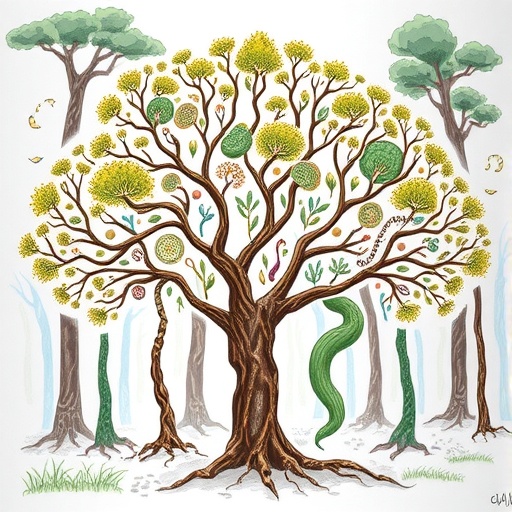
In an era marked by rapid advances in microbiome research, scientists have turned their gaze toward an overlooked yet vast and vital reservoir of microbial life: the inner wood of living trees. This unexplored frontier harbors an immense diversity of microorganisms, intricately adapted to the unique ecological niche within woody tissues. Recent research led by Arnold, Gewirtzman, Raymond, and colleagues has unveiled the staggering complexity and specialization of the microbiomes residing inside living trees, revolutionizing our understanding of plant-microbe interactions and forest ecosystem dynamics.
Traditionally, studies of plant microbiomes have concentrated on readily accessible compartments such as leaves, roots, and soil rhizospheres. However, the wood itself—forming Earth’s largest biomass reservoir—has remained enigmatic, a black box shielding the secrets of its microbial inhabitants. The team’s pioneering investigation illuminates this hidden biosphere, revealing that a single mature tree can host roughly one trillion bacteria nestled within its woody tissues alone. This astonishing concentration underscores wood’s significant role as a microbial habitat, one previously unappreciated in environmental microbiology.
To decipher the complexity of these microbial consortia, the researchers dissected trees at a fine-scale resolution, differentiating between heartwood—the dense, dead central core—and sapwood, the living outer layer conducting water and nutrients. Their analyses identified starkly distinct microbiomes within these compartments, each characterized by unique microbial community compositions and functional potentials. Intriguingly, these wood-inhabiting microbiomes showed minimal overlap with those found in leaves, roots, or surrounding soil, highlighting wood as a specialized ecological niche harboring bespoke microbial assemblages.
Heartwood emerged as a particularly fascinating locus of microbial diversity, hosting specialized archaeal taxa and anaerobic bacterial communities unfamiliar in aboveground plant parts or soil. These microorganisms appear to drive crucial biogeochemical transformations under the oxygen-poor conditions of inner wood, mediating processes that influence nutrient cycling, decomposition, and potentially even tree health. The presence of such anaerobic microorganisms challenges longstanding assumptions about wood sterility and elevates our understanding of the dynamic, microbially mediated processes occurring deep within tree trunks.
The revelation of wood as a microbiome hotspot supports the increasingly embraced conceptual framework of plants as holobionts—integrated units composed of the host organism and its diverse microbial partners. This perspective emphasizes the importance of microbial communities in shaping plant physiology, immunity, and adaptation to environmental stresses. The internal wood microbiome, as demonstrated by this work, may play a pivotal role in strengthening trees against pathogens, modulating internal nutrient fluxes, or sustaining longevity by influencing heartwood durability and decay resistance.
From a methodological standpoint, the study employed cutting-edge metagenomic sequencing, spatially resolved sampling, and sophisticated bioinformatics to decode the community structure and functional potential of wood-associated microbes. By coupling taxonomic profiling with metabolic pathway analyses, the researchers delineated microbial roles in sulfur and nitrogen cycling, hydrogen metabolism, and anaerobic respiration—all processes integral to tree vitality and ecosystem nutrient dynamics. Such integrative approaches mark a leap forward in environmental microbiology, enabling us to move beyond cataloging species toward unraveling their ecological functions in situ.
The findings also hold profound implications for forestry and conservation biology. Trees, as keystone species in terrestrial ecosystems, depend on their internal microbiomes not only for survival but also for interactions with surrounding biota and environmental resilience. Understanding how wood microbiomes influence tree responses to climate change, pathogens, and environmental stressors opens avenues for innovative forest management strategies, potentially leveraging microbes to enhance tree health and productivity sustainably.
Furthermore, the discovery raises intriguing questions about the evolution of plant-microbiome symbioses within wood. How do microbial communities establish and maintain themselves in the apparently inhospitable, oxygen-limited heartwood environment? What genetic and biochemical adaptations enable these microbes to thrive, and how might co-evolution have shaped these relationships? Addressing these questions could illuminate fundamental principles of symbiosis and microbial ecology.
The study also shatters the previous notion that the heartwood is essentially a lifeless, inert compartment. Instead, it appears as a dynamic environment, where microbial activity might contribute to the gradual transformation and aging of wood tissues. This insight redefines heartwood from a passive structural element to an active microbial habitat with ecological and physiological ramifications, prompting a re-evaluation of its role in wood decay and carbon cycling at forest scales.
Moreover, the uniqueness of wood microbiomes among tree species suggests host-specific microbial assemblages finely tuned to individual tree physiology and chemistry. This specificity hints at complex host-microbe signaling pathways, chemical mediation, and niche differentiation within the woody interior, painting a picture of hierarchical microbial biogeography from macro- to microscale within the tree body.
With forests acting as critical carbon sinks and biodiversity reservoirs, unveiling the hidden microbial diversity inside wood not only enriches microbiology but also contributes to our broader understanding of global biogeochemical cycles. The microbial networks within wood may influence carbon sequestration dynamics, decomposition rates, and nutrient feedback loops, factors essential for modeling forest ecosystem responses under shifting climate regimes.
This groundbreaking work invites the environmental microbiology community to embrace wood as a fertile ground for discovery. It urges the development of targeted cultivation strategies, functional assays, and in vivo imaging techniques to further interrogate the lifestyles of these wood-dwelling microbes. By opening this new frontier, the study lays a conceptual and methodological foundation for future research endeavors that could transform forestry, biotechnology, and our grasp of terrestrial life.
In essence, the research spearheaded by Arnold and colleagues exemplifies a paradigm shift in microbiome science, turning attention inward toward tree interiors and uncovering a hidden microbial universe. It expands the notion of holobionts into woody realms, reshaping our perception of plants as complex ecosystems unto themselves. The implications ripple through ecology, evolution, and applied sciences, heralding a new age of integrative biology where microbes within wood are recognized as vital architects of tree health and forest ecosystems.
Cite Scienmag News
Morgan Morrow. (August 7, 2025). Unique and Diverse Microbiomes Within Trees. Scienmag. https://scienmag.com/unique-and-diverse-microbiomes-within-trees/
Morgan Morrow. "Unique and Diverse Microbiomes Within Trees." Scienmag, 7 August 2025, https://scienmag.com/unique-and-diverse-microbiomes-within-trees/. Accessed 3 September 2026.
Morgan Morrow. "Unique and Diverse Microbiomes Within Trees." Scienmag. August 7, 2025. https://scienmag.com/unique-and-diverse-microbiomes-within-trees/


