


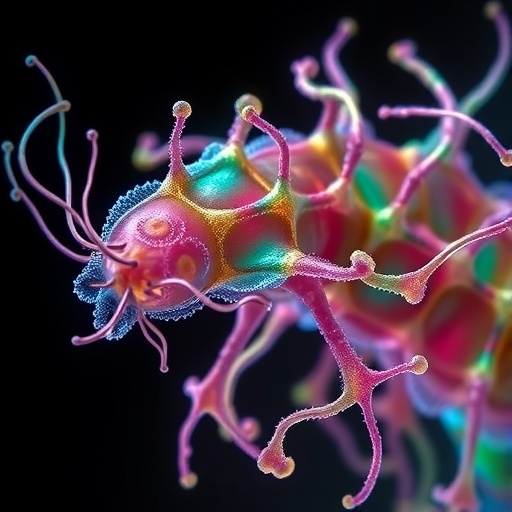
The mystery surrounding the emergence of complex multicellularity in animals has long fascinated evolutionary biologists. Despite the myriad of hypotheses, a fundamental question remains unresolved: how did animals transition from their single-celled ancestors to the intricate, multicellular organisms we observe today? Researchers continue to investigate the various pathways through which simple multicellularity may have evolved, particularly because extant unicellular relatives demonstrate diverse multicellular behaviors. These behaviors include clonal division, multinucleate coenocyte formation, and cellular aggregation, each providing valuable insights into possible evolutionary strategies.
Traditionally, the notion that aggregation—the coming together of individual cells not necessarily sharing a clonal origin—could serve as a precursor to complex multicellularity in animals has been met with skepticism. This is largely due to the belief that aggregation-based multicellularity, often observed in slime molds and other protists, tends to be transient and less tightly regulated compared to clonal multicellularity. However, recent discoveries challenge this paradigm by showing that aggregation is more common in both animal cells and their closest unicellular relatives than previously appreciated.
Specifically, several unicellular organisms closely related to animals have been found to exhibit aggregation behaviors under certain conditions. Three notable species—the choanoflagellates Salpingoeca rosetta and Choanoeca flexa, along with the filasterean Capsaspora owczarzaki—have demonstrated capacities for reversible aggregation or simple colony formation. These findings have opened a window into the possible ancestral states of animal multicellularity and prompt a re-evaluation of aggregation’s role in the evolutionary narrative.
Despite these advances, crucial gaps remain, particularly concerning whether such aggregative behavior is an ancestral trait retained from a common ancestor or a more recently derived characteristic unique to these lineages. Furthermore, the specific biological and molecular mechanisms driving aggregation and their implications for the development of complex multicellular animals are poorly understood. Filling this gap is essential for deepening our comprehension of animal origins.
In a groundbreaking study, a team led by Li, R., Dharamshi, J.E., and Kwok, K. has turned attention toward Ministeria vibrans, a marine, free-living unicellular filasterean closely related to animals. Ministeria vibrans has languished in relative obscurity despite its evolutionary importance. The research unveiled that this organism forms highly reproducible, homogeneous cellular aggregates that maintain stability over long periods, a behavior indicative of regulated multicellular interactions rather than accidental clustering.
These aggregates of Ministeria vibrans suggest a functional advantage possibly linked to feeding efficiency and mating behaviors, providing a plausible evolutionary impetus for the evolution of such multicellularity. The study hypothesizes that aggregation may bolster the organism’s ability to capture and consume bacterial prey more effectively or facilitate genetic exchange, both of which could have been selective pressures favoring multicellular organization in the unicellular-to-multicellular transition.
Importantly, the research delved into the molecular underpinnings of this aggregation process using advanced genomic and transcriptomic techniques. They identified the expression of numerous genes homologous to those implicated in animal multicellularity. These genes play pivotal roles in cell adhesion, intracellular signaling, and transcriptional regulation, fundamental processes for constructing and maintaining multicellular architectures in animals.
The deployment of such genes during Ministeria vibrans aggregation underscores a profound evolutionary continuity. It indicates that components of the intricate animal multicellular toolkit were already operational in unicellular ancestors, serving aggregation-based functions before being repurposed or co-opted for more complex developmental pathways in animals. This molecular evidence supports a model where aggregative multicellularity was an ancestral trait that paved the way for the emergence of complex multicellular animals.
These findings shed new light on the evolutionary mechanisms driving multicellularity and challenge long-held assumptions that aggregation is merely a rudimentary or ancillary form of multicellular organization. Instead, aggregation appears to be a viable and potentially critical route toward complexity, reinforcing the idea that evolutionary innovation often arises from co-opting existing biological systems for new functions.
Moreover, the temporal stability and reproducibility of Ministeria vibrans aggregates contrast with the transient aggregates observed in other protists, implying that regulatory mechanisms necessary for stable multicellularity can evolve early in unicellular lineages. This stability might be a cornerstone facilitating the gradual integration of cellular functions and cooperation, hallmarks of true multicellularity.
By positioning aggregative multicellularity as a key evolutionary strategy, the study invites a broader reconsideration of how multicellular animals originated. The presence of conserved genetic components involved in aggregation across diverse unicellular relatives argues for a mosaic evolution of multicellularity, involving multiple mechanisms simultaneously rather than a single, linear pathway.
In conclusion, the research by Li and colleagues brings us closer to understanding the complex evolutionary journey from unicellularity to multicellularity. By demonstrating that aggregative behavior, regulated by genes ancestral to animals, exists in Ministeria vibrans, they provide compelling evidence that aggregation was not simply a dead-end evolutionary experiment but rather a foundational step in the assembly of the animal multicellular toolbox. This work not only advances evolutionary biology but also opens new avenues for exploring the origins of animal complexity.
Cite Scienmag News
Gavin Prescott. (June 9, 2026). Unicellular Link Ties Multicellularity to Animals. Scienmag. https://scienmag.com/unicellular-link-ties-multicellularity-to-animals/
Gavin Prescott. "Unicellular Link Ties Multicellularity to Animals." Scienmag, 9 June 2026, https://scienmag.com/unicellular-link-ties-multicellularity-to-animals/. Accessed 3 September 2026.
Gavin Prescott. "Unicellular Link Ties Multicellularity to Animals." Scienmag. June 9, 2026. https://scienmag.com/unicellular-link-ties-multicellularity-to-animals/


