


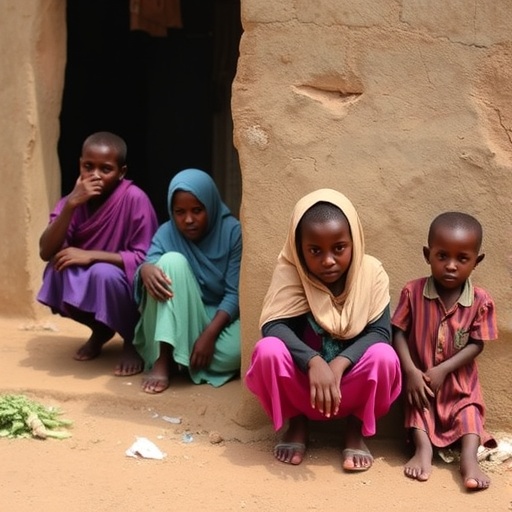
In a world marked by economic fluctuations and pressing humanitarian challenges, the intricate relationship between unemployment and food insecurity has come to the forefront of global discussions, particularly in vulnerable regions such as Somalia. A recent study conducted by academics Abdullah O. Hassan and Abdirahman S. Abdulle delves into this pressing issue, aiming to illuminate the connection between rising unemployment rates and escalating levels of food insufficiency. Their research, published in Discover Sustainability, provides a comprehensive analysis of the socio-economic factors that intertwine these two critical issues, revealing the alarming consequences they have on the livelihoods of Somali citizens.
The findings of this research underscore the complex web of causation linking unemployment with food insecurity, particularly in a country that has been grappling with instability for decades. Somalia’s economy has faced numerous shocks—from civil conflict to natural disasters—to create a scenario where joblessness not only erodes individual dignity but also exacerbates the already precarious food situation. The authors suggest that understanding this nexus is vital for policymakers aiming to craft effective interventions that can alleviate poverty and improve food accessibility.
One of the most striking assertions made in the study is the suggestion that the relationship between unemployment and food scarcity is not merely correlational but deeply causal. High levels of unemployment lead to decreased purchasing power among households, which directly affects their ability to access adequate nutrition. This cycle of deprivation is particularly pertinent in urban areas, where reliance on the market for food is predominant and unemployment has surged due to various economic disruptions. The authors argue that this relationship highlights the urgent need for targeted social safety nets.
The research employs a mixed-methods approach, combining quantitative data from national surveys with qualitative interviews from affected populations. This dual approach enhances the richness of the findings, providing a more nuanced understanding of how unemployment shapes food insecurity beyond mere statistics. The authors emphasize the vital role of local context in comprehending and addressing these issues, as the experiences of Somali citizens vary widely based on their geographical locations and socio-economic backgrounds.
The study further highlights the unique challenges posed by the COVID-19 pandemic, which added an additional layer of complication to an already fragile situation. The pandemic’s repercussions have spurred job losses across various sectors, leading to an unprecedented surge in food prices in Somalia. Consequently, families who were once able to afford basic necessities found themselves scrambling to secure even the most essential items. The authors offer insights into how altruism and community solidarity emerged in response to this crisis, although these measures were often insufficient to meet the immense demand.
To fully grasp the systemic nature of this issue, it is crucial to consider broader economic trends that have historically plagued Somalia. Years of conflict, flawed economic policies, and environmental challenges have created obstacles that extend beyond immediate concerns of unemployment and food access. Previous research indicates that agricultural productivity has declined significantly over the years, exacerbating food scarcity. Thus, the nexus identified by Hassan and Abdulle must be placed within the context of these prolonged structural issues, providing a clearer picture of how to implement lasting solutions.
Moreover, the authors examine the intersections of gender and vulnerability within the unemployment-food insecurity nexus. Women, who are often tasked with household nutrition and child care, disproportionately bear the brunt of economic instability. The study suggests that interventions aimed at creating jobs should take into account the specific barriers faced by women, such as cultural norms and access to education. By addressing these barriers, policy measures can be tailored to not only create jobs but also ensure that food security initiatives reach the most vulnerable populations effectively.
The implications of this research extend far beyond the borders of Somalia. As nations around the world face the dual challenges of rising unemployment and economic instability exacerbated by global crises, understanding the Somali context can provide valuable lessons. The study advocates for a multi-faceted approach that integrates economic recovery with food security initiatives. Programs focusing on job creation, vocational training, and agricultural investments can be pivotal in breaking the cycle of poverty and food unsustainability, not just in Somalia but globally.
Furthermore, the need for collaborative efforts from international organizations, government agencies, and local communities is emphasized throughout the study. An integrated response is essential, as food insecurity does not exist in isolation. The research offers compelling arguments for the importance of holistic policies that intertwine economic development with humanitarian aid. Increased dialogue and partnerships among various stakeholders can facilitate innovative solutions to combat both unemployment and food scarcity effectively.
In conclusion, Hassan and Abdulle’s study presents a clarion call for attention to the vicious cycle linking unemployment and food insecurity in Somalia. Their work provides a significant contribution to understanding the socio-economic landscape of the region and offers a foundation for future research and policy development. As the world grapples with similar challenges, the insights gained from this research could serve as a stepping stone for more sustained interventions that ensure not only employment opportunities but a more secure and nourished future for vulnerable populations.
This research ultimately underscores that to tackle the issues arising from unemployment and food insecurity effectively, we must understand the intricate dynamics at play. Policymakers must go beyond band-aid solutions and commit to building resilient economic structures that foster both job creation and food security. The urgency of the situation demands our attention now more than ever, as millions continue to suffer under the weight of these intertwined challenges. The path forward requires a concerted effort, driven by data and community engagement, to ensure that all people, particularly those in vulnerable conditions, can thrive.
Hassan, A.O., Abdulle, A.S. Investigating the Nexus between unemployment and food insecurity in Somalia. Discov Sustain 6, 1377 (2025). https://doi.org/10.1007/s43621-025-02393-1
Cite Scienmag News
Violet Maxwell. (December 11, 2025). Unemployment and Food Insecurity: Somalia’s Critical Link. Scienmag. https://scienmag.com/unemployment-and-food-insecurity-somalias-critical-link/
Violet Maxwell. "Unemployment and Food Insecurity: Somalia’s Critical Link." Scienmag, 11 December 2025, https://scienmag.com/unemployment-and-food-insecurity-somalias-critical-link/. Accessed 4 September 2026.
Violet Maxwell. "Unemployment and Food Insecurity: Somalia’s Critical Link." Scienmag. December 11, 2025. https://scienmag.com/unemployment-and-food-insecurity-somalias-critical-link/


