


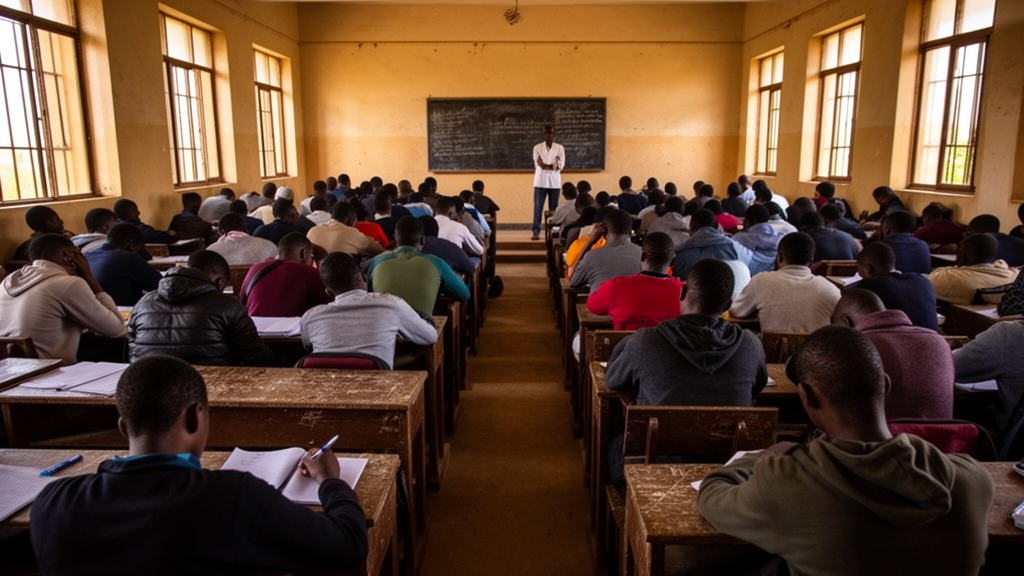
When a university asks the people inside its lecture halls how well teaching and assessment actually work, the answers it receives depend heavily on who is doing the answering. That is the central lesson of a large new survey from Ethiopia, where researchers asked more than 1,500 students, instructors, and university officials across eight public universities to rate the quality of the teaching–learning and assessment processes that shape every undergraduate degree. The results, published in Discover Education, reveal a striking perceptual divide: nearly everyone inside the system views the quality of these core processes positively, except the undergraduates who experience them most directly.
The study, led by Samuel Assefa Zinabu of Hawassa University together with colleagues from the same institution, set out to fill a well-documented gap in how higher education quality is measured. Researchers typically evaluate universities through two convenient lenses: inputs, meaning the financial, physical, and human resources an institution commands, and outputs, meaning graduate competence and learning achievement. But resources alone guarantee nothing unless they are effectively used, and outcomes cannot be understood without examining the processes that produce them. The process dimension—the actual teaching, learning, and assessment activities that transform inputs into outcomes—directly shapes students’ experiences and competence development, yet it remains comparatively under-examined in the research literature.
Ethiopia offers a compelling setting for such an investigation. Over recent decades, the country has pursued one of the most aggressive higher education expansions in Africa, driven by political commitment linking increased access to national development and human capital formation. Government policies prioritized widening participation while emphasizing graduate competence and employability as pillars of poverty reduction strategies. But rapid enrollment growth has not been matched by proportional increases in financial, human, and physical resources. Studies cited by the team indicate that mass expansion has strained institutional capacity and contributed to concerns about declining educational standards, prompting employers, policymakers, and the public to question whether graduates are ready for the labor market.
To capture the process dimension empirically, the researchers employed a descriptive cross-sectional survey design within a quantitative framework. Eight public universities were selected using stratified sampling that reflected the Ministry of Education’s institutional classification system, which divides Ethiopian public universities into research, applied sciences, comprehensive, and specialized categories. The sampled institutions—Addis Ababa, Adama Science and Technology, Madda Walabu, Wachamo, Bahir Dar, Hawassa, Werabe, and Dire Dawa universities—represented approximately 18.36 percent of the country’s public universities. Within each institution, colleges were chosen through simple random sampling, departments were then randomly selected from the chosen colleges, and participants were drawn at random from each department, a multistage random sampling procedure designed to produce a representative cross-section of the university population.
The final sample totaled 1,518 participants: 791 undergraduate students, 391 graduate students, and 336 instructors, university officials, and staff members. Structured questionnaires measured perceptions of teaching–learning and assessment quality using five-point Likert scales ranging from strongly disagree to strongly agree. Students received 15 items addressing teaching–learning processes and 8 items addressing assessment, while instructors and officials received 24 teaching–learning items alongside the common assessment items. University officials, including academic program directors, quality assurance directors, and college deans, were identified through purposive sampling because of their influence on policy implementation, resource allocation, and institutional support systems. Data were analyzed using SPSS version 24, with descriptive statistics summarizing perceptions and inferential tests— independent-samples t-tests and one-way ANOVA with post hoc analyses—examining differences among stakeholder groups.
The descriptive findings painted a consistent picture. Graduate students rated teaching–learning quality positively, with all mean scores above the neutral midpoint of 3.00 and relatively low standard deviations indicating strong, consistent agreement. University officials and faculty members expressed even more favorable views, with mean scores ranging from approximately 3.2 to 3.7. Undergraduate students, by contrast, produced mean scores between roughly 2.9 and 3.3—neutral to moderately positive—with standard deviations around 1.1 to 1.2 reflecting moderate variability and differing experiences among respondents. The same hierarchy appeared for assessment quality: graduate students scored between 3.36 and 3.60, officials and faculty between 3.3 and 3.5, and undergraduates between 3.1 and 3.3, again with the least favorable and most varied responses coming from the undergraduate cohort.
The inferential statistics confirmed that these gaps were not statistical noise. An independent-samples t-test comparing undergraduate and graduate students on teaching–learning quality yielded t = 5.77, p < 0.001, with Levene’s test for equality of variances satisfied, allowing the researchers to reject the null hypothesis of no difference. For assessment quality, the comparison produced t = 5.25, p < 0.001, again favoring graduate students. One-way ANOVA across undergraduates, graduate students, and officials/faculty members revealed a statistically significant difference among the three groups for teaching–learning quality (F = 932.48, p < 0.001), with post hoc LSD tests showing officials/faculty members reporting the highest mean scores, followed by graduate students, and undergraduates the lowest, with all pairwise differences significant. For assessment quality, the ANOVA was again significant (F = 20.58, p < 0.001), and post hoc comparisons showed undergraduates scoring significantly lower than both other groups, while graduate students and officials/faculty members were statistically indistinguishable.
Why would the people delivering and governing education rate it so much more positively than the undergraduates living through it? The discussion section offers several converging explanations. Graduate programs in Ethiopia typically feature smaller class sizes, more specialized curricula, and closer student–faculty interaction, and their pedagogy often emphasizes active learning, research-oriented projects, and scholarly dialogue that align with students’ academic maturity. Graduate students are also evaluated through more diverse and authentic methods—research projects, seminar presentations, comprehensive examinations—that better reflect advanced learning outcomes. Undergraduate education, in contrast, has been repeatedly described in the Ethiopian literature as dominated by traditional, teacher-centered instruction with limited implementation of student-centered pedagogies, compounded by structural challenges such as large class sizes, inadequate resources, and insufficient infrastructure. Prior research has also documented an overreliance on traditional assessment methods, weak alignment with learning outcomes, and limited use of continuous assessment and feedback in Ethiopian institutions.
The perceptual gap itself carries a technical implication for quality assurance systems. If institutions rely on a single stakeholder perspective—most commonly students, or alternatively faculty and administrators—they risk systematically misjudging the quality of their educational processes. Faculty members play a central role in shaping instructional practices and student learning outcomes, while institutional leaders affect quality through governance structures, policy implementation, and support systems. Integrating the perspectives of students, academic staff, and university leaders, the authors argue, offers a more comprehensive and balanced understanding of educational quality, particularly when the focus is the process dimension that research and evaluation frameworks often overlook in favor of input and output indicators.
The recommendations that follow from the findings are correspondingly concrete. The Ministry of Education should shift from emphasizing policy formulation to strengthening policy implementation, establishing clear national standards with measurable performance indicators for teaching and learning, and requiring universities to demonstrate evidence of active learning practices through periodic institutional audits, classroom observations, teaching portfolios, and peer reviews. Improving undergraduate education should become a national strategic priority, with comprehensive teaching enhancement plans targeting the negative effects of large class sizes, expanded tutorial and mentoring programs, stronger academic advising, and particular attention to first-year students whose transition shapes subsequent academic experiences. Assessment reform should be embedded in national policy through a framework promoting constructive alignment among learning outcomes, teaching strategies, and assessment methods, progressively integrating authentic approaches such as project-based learning, portfolios, case studies, presentations, and reflective assignments. Continuous professional development for academic staff should become mandatory and evidence-based, addressing active learning pedagogy, assessment for learning, formative feedback, and digital instructional technologies, with participation in certified teaching development programs incorporated into promotion criteria and performance appraisal systems.
The authors also call for institutionalizing stakeholder-driven quality enhancement, collecting student feedback systematically with valid and reliable instruments, complementing it with perspectives from graduate students, faculty, alumni, employers, and professional bodies, and—critically—establishing transparent mechanisms that communicate how feedback informs curriculum revision, teaching improvement, assessment redesign, and resource allocation. Structural conditions matter too: improving staff-to-student ratios, expanding classroom and laboratory facilities, strengthening digital learning infrastructure, and ensuring adequate teaching materials are prerequisites for implementing student-centered pedagogy effectively. Future research, the team notes, should employ explanatory and longitudinal designs to investigate the institutional, pedagogical, organizational, and contextual factors behind these perceptual differences, alongside qualitative approaches using interviews and focus group discussions. For now, the survey delivers a clear message to quality assurance systems worldwide: the undergraduates at the center of the educational process may be the most honest witnesses to its quality, and listening to them is the first step toward closing the gap between what universities believe they deliver and what their students actually experience.
Subject of Research: Higher Education Quality Research
Article Title: Stakeholders’ perceptions of the teaching–learning and assessment quality in Ethiopian public universities
Article References: Zinabu, S. A., Mihirka, A. A., Wubshet, H., Workneh, A. W., & Nigussie, T. A. (2026). Stakeholders’ perceptions of the teaching–learning and assessment quality in Ethiopian public universities. Discover Education, 5(1), Article 848. https://doi.org/10.1007/s44217-026-02096-3
Image Credits: AI Generated
DOI: 10.1007/s44217-026-02096-3
Keywords: Ethiopian public universities, teaching–learning quality, assessment practices, stakeholder perceptions, higher education quality assurance, undergraduate education, cross-sectional survey, Discover Education, Stakeholders, perceptions, teaching, learning
Cite Scienmag News
Courtney Benton. (October 18, 2026). Undergraduate Students Rate Teaching Quality Lowest in Ethiopian Public Universities Survey. Scienmag. https://scienmag.com/undergraduate-students-rate-teaching-quality-lowest-in-ethiopian-public-universities-survey/
Courtney Benton. "Undergraduate Students Rate Teaching Quality Lowest in Ethiopian Public Universities Survey." Scienmag, 18 October 2026, https://scienmag.com/undergraduate-students-rate-teaching-quality-lowest-in-ethiopian-public-universities-survey/. Accessed 18 October 2026.
Courtney Benton. "Undergraduate Students Rate Teaching Quality Lowest in Ethiopian Public Universities Survey." Scienmag. October 18, 2026. https://scienmag.com/undergraduate-students-rate-teaching-quality-lowest-in-ethiopian-public-universities-survey/


