


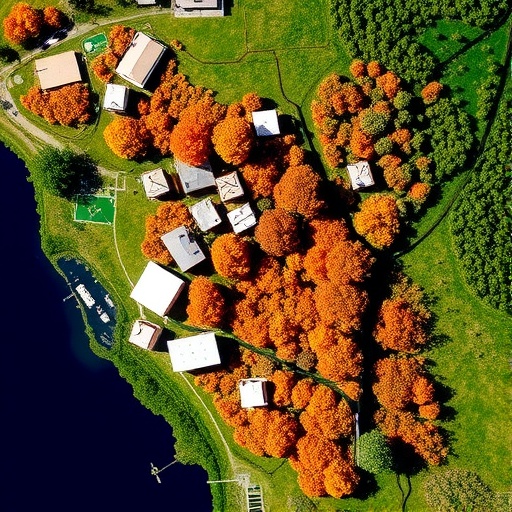
In a groundbreaking study recently published in Remote Sensing Letters, researchers have harnessed the advanced capabilities of NASA’s Plankton, Aerosol, Cloud, ocean Ecosystem (PACE) satellite to track the progression of autumn foliage colors with unprecedented spectral precision and spatial coverage. This innovative approach leverages hyperspectral data to decipher the intricate biochemical signatures embedded in leaves, providing a novel lens to observe the timing and dynamics of fall leaf coloration across vast landscapes.
The PACE satellite, a marvel of remote sensing technology, collects near-daily global coverage with exquisite spectral resolution, enabling scientists to analyze the subtle variations in leaf pigments, including chlorophylls, anthocyanins, and carotenoids. These pigments are critical indicators of leaf physiology and phenology—chlorophylls giving leaves their green hues, anthocyanins responsible for the vivid reds, and carotenoids imparting yellow and orange shades. By applying pigment-sensitive indices to PACE’s spectral data, the research team has been able to produce high-resolution maps detailing the spatial and temporal evolution of fall colors.
Traditional satellite-based vegetation indices, such as the well-known Normalized Difference Vegetation Index (NDVI), primarily capture variations in green leaf biomass and consequently depict a generally smooth decline in greenness as autumn progresses. However, NDVI and similar indices lack the discriminatory power to distinguish between different pigment pathways or to precisely mark the onset and peak of pigment transitions that define fall foliage displays. The PACE-based pigments indices go beyond this limitation by extracting specific biochemical signals from hyperspectral reflectance data, allowing researchers to pinpoint the nuanced shifts in pigment composition that herald the peak of leaf coloration.
This advancement is not merely academic. The ability to monitor fall foliage pigment dynamics in near real-time over continental scales opens a suite of practical applications. One immediate benefit lies in the tourism sector, where “leaf-peeping” drives a multibillion-dollar economy during the autumn months. Providing accurate, up-to-date guidance on peak viewing times and locations can enhance visitor experiences and improve management of tourist inflows, potentially reducing environmental stress on fragile ecosystems.
Beyond tourism, the dataset promises to enrich ecological and agricultural research. Changes in pigment profiles can signal plant stress induced by drought, pest outbreaks, or other environmental factors long before visible damage occurs. Consequently, these indices could facilitate early detection of ecosystem perturbations, feeding into predictive models that enhance our ability to manage natural resources and agricultural productivity in a changing climate.
Karl F. Huemmrich, the study’s lead author and a research professor at the University of Maryland Baltimore County’s Goddard Earth Sciences Technology and Research (GESTAR) II center, emphasized the transformative potential of this approach. He noted that while pigment indices have existed since the early 2000s, this is the first instance they have been applied at a global scale using satellite hyperspectral data continuously and consistently. By accumulating years of observations, Huemmrich anticipates detecting patterns and shifts in leaf phenology linked to broader climate trends, offering new insights into ecosystem responses to environmental changes.
The study also benefits from collaboration with NASA data scientist Skye Caplan, who highlighted the multidimensional nature of PACE data. According to Caplan, PACE does more than observe oceans; it integrates atmospheric and terrestrial measurements, providing a holistic view of Earth systems. This systemic perspective opens doors for cross-disciplinary research, enabling exploration of how atmospheric conditions, land surfaces, and oceanic processes interact, all traceable through PACE’s hyperspectral sensors.
The team’s approach relies on refined pigment indices that leverage specific reflectance wavelengths sensitive to particular pigments. By analyzing hyperspectral signatures, these indices detect the biochemical shifts that signal the degradation of chlorophyll and the consequent rise of anthocyanins and carotenoids during senescence. Such detailed spectral characterization was previously unattainable through multispectral satellite data, underscoring the leap forward offered by PACE’s enhanced sensing capabilities.
Furthermore, this research exemplifies the expanding frontiers of ecosystem science facilitated by PACE data. Earlier research by Huemmrich utilized PACE-derived information to assess ecosystem productivity, while instruments like UMBC’s HARP2, flying aboard the satellite, contribute vital measurements to atmospheric chemistry studies. Together, these efforts demonstrate the satellite’s utility across diverse scientific domains—from phenology to climate modeling to atmospheric monitoring.
Public engagement is also a notable aspect of this research’s impact. PACE data are accessible to the broader public through platforms like NASA Worldview, an interactive portal allowing users to explore daily satellite imagery. As Caplan remarks, the accessibility of such rich, multidimensional data sets invites curiosity and exploration, fostering wider awareness of Earth’s dynamic systems through everyday user experiences.
This new method of observing fall foliage is poised to redefine our understanding of seasonal phenological changes. By capturing pigment transitions with fine temporal and spatial granularity, the study not only advances scientific knowledge but also provides tangible benefits spanning ecological monitoring, tourism management, and climate change research. PACE’s cutting-edge technology thus signals a new era of integrated Earth observation, where the colors of autumn become a window into the health and rhythms of our planet’s ecosystems.
- https://pace.gsfc.nasa.gov/
- https://www.tandfonline.com/doi/full/10.1080/2150704X.2026.2673540
- https://worldview.earthdata.nasa.gov/?l=Reference_Labels_15m(hidden),Reference_Features_15m(hidden),Coastlines_15m,OCI_PACE_True_Color,VIIRS_NOAA21_CorrectedReflectance_TrueColor(hidden),VIIRS_NOAA20_CorrectedReflectance_TrueColor(hidden),VIIRS_SNPP_CorrectedReflectance_TrueColor(hidden),MODIS_Aqua_CorrectedReflectance_TrueColor(hidden),MODIS_Terra_CorrectedReflectance_TrueColor(hidden)&lg=true&t=2026-06-02-T13%3A27%3A35Z
References: 10.1080/2150704X.2026.2673540
Image Credits: Courtesy of Fred Huemmrich
Keywords
PACE satellite, hyperspectral remote sensing, leaf pigments, autumn foliage, anthocyanins, carotenoids, chlorophyll, fall color progression, phenology, plant stress detection, ecosystem monitoring, climate change observation
Cite Scienmag News
Denise Maddox. (June 12, 2026). UMBC-Led Study Harnesses NASA PACE Satellite to Monitor Fall Foliage with Enhanced Precision. Scienmag. https://scienmag.com/umbc-led-study-harnesses-nasa-pace-satellite-to-monitor-fall-foliage-with-enhanced-precision/
Denise Maddox. "UMBC-Led Study Harnesses NASA PACE Satellite to Monitor Fall Foliage with Enhanced Precision." Scienmag, 12 June 2026, https://scienmag.com/umbc-led-study-harnesses-nasa-pace-satellite-to-monitor-fall-foliage-with-enhanced-precision/. Accessed 3 September 2026.
Denise Maddox. "UMBC-Led Study Harnesses NASA PACE Satellite to Monitor Fall Foliage with Enhanced Precision." Scienmag. June 12, 2026. https://scienmag.com/umbc-led-study-harnesses-nasa-pace-satellite-to-monitor-fall-foliage-with-enhanced-precision/


