The work, published in Nature Materials, combines first-principles calculations, symmetry analysis, atomic-resolution imaging and magnetic imaging to characterize the films.
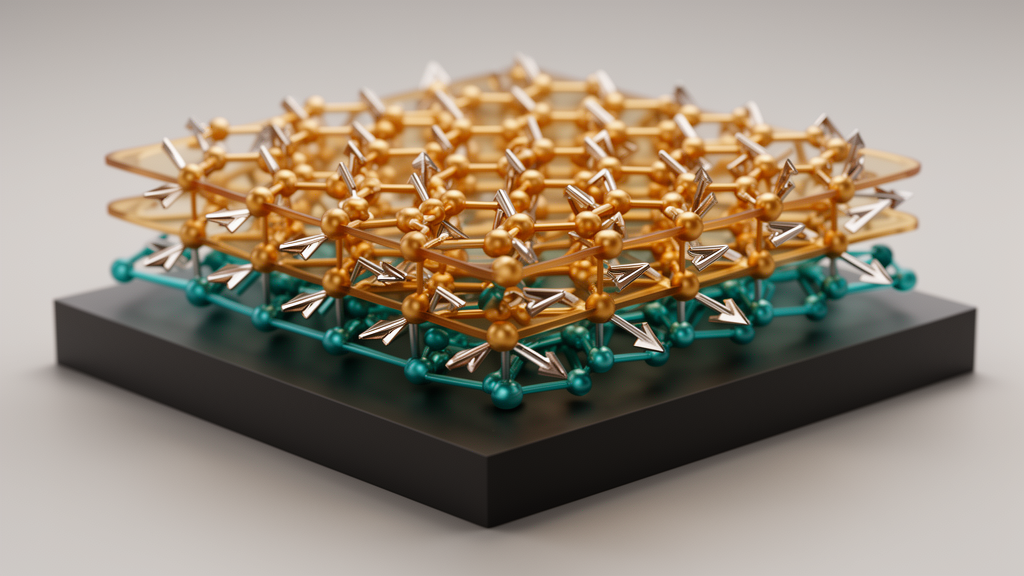
Ultrathin multiferroics are attractive because magnetoelectric materials, which couple electric and magnetic order, promise low-power switching, non-volatile memory and signal transduction. But shrinking them to device-relevant thicknesses has long been problematic. Uncompensated bound charge drives depolarization in ferroelectrics, while off-stoichiometry, reduced magnetic anisotropy and charge transfer at interfaces can produce magnetic dead layers, regions where magnetic order collapses. The new study reports a multiferroic phase of BiFeO3 with no dead layer, achieved by growing the films epitaxially on a metallic SrRuO3 bottom electrode and using epitaxial strain to stabilize a monoclinic crystal structure.
According to the abstract, short-circuit electrostatic boundary conditions and epitaxial strain together drive a continuous, thickness-induced phase transition accompanied by multiferroic topological textures. At four unit cells, these boundary conditions stabilize a collinear monoclinic phase with d-wave altermagnetic order. The reported altermagnetic signatures in the ultrathin films are supported by magnetic circular dichroism and spin-resolved photoemission measurements.
The study is framed as establishing a pathway to stabilize unconventional multiferroicity at device-relevant thicknesses, reframing scaling limits for oxide electronics. Because the reported findings rest on the abstract and figure captions of the published paper, the detailed experimental conditions, quantitative measurements and the full scope of the imaging and spectroscopic evidence are described in the underlying article, which is available by subscription. The authors include researchers from multiple institutions working on oxide molecular-beam epitaxy, electron microscopy, spin-resolved spectroscopy and first-principles theory.
Subject of Research: Altermagnetism and multiferroic order in ultrathin BiFeO3 thin films
Article Title: Altermagnetic signatures and topological textures in ultrathin multiferroic BiFeO3
Article References: Fratian, G., Ramesh, M., Li, X., Golias, E., Nahas, Y., Schultheis, S. M. U., Skolaut, J., Checa, M., Ghosal, A., Krysko, E., Malinowski, P., Faeth, B. D., Priessnitz, J., Fobasso Mbognou, F. C., Hariki, A., Sakurai, K., Furo, M., Ojha, S. K., Congdon, M., … Caretta, L. (2026). Altermagnetic signatures and topological textures in ultrathin multiferroic BiFeO3. Nature Materials. https://doi.org/10.1038/s41563-026-02786-1
Image Credits: AI Generated
DOI: 10.1038/s41563-026-02786-1
Keywords: BiFeO3, multiferroic, altermagnetism, ultrathin films, ferroelectricity, magnetic dead layer, epitaxial strain, topological textures, oxide electronics, spin-resolved photoemission, magnetic circular dichroism, SrRuO3
Cite Scienmag News
Denise Maddox. (October 28, 2026). Ultrathin BiFeO3 films show altermagnetic signatures without a dead layer. Scienmag. https://scienmag.com/ultrathin-bifeo3-films-show-altermagnetic-signatures-without-a-dead-layer/
Denise Maddox. "Ultrathin BiFeO3 films show altermagnetic signatures without a dead layer." Scienmag, 28 October 2026, https://scienmag.com/ultrathin-bifeo3-films-show-altermagnetic-signatures-without-a-dead-layer/. Accessed 28 October 2026.
Denise Maddox. "Ultrathin BiFeO3 films show altermagnetic signatures without a dead layer." Scienmag. October 28, 2026. https://scienmag.com/ultrathin-bifeo3-films-show-altermagnetic-signatures-without-a-dead-layer/