


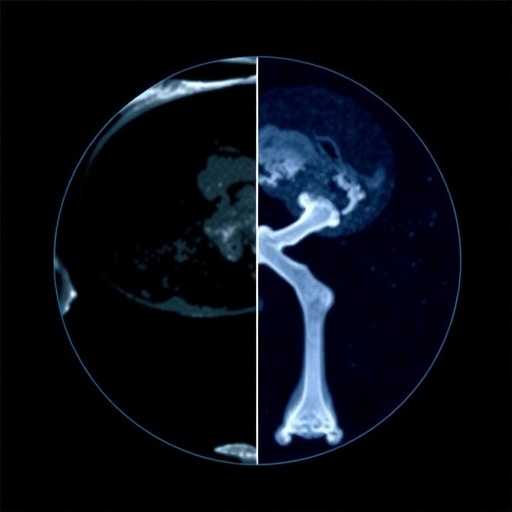
In the relentless pursuit of advancing cancer diagnostics, researchers have unveiled compelling insights into the surveillance of local soft tissue recurrence (LR) in patients treated for primary bone tumors. A groundbreaking study recently published in BMC Cancer compares the diagnostic prowess of ultrasonography (US) against the established magnetic resonance imaging (MRI) standard, illuminating new pathways for postoperative monitoring. This research not only probes the sonographic nuances that characterize osteosarcoma recurrence but also challenges the existing paradigms of tumor surveillance by proposing ultrasonography as a robust, viable alternative.
Primary bone tumors, including osteosarcoma, represent a medical frontier where early detection of recurrence significantly influences patient prognosis and subsequent therapeutic strategies. Traditional postoperative surveillance heavily relies on MRI for its detailed soft tissue resolution; however, accessibility, cost, and patient compliance often limit its universal application. The study in question retrospectively analyzes data gathered over a seven-year span, meticulously comparing US and MRI’s diagnostic efficacy in real-world clinical settings. This comprehensive comparison offers invaluable evidence to refine monitoring protocols.
Intriguingly, the study reveals no statistically significant difference in sensitivity, specificity, or overall accuracy between US and MRI when detecting local soft tissue recurrences. Sensitivity reflects a test’s ability to correctly identify patients with recurrence, and specificity measures the correct exclusion of non-recurrence cases. An accuracy exceeding 90% in both modalities signals that ultrasonography could serve as a frontline diagnostic tool in postoperative surveillance, particularly in resource-limited environments or scenarios demanding rapid assessment.
The sonographic examination, a non-invasive imaging technique utilizing high-frequency sound waves, has traditionally been underappreciated in bone oncology surveillance. Yet, its capability to detect morphological changes in soft tissue around the surgical site is remarkable. The research further delineates specific sonographic features linked to osteosarcoma recurrence, highlighting tumor size and anatomical location as principal predictive markers. This correlation implies that US can not only confirm recurrence but aid clinicians in understanding tumor dynamics in situ.
Quantitatively, the study’s diagnostic model built upon sonographic parameters achieves an outstanding area under the receiver operating characteristic (ROC) curve of 0.973, denoting excellent discriminative ability. In clinical terms, this metric translates into a near-perfect capacity to distinguish between presence and absence of local soft tissue recurrence. Such a high ROC value is pivotal since it inspires confidence in ultrasonography when used as a solitary or complementary diagnostic tool alongside MRI.
Sensitivity metrics reported at 96.6% suggest that ultrasonography misses very few true positive cases, minimizing the risk of undiagnosed recurrence that can compromise patient outcomes. Meanwhile, specificity at 90.9% assures that false positives, which can lead to unnecessary interventions and patient anxiety, are relatively low. The resulting accuracy of 94.6% confirms the reliability and consistency of US in this role.
Furthermore, the positive predictive value (PPV) of 95.0% and a negative predictive value (NPV) of 93.8% underpin the practical utility of ultrasonography in clinical decision-making. PPV indicates how likely a positive US result genuinely reflects tumor recurrence, while NPV reflects confidence in excluding recurrence when results are negative. These values showcase ultrasonography’s dual strength in both ruling in and ruling out disease.
Strategically, integrating ultrasonography into postoperative surveillance protocols offers a pragmatic advantage. Ultrasound machines are more widely available, less expensive, and portable compared to MRI scanners. Moreover, ultrasound examinations allow dynamic real-time visualization, facilitating immediate clinical feedback. This immediacy can foster earlier intervention strategies, potentially improving survival rates in primary bone tumor patients.
However, the study also notes the importance of operator expertise in ultrasonography to ensure optimal image acquisition and interpretation. Sonographic evaluation requires a nuanced understanding of the tumor’s sonomorphology, especially in complex anatomical sites where differentiating scar tissue from recurrent tumor is challenging. Training and standardization of ultrasonographic protocols will be essential for widespread adoption.
Importantly, this research emerges against a backdrop of absent standardized postoperative surveillance guidelines for primary bone tumors, revealing a significant gap in clinical oncology practice. By validating ultrasonography as an effective surveillance tool, this study advocates for the development of integrated imaging strategies that elevate patient care while addressing economic and logistical constraints faced globally.
The scientific community’s fascination with multimodal imaging is well justified, as combining modalities often enhances diagnostic confidence. Yet, simplification—such as prioritizing ultrasonography when appropriate—can reduce patient burden and streamline management pathways. Future prospective studies may explore optimized imaging algorithms and cost-effectiveness analyses to further cement ultrasonography’s clinical role.
Beyond its immediate clinical implications, the study also advances the understanding of osteosarcoma biology through its focus on anatomical and size-related recurrence patterns revealed by ultrasound. These findings open avenues for tailored imaging surveillance, potentially correlating tumor microenvironment factors with sonographic signatures, an exciting frontier in precision oncology.
In conclusion, this study positions ultrasonography not merely as a supplementary modality but as a potent contender to MRI in the postoperative surveillance of local soft tissue recurrence in primary bone tumors. Its high sensitivity, specificity, and accuracy combined with accessibility advantages make it a transformative tool likely to impact clinical guidelines and patient outcomes positively. As bone oncology evolves, this research signals a paradigm shift where affordable, accessible, and scientifically validated imaging can democratize postoperative care on a global scale.
The implications extend beyond primary bone tumors, encouraging the oncology field to rethink conventional imaging hierarchies and embrace versatile technologies that offer timely and reliable diagnostics. Ultrasound’s emergence as a frontline surveillance modality epitomizes how innovation rooted in pragmatic clinical research can propel cancer care toward a future that is both cutting-edge and equitable.
Cite Scienmag News
Nathaniel Bowman. (April 16, 2025). Ultrasound vs. MRI: Detecting Bone Tumor Recurrence. Scienmag. https://scienmag.com/ultrasound-vs-mri-detecting-bone-tumor-recurrence/
Nathaniel Bowman. "Ultrasound vs. MRI: Detecting Bone Tumor Recurrence." Scienmag, 16 April 2025, https://scienmag.com/ultrasound-vs-mri-detecting-bone-tumor-recurrence/. Accessed 3 September 2026.
Nathaniel Bowman. "Ultrasound vs. MRI: Detecting Bone Tumor Recurrence." Scienmag. April 16, 2025. https://scienmag.com/ultrasound-vs-mri-detecting-bone-tumor-recurrence/


