


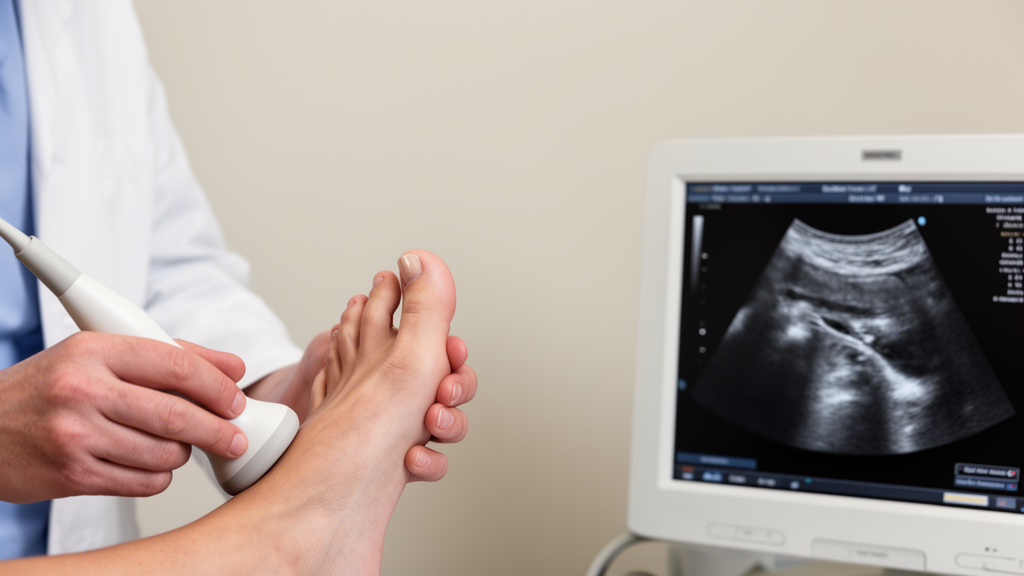
Ultrasound measurements of abductor hallucis muscle volume were highly repeatable and statistically equivalent to magnetic resonance imaging measurements in a small comparison study involving assessors with limited image-analysis experience. Across the analyzed feet, intraclass correlation coefficients ranged from 0.932 to 0.997, while all three method comparisons met a predefined equivalence margin of ±10%. The study included 22 participants—12 females and 10 males—and examined the right and left abductor hallucis muscles.
Following exclusions, 37 feet were available for analysis, with 36 complete ultrasound–MRI observations. Investigators calculated volume across the muscle belly at 0.5-centimeter intervals. They used a truncated-cone formula manually and a semi-automated tool in OsiriX software.
The manual and semi-automated calculations provided the basis for comparing the imaging approaches, with the same analyses performed for the right and left sides separately. Reliability was evaluated using intraclass correlation coefficients, standard error of measurement and minimal detectable change. The resulting intraclass correlation coefficients of 0.932–0.997 indicated high side-specific intrarater reliability across the methods.
Criterion validity was assessed with Pearson correlations, Bland–Altman analyses and two one-sided tests. Very strong associations were observed among methods, with correlation coefficients ranging from 0.906 to 0.995. The two one-sided tests showed that all three method comparisons satisfied the ±10% equivalence criterion, supporting statistical equivalence between ultrasound-derived and MRI-derived volume measurements within that margin.
Agreement at the individual-foot level was more variable. The Bland–Altman limits-of-agreement half-widths were 6.52%–9.84% for MRI-to-MRI comparisons, compared with 17.86%–27.35% for MRI-to-ultrasound comparisons. The results therefore distinguished the high repeatability of the measurements and the overall statistical equivalence of the methods from the larger differences seen between particular ultrasound and MRI values.
The sample was small, comprising 22 participants and 37 analyzed feet, and the investigators specifically assessed performance when image analysis was performed by assessors with limited experience. Those features define the study’s scope: the findings support the use of ultrasound as a practical alternative for assessing abductor hallucis volume when MRI is impractical, but they do not eliminate the greater individual-level variability observed in comparisons between the two imaging methods.
Subject of Research: Reliability and criterion validity of ultrasound-derived abductor hallucis muscle-volume measurements compared with MRI
Article Title: Reliability and criterion validity of abductor hallucis muscle volume measurements using ultrasound and MRI by assessors with limited image analysis experience
Article References: Willes, J. B., Robinson, E., Sponbeck, J. K., Swanson, D. A., Swanson, D. C., Goodrich, A. G., Allen, S. P., & Johnson, A. W. (2026). Reliability and criterion validity of abductor hallucis muscle volume measurements using ultrasound and MRI by assessors with limited image analysis experience. PLOS One, 21(10), e0360725. https://doi.org/10.1371/journal.pone.0360725
Image Credits: AI Generated
DOI: 10.1371/journal.pone.0360725
Keywords: abductor hallucis, muscle volume, ultrasound, magnetic resonance imaging, measurement reliability, criterion validity, Bland–Altman analysis, foot anatomy, medical imaging, Reliability, criterion, validity
Cite Scienmag News
Ophelia Keating. (October 26, 2026). Ultrasound shows high reliability for abductor hallucis volume in small study. Scienmag. https://scienmag.com/ultrasound-shows-high-reliability-for-abductor-hallucis-volume-in-small-study/
Ophelia Keating. "Ultrasound shows high reliability for abductor hallucis volume in small study." Scienmag, 26 October 2026, https://scienmag.com/ultrasound-shows-high-reliability-for-abductor-hallucis-volume-in-small-study/. Accessed 26 October 2026.
Ophelia Keating. "Ultrasound shows high reliability for abductor hallucis volume in small study." Scienmag. October 26, 2026. https://scienmag.com/ultrasound-shows-high-reliability-for-abductor-hallucis-volume-in-small-study/


