


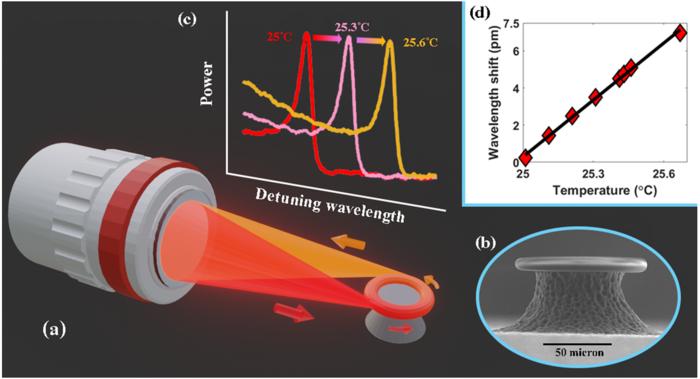
Rapid and sensitive label-free sensors are needed for many biochemical applications including early diagnostics and prognostics, monitoring food and water quality, chemical threat sensing, and early detection of hazardous gases. Whispering gallery mode (WGM) microtoroid optical resonators are one of the most sensitive biochemical sensors in existence, capable of single molecule detection. Light is typically coupled into these resonators using a tapered optical fiber, which is easily broken, subject to vibrational noise, and time consuming to make, requiring bulky and, costly instrumentation as well as specialized expertise. The use of tapered optical fibers is the main barrier to launching these sensors outside the laboratory.

Credit: by Sartanee Suebka, Euan McLeod & Judith Su
Rapid and sensitive label-free sensors are needed for many biochemical applications including early diagnostics and prognostics, monitoring food and water quality, chemical threat sensing, and early detection of hazardous gases. Whispering gallery mode (WGM) microtoroid optical resonators are one of the most sensitive biochemical sensors in existence, capable of single molecule detection. Light is typically coupled into these resonators using a tapered optical fiber, which is easily broken, subject to vibrational noise, and time consuming to make, requiring bulky and, costly instrumentation as well as specialized expertise. The use of tapered optical fibers is the main barrier to launching these sensors outside the laboratory.
Led by Prof. Judith Su, a research group from the Wyant College of Optical Sciences and Department of Biomedical Engineering at the University of Arizona has demonstrated a way to eliminate the need for a tapered fiber by performing far-field excitation with an SNR > 26 dB. This was done by using a single objective lens for resonator excitation, monitoring the resonance wavelength, and imaging. The system is more compact, cost-effective, and stable than tapered fiber-based couplers. The complicated process of pulling a tapered fiber is no longer needed. Ultra-high-quality factors (> 108) were achieved using 100-micron diameter microtoroids. Su’s team showed it was possible to enhance the far field coupling efficiency by using a highly divergent laser beam and by scanning the far-field beam, it was possible to study the electric field profile inside the resonator.
Achieving a far-field excitation system makes fully on-chip microtoroid resonator sensing platforms feasible for field use. Su’s group has previously demonstrated that microtoroid resonators can detect hazardous gases at low parts-per-trillion, and thus a hazardous gas early detection system for practical use can be developed soon. The sensing performance of this system was verified through a temperature sensing experiment. In parallel, Su’s group is working on adapting the system for biosensing detection in aqueous environments as well as multiplexing the sensors for simultaneous multi-target detection.
“We believe that this far-field coupling system can be used for spectroscopy and biosensing, and is the foundation of a fully on-chip microtoroid resonator sensing platform. This approach has made our experiments a lot easier. We aim to miniaturize our system to make it more convenient for practical use,” said Sartanee Suebka, first author of the paper.
Journal
Light Science & Applications
Article Title
Ultra-high-Q free-space coupling to microtoroid resonators
Cite Scienmag News
Grant Pearson. (May 16, 2024). Ultra-high-Q free space coupling to microtoroid resonators. Scienmag. https://scienmag.com/ultra-high-q-free-space-coupling-to-microtoroid-resonators/
Grant Pearson. "Ultra-high-Q free space coupling to microtoroid resonators." Scienmag, 16 May 2024, https://scienmag.com/ultra-high-q-free-space-coupling-to-microtoroid-resonators/. Accessed 6 September 2026.
Grant Pearson. "Ultra-high-Q free space coupling to microtoroid resonators." Scienmag. May 16, 2024. https://scienmag.com/ultra-high-q-free-space-coupling-to-microtoroid-resonators/

