

Sunday, November 29, 2026
Science
No Result
View All Result
  • Login
  • HOME
  • SCIENCE NEWS
  • CONTACT US
  • HOME
  • SCIENCE NEWS
  • CONTACT US
No Result
View All Result
Scienmag
No Result
View All Result
Home Science News Technology and Engineering

Uganda Flood Study Projects Significant Climate-Driven Risk Increases

November 7, 2026
in Technology and Engineering
Violet Maxwell
By Violet Maxwell Scienmag Editorial Profile - Natural Hazards
Reading Time: 3 mins read
0
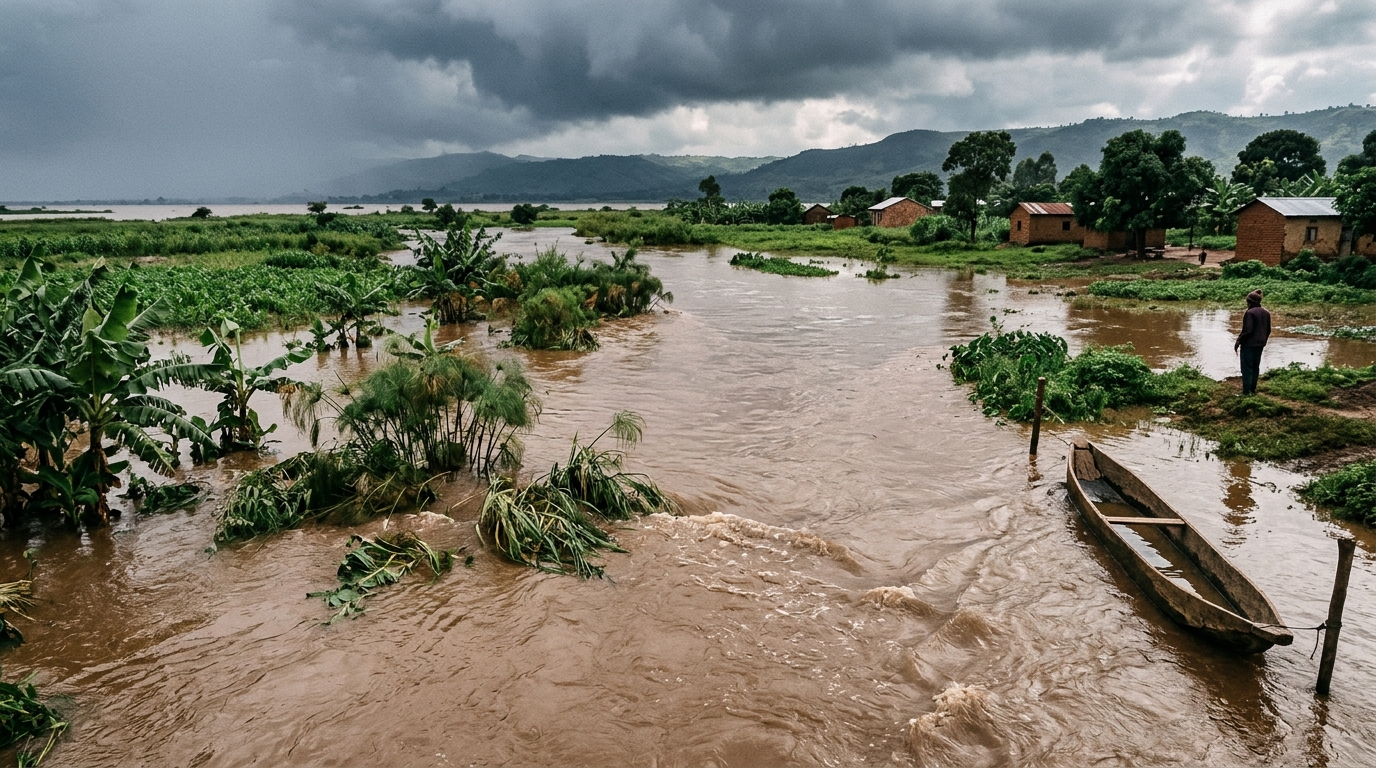
Uganda Flood Study Projects Significant Climate-Driven Risk Increases

Uganda Flood Study Projects Significant Climate-Driven Risk Increases

65
SHARES
587
VIEWS
Share on FacebookShare on Twitter
ADVERTISEMENT

A new study published in Discover Applied Sciences assesses future flood risk in the River Nyamugasani Basin in Uganda’s Rwenzori region, where flooding increasingly threatens settlements, livelihoods, and essential services. The research integrates hydrological and hydrodynamic modelling to evaluate how climate change may alter flood hazards, exposure, and socioeconomic impacts in the basin. The study aims to provide evidence for future-climate planning, a domain where such data has previously been limited for this specific region of Uganda.

The researchers utilized bias-corrected rainfall data from 11 CMIP6 models to drive the HEC-HMS hydrological model. These simulations were conducted under three Shared Socioeconomic Pathways: SSP1-2.6, SSP2-4.5, and SSP5-8.5. Annual maximum discharges were fitted with the Generalized Extreme Value distribution and subsequently passed to HEC-RAS 2D for hydrodynamic inundation mapping. This multi-model approach allows for a range of potential climate outcomes to be considered in the risk assessment.

Under the high-emission SSP5-8.5 scenario, the estimated 100-year discharge increased significantly from a baseline of 61.9 cubic meters per second to 126.0 cubic meters per second. The baseline estimate carried a 95% confidence interval of 44.1 to 95.7 cubic meters per second, while the future projection had a 95% confidence interval of 113.9 to 140.7 cubic meters per second.

The corresponding inundated area expanded from 16.05 square kilometers at baseline to 22.96 square kilometers under the SSP5-8.5 scenario. As a result of this expanded flood extent, the exposed population rose from 4,862 individuals to 6,956 individuals.

The study also estimated direct physical losses to critical infrastructure, including schools, health facilities, and religious institutions. These losses were calculated at USD 1.91 million in constant June 2025 prices. A combined sensitivity analysis revealed a range of USD 1.09 million to USD 2.69 million, reflecting the uncertainty inherent in damage estimation models.

Management options were ranked using household surveys and expert ratings to identify preferred structural and non-structural measures. Diversion channels and gabion revetments emerged as the preferred structural measures for flood mitigation. In the non-structural category, flood forecasting and warning systems were identified as the leading priority.

Despite the detailed modelling, the study notes significant limitations in model calibration. Attempts to calibrate both HEC-HMS and SWAT models showed weak performance due to limited available observational data. Consequently, the final HEC-HMS discharge series was generated using physically estimated parameters rather than a calibrated parameter set. This means the discharge, inundation, exposure, and damage estimates should be interpreted as scenario-based screening results rather than precise engineering-design values.

The study supports the use of these results for floodplain zoning, prioritizing the protection of critical facilities, and expanding forecasting and warning systems. It also suggests a phased evaluation of structural flood-management measures, providing a framework for adaptive management in the face of increasing climate uncertainty.

Subject of Research: Climate-driven flood risk and socioeconomic impacts in the River Nyamugasani Basin, Uganda

Article Title: Integrated hydrological and hydrodynamic modelling of climate driven flood risk and socioeconomic impacts in the River Nyamugasani Basin in Uganda

Article References: Betungura, A., Mubialiwo, A., & Aluku, H. (2026). Integrated hydrological and hydrodynamic modelling of climate driven flood risk and socioeconomic impacts in the River Nyamugasani Basin in Uganda. Discover Applied Sciences. https://doi.org/10.1007/s42452-026-09794-5

Image Credits: AI Generated

DOI: 10.1007/s42452-026-09794-5

Keywords: flood risk, climate change, Uganda, hydrological modelling, socioeconomic impacts, CMIP6, HEC-HMS, HEC-RAS, Rwenzori region, flood management, Integrated, hydrological

Cite Scienmag News

Violet Maxwell. (November 7, 2026). Uganda Flood Study Projects Significant Climate-Driven Risk Increases. Scienmag. https://scienmag.com/uganda-flood-study-projects-significant-climate-driven-risk-increases/

Violet Maxwell. "Uganda Flood Study Projects Significant Climate-Driven Risk Increases." Scienmag, 7 November 2026, https://scienmag.com/uganda-flood-study-projects-significant-climate-driven-risk-increases/. Accessed 29 November 2026.

Violet Maxwell. "Uganda Flood Study Projects Significant Climate-Driven Risk Increases." Scienmag. November 7, 2026. https://scienmag.com/uganda-flood-study-projects-significant-climate-driven-risk-increases/

Tags: climate changeCMIP6flood managementflood riskHEC-HMSHEC-RAShydrologicalhydrological modellingintegratedRwenzori regionsocioeconomic impactsUganda
Share26Tweet16
Previous Post

Experts Debate Design and Monitoring of Community Benefit Funds

Next Post

Iron mine waste could replace scarce natural sand in geotechnical construction

Related Posts

Programmers With High AI Literacy Rely Less on Flawed Generative Code
Technology and Engineering

Programmers With High AI Literacy Rely Less on Flawed Generative Code

November 29, 2026
Drone phenomics paired with fertilizer history enhances strawberry crop nutrient predictions
Agriculture

Drone phenomics paired with fertilizer history enhances strawberry crop nutrient predictions

November 29, 2026
Generative AI Accelerates Circuit Design While Reinforcement Learning Leads Optimization Efficiency
Technology and Engineering

Generative AI Accelerates Circuit Design While Reinforcement Learning Leads Optimization Efficiency

November 29, 2026
Multimodal Piano Model Compression Balances Modalities but Fails to Boost Accuracy
Technology and Engineering

Multimodal Piano Model Compression Balances Modalities but Fails to Boost Accuracy

November 29, 2026
Wheel Hollowness and Track Gauge Widening Drive Divergent Rail Curve Damage
Technology and Engineering

Wheel Hollowness and Track Gauge Widening Drive Divergent Rail Curve Damage

November 29, 2026
SegFormer Architecture Accurately Estimates Species-Specific Proximal Crop and Weed Cover
Agriculture

SegFormer Architecture Accurately Estimates Species-Specific Proximal Crop and Weed Cover

November 29, 2026
Next Post
Iron mine waste could replace scarce natural sand in geotechnical construction

Iron mine waste could replace scarce natural sand in geotechnical construction

  • Mothers who receive childcare support from maternal grandparents show more optimized

    Mothers who receive childcare support from maternal grandparents show more parental warmth, finds NTU Singapore study

    27657 shares
    Share 11059 Tweet 6912
  • University of Seville Breaks 120-Year-Old Mystery, Revises a Key Einstein Concept

    1061 shares
    Share 424 Tweet 265
  • Bee body mass, pathogens and local climate influence heat tolerance

    682 shares
    Share 273 Tweet 171
  • Researchers record first-ever images and data of a shark experiencing a boat strike

    546 shares
    Share 218 Tweet 137
  • Groundbreaking Clinical Trial Reveals Lubiprostone Enhances Kidney Function

    531 shares
    Share 212 Tweet 133
Science

Embark on a thrilling journey of discovery with Scienmag.com—your ultimate source for cutting-edge breakthroughs. Immerse yourself in a world where curiosity knows no limits and tomorrow’s possibilities become today’s reality!

RECENT NEWS

  • Case Report Details Autoimmune Gastritis Complicated by Intramedullary Hemolysis and Anemia
  • Direct Landslide Model Transfer Fails Across Himalayan Corridors Without Local Terrain Data
  • Rhein Blocks Respiratory Syncytial Virus Entry by Stabilizing Viral Prefusion Protein
  • Cone-Beam CT Accurately Identifies Acute Scaphoid Fractures in Large Study

Categories

  • Agriculture
  • Anthropology
  • Archaeology
  • Athmospheric
  • Biology
  • Biotechnology
  • Blog
  • Bussines
  • Cancer
  • Chemistry
  • Climate
  • Earth Science
  • Editorial Policy
  • Marine
  • Mathematics
  • Medicine
  • Pediatry
  • Policy
  • Psychology & Psychiatry
  • Science Education
  • Science News
  • Social Science
  • Space
  • Technology and Engineering

Subscribe to Blog via Email

Enter your email address to subscribe to this blog and receive notifications of new posts by email.

Join 5,151 other subscribers

© 2026 Scienmag - Science Magazine

Welcome Back!

Login to your account below

Forgotten Password?

Retrieve your password

Please enter your username or email address to reset your password.

Log In
No Result
View All Result
  • HOME
  • SCIENCE NEWS
  • CONTACT US

© 2026 Scienmag - Science Magazine

Discover more from Science

Subscribe now to keep reading and get access to the full archive.

Continue reading

