

Saturday, August 29, 2026
Science
No Result
View All Result
  • Login
  • HOME
  • SCIENCE NEWS
  • CONTACT US
  • HOME
  • SCIENCE NEWS
  • CONTACT US
No Result
View All Result
Scienmag
No Result
View All Result
Home Science News Science Education

UCF researchers receive $1.2M DARPA grant to improve autonomous systems training

July 16, 2024
in Science Education
Celia A.
By Celia A. Humanity, Society & Science Policy
Reading Time: 2 mins read
0
UCF researchers receive $1.2M DARPA grant to improve autonomous systems
66
SHARES
604
VIEWS
Share on FacebookShare on Twitter
ADVERTISEMENT

Autonomous systems, such as self-driving cars and unmanned aircraft, learn from modeling and simulation. However, the training process can take months to years, and it doesn’t account for the uncertainty found in the real world. In the world of robotics, this is known as the simulation-to-real gap.

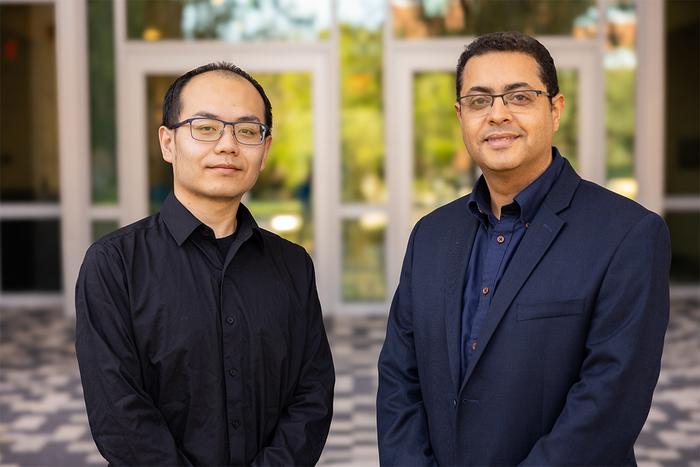
Yue Wang and George Atia

Credit: Photo by Antoine Hart

Autonomous systems, such as self-driving cars and unmanned aircraft, learn from modeling and simulation. However, the training process can take months to years, and it doesn’t account for the uncertainty found in the real world. In the world of robotics, this is known as the simulation-to-real gap.

To improve this gap, the Defense Advanced Research Projects Agency (DARPA) has implemented the Transfer Learning from Imprecise and Abstract Models to Autonomous Technologies (TIAMAT) program, which recently awarded a $1.2 million grant to UCF researchers George Atia and Yue Wang. Their project is titled “Distributionally Robust Approaches to Transfer Learning.”

“Being selected for this award from DARPA is truly an honor,” says Atia, an associate professor in the Department of Electrical and Computer Engineering. “I’m thrilled to have the opportunity to participate in the TIAMAT program. This recognition is especially meaningful given the competitive nature of the funding environment.”

Over the next 18 months, Atia and Wang will develop artificial intelligence-based technologies that can help autonomous systems better adapt to unknown variables. Current simulation environments may be very complex and realistic, but they don’t account for the unexpected. For example, a drone flying from a city to a coast may not know how to cope with changes in flight dynamics or lighting.

Speed is another issue to overcome. It can take millions of simulated episodes, spanning the course of several years, for an autonomous system to be trained well for real-world platforms. The UCF team plans to mitigate both factors by designing technology that can train quickly and efficiently.

“Imagine teaching a robot to navigate a bustling city street after mastering a simple maze,” Atia says. “Most methods either ignore uncertainties or play it too safe. But our approach would equip the robot with special abilities to handle surprises, enabling quicker learning and better performance. By bridging theory with practical application, we aim to improve knowledge transfer effectiveness, particularly in scenarios with limited real-world data.”

While defense agencies like DARPA have a particular interest in autonomous systems that can handle the unexpected, the technology can span across industries.

“In healthcare, for instance, our robust knowledge transfer methods could facilitate the transfer of treatment plans between patients, improving personalized care,” Atia says. “Likewise, decision-making policies tailored for specific road conditions could be repurposed for other environments, enhancing safety and efficiency in autonomous driving. By addressing the limitations of traditional machine learning methods, our research has the potential to revolutionize various industries and enable transformative approaches to complex problems.”


Subject of Research: Science Education

Article Title: UCF researchers receive $1.2M DARPA grant to improve autonomous systems training

Article References: Original research article

Image Credits: AI Generated

DOI: Not provided

Keywords: Not provided

Cite Scienmag News

Celia A. (July 16, 2024). UCF researchers receive $1.2M DARPA grant to improve autonomous systems training. Scienmag. https://scienmag.com/ucf-researchers-receive-1-2m-darpa-grant-to-improve-autonomous-systems-training/

Celia A. "UCF researchers receive $1.2M DARPA grant to improve autonomous systems training." Scienmag, 16 July 2024, https://scienmag.com/ucf-researchers-receive-1-2m-darpa-grant-to-improve-autonomous-systems-training/. Accessed 29 August 2026.

Celia A. "UCF researchers receive $1.2M DARPA grant to improve autonomous systems training." Scienmag. July 16, 2024. https://scienmag.com/ucf-researchers-receive-1-2m-darpa-grant-to-improve-autonomous-systems-training/

Share26Tweet17
Previous Post

Alcoholic liver disease in China: A disease influenced by complex social factors that should not be neglected

Next Post

Do protective policies in elite sports safeguard athletes?

Related Posts

SUNY Chancellor King Visits Great New York State Fair
Science Education

SUNY Chancellor King Visits Great New York State Fair

August 28, 2026
How Science Museum Visits Shape High School Students’ Science Identities
Science Education

How Science Museum Visits Shape High School Students’ Science Identities

August 27, 2026
Study reveals racial and gender disparities in food insecurity among college students
Science Education

Study reveals racial and gender disparities in food insecurity among college students

August 27, 2026
New Mathematics Anxiety Questionnaire Developed and Validated for Primary School Students
Science Education

New Mathematics Anxiety Questionnaire Developed and Validated for Primary School Students

August 27, 2026
PISA 2018 Across 52 Countries Links Scientific Literacy to Students’ Global Competence
Science Education

PISA 2018 Across 52 Countries Links Scientific Literacy to Students’ Global Competence

August 27, 2026
Clinical anatomy case discussions linked to improved national exam performance over 10 years
Science Education

Clinical anatomy case discussions linked to improved national exam performance over 10 years

August 27, 2026
Next Post
Do protective policies in elite sports safeguard athletes?

Do protective policies in elite sports safeguard athletes?

  • Mothers who receive childcare support from maternal grandparents show more optimized

    Mothers who receive childcare support from maternal grandparents show more parental warmth, finds NTU Singapore study

    27656 shares
    Share 11059 Tweet 6912
  • University of Seville Breaks 120-Year-Old Mystery, Revises a Key Einstein Concept

    1061 shares
    Share 424 Tweet 265
  • Bee body mass, pathogens and local climate influence heat tolerance

    682 shares
    Share 273 Tweet 171
  • Researchers record first-ever images and data of a shark experiencing a boat strike

    546 shares
    Share 218 Tweet 137
  • Groundbreaking Clinical Trial Reveals Lubiprostone Enhances Kidney Function

    531 shares
    Share 212 Tweet 133
Science

Embark on a thrilling journey of discovery with Scienmag.com—your ultimate source for cutting-edge breakthroughs. Immerse yourself in a world where curiosity knows no limits and tomorrow’s possibilities become today’s reality!

RECENT NEWS

  • 3D-printed skin model teaches medical students biopsy and suturing skills
  • Promise and Pitfalls: Alternative Psychiatry Licensure Paths for International Medical Graduates
  • Stakeholders hail mobile opioid treatment units as a lifeline on wheels
  • Blood protein ApoB linked to suicidal thoughts, study and genetic analysis suggest

Categories

  • Agriculture
  • Anthropology
  • Archaeology
  • Athmospheric
  • Biology
  • Biotechnology
  • Blog
  • Bussines
  • Cancer
  • Chemistry
  • Climate
  • Earth Science
  • Editorial Policy
  • Marine
  • Mathematics
  • Medicine
  • Pediatry
  • Policy
  • Psychology & Psychiatry
  • Science Education
  • Social Science
  • Space
  • Technology and Engineering

Subscribe to Blog via Email

Enter your email address to subscribe to this blog and receive notifications of new posts by email.

Join 5,150 other subscribers

© 2025 Scienmag - Science Magazine

Welcome Back!

Login to your account below

Forgotten Password?

Retrieve your password

Please enter your username or email address to reset your password.

Log In
No Result
View All Result
  • HOME
  • SCIENCE NEWS
  • CONTACT US

© 2025 Scienmag - Science Magazine

Discover more from Science

Subscribe now to keep reading and get access to the full archive.

Continue reading